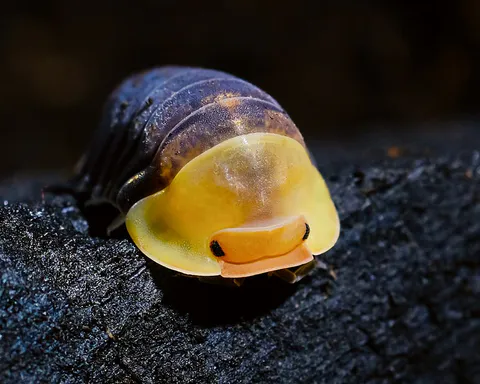


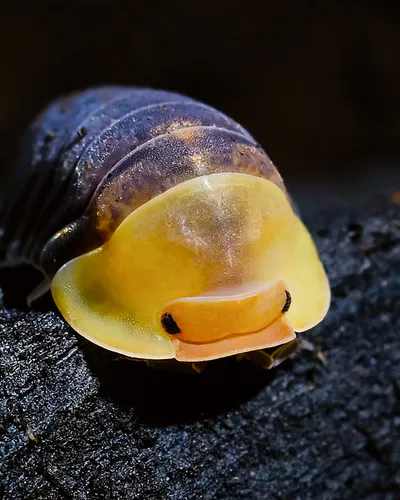

Nobody has published a species identification for the Durian isopod. Sellers place it in Laureola, sell it as Durian or Durian Spiky and report it from Vietnam; adults run ≈ 8–14 mm. It is a climber that needs a damp end that never dries and fresh air at once. Our rating is Intermediate.
Durian isopod at a glance
| What | Durian | How sure |
|---|---|---|
| Temperature | 72–80°F | Creature Cache’s range; every seller’s published range takes in 75–79°F |
| Humidity and moisture | High, the damp end always damp; published figures run 50–95%, and the one dedicated care guide (Creature Cache) says 60–80% | Sellers split on the number more than the method |
| Substrate depth | ≈ 2–3 in | One source (Creature Cache) |
| Adult size | ≈ 8–14 mm | Two sellers: Exuvium 8–10 mm, Creature Cache 8–14 mm |
| Breeding pace | Moderate to prolific once settled; first young ≈ a few months | Sellers’ impressions; the timing is one source |
| Lifespan | No published figure, measured or estimated | No source gives one |
| Difficulty | Intermediate | Rene’s rating; Exuvium says easy to moderate, Richard’s Inverts says High |
Spiky Pineapple (Cristarmadillidium muricatum): a spiny isopod from Spain, in another family, kept cooler and drier. Compared below.
Other spiky Laureola morphs, such as Ivory Spiky: the same genus label, and one US seller gives a sister line the same care as Durian. Nobody has published whether they interbreed; as general practice, keep each line in its own tub.
Frosty Gator: one US shop sells normal-colored Frosty Gators as "Spiky"; that is a different genus (Frosty Gator care guide).
Is the Durian isopod really a Laureola?
Sellers file Durian under Laureola, a genus of long-spined isopods in the family Armadillidae, named by Barnard in 1960. WoRMS, the taxonomic register, accepts 13 species in it. One was described from Vietnam: L. vietnamensis Kwon, Ferrara & Taiti, 1992. The newest, L. volamuca from Hainan, China, was named in January 2026 by Zong, Wang, Jiang and Li in ZooKeys, in a paper with an identification key to every species in the genus.
None of that work mentions the hobby animal. No paper, and no record in WoRMS or GBIF, names Durian, and nobody has published a check of hobby animals against the key. “Laureola sp.” is the sellers’ placement. The honest status is not identified to species; thought to be undescribed.
- Fragile legs. The paper describes the walking legs as elongated and fragile. Wikipedia adds a thin, leaf-like body; the paper itself calls the body elliptic.
- Not every Laureola rolls up. L. volamuca can’t, and escapes by jumping. Nobody has published what Durian does.
- Some are tiny. L. volamuca grows to only 3.5 mm in males and 3.8 mm in females.
Names. Durian, Durian Spiky, Spiky Durian and “Laureola durian”. No species named durian has been described, so the last is a trade name, not a species name.
Origin and arrival. Six sellers say Vietnam, and Richard’s Inverts says Southeast Asia; no collecting locality has been published. Exuvium dates the arrival in the hobby to spring 2024, and one US breeder’s listing record goes back to September 2023, though it may first have been for another animal. Around 2023–2024 is the closest the published dates allow.
Look. Creature Cache describes a golden amber body covered in dark spines. Peeters, a Belgian seller, describes pale-to-greenish animals, the one outlier.
Durian or Spiky Pineapple?
Both carry “spiky” in their trade names, but they want different tubs.
| Durian | Spiky Pineapple | |
|---|---|---|
| Sold as | Laureola sp. “Durian”, Durian Spiky | Cristarmadillidium muricatum (Pineapple Spiky, Spanish Spiky) |
| Family | Armadillidae | Armadillidiidae |
| Named species? | Not identified to species | Yes, described in 1885 |
| Reported from | Vietnam, no locality published | Eastern and south-eastern Spain and Ibiza, mostly in limestone caves |
| Adult size | ≈ 8–14 mm | 6–8 mm |
| Temperature | 72–80°F | 65–77°F |
| Moisture | High, the damp end always damp (published figures run 50–95%) | One corner damp all the way down, the rest fairly dry |
| Air | Fresh and moving, never enough to dry the tub | Good cross-ventilation |
| Our rating | Intermediate | Beginner |
Spiky Pineapple’s origin and cave habitat come from Recuero et al. (2022); its full setup is in the Spiky Pineapple care guide.
Setting up: build up, not down
Durian lives on its decor. Five sellers stress vertical structure, and BCO Mushi says outright that they don’t burrow.
- A vented tub with some height. Ants Invasion recommends tall containers, and OnlyPods asks for plenty of climbing room.
- ≈ 2–3 in (5–8 cm) of humus-rich substrate that holds moisture. Creature Cache, the only source with a depth, uses an ABG-style tropical mix (ABG is a standard terrarium blend of tree fern fiber, peat, sphagnum, bark and charcoal); Peeters uses coco peat, sphagnum and organic soil.
- Bark and sticks stood upright: cork, and lichen-covered or mossy sticks, not laid flat. Isorare Pods, a US breeder, adds lichen sticks for climbing.
- Moss at the damp end, sphagnum or forest moss.
- Thick leaf litter and rotting white wood on top.
- A permanent calcium source.
- A tight lid, with the vent mesh fixed on every edge. Climbers reach the lid.
- Move the decor, not the animal. Carry the bark or stick it is holding into the new tub and set it down.
- For a loose animal, let it walk. Put a leaf or a soft brush in front of it and nudge it from behind.
- Never pull one off a surface it is gripping. Wait for it to let go.
General handling for an isopod with fragile legs (the genus description); no seller publishes a Durian method.
Damp and fresh at once: temperature, humidity and air
Temperature. It wants the warm end of room temperature, 72–80°F (22–27°C), held steady. Published ranges run from 64–79°F (18–26°C) at Richard’s Inverts to 75–82°F (24–28°C) at Exuvium and Peeters, and every one overlaps at 75–79°F (24–26°C). Creature Cache warns against letting it fall below 65°F (18°C), one breeder’s precaution rather than a tested limit. Keep it under about 80°F; no tested lethal temperature has been published.
Damp end and air. Keep one end damp to the base with moss on top and the rest just moist. Vent for fresh air, but never so much that the damp end dries. The isopod care basics cover vents, the gradient, calcium and the two-part molt, and in a dry house the hub’s dry-climate section applies too, because the tub loses water faster.
Why there is no single humidity number
| Source | Humidity | What else it says |
|---|---|---|
| Exuvium (Netherlands) | 50–80% | Prefers high humidity but adapts; about two-thirds of the substrate moist |
| Creature Cache (US) | 60–80% | The balance of humidity and fresh air is the thing to get right |
| Ants Invasion (Poland) | About 80% | Emphasis on high ventilation |
| OnlyPods (UK) | 75–90% | High airflow is essential |
| Peeters Reptiles (Belgium) | 90–95% | High airflow to prevent mold |
End to end, that is 50–95%, and Exuvium is the one source in it that says nothing about air. Still, the low-end sellers ask for a moist zone and the high-end sellers for strong airflow, so the setups look more alike than the numbers: a damp end that stays damp, a just-moist rest and moving air.
Feeding: litter, wood and lichen
The base diet is the setup: leaf litter (oak, magnolia, and thinner leaves such as maple, which BCO Mushi suggests), rotting white wood, moss and lichen. Creature Cache lists thin leaf litter among its mistakes: it is their main food, not decoration. Four sellers name lichen or mossy sticks, as decor, food or both, and BCO Mushi names mossy sticks a favorite food, so the climbing decor doubles as food. Sellers add soft vegetables or fruit now and then, and small amounts of protein (Exuvium says at least twice a week). Creature Cache warns that too much protein molds; take out what isn’t eaten. Leave a calcium source in permanently.
Bee pollen is unsettled. Exuvium lists it among the foods Durians don’t eat; a US breeder’s social post, seen only as a search result, says its colony eats mostly bee pollen. There is no rule either way.
Durian breeding: sellers’ impressions and one warning
Four sellers say something about breeding; none gives a brood size or a time to a split.
| Source | What it says | About Durian or the genus |
|---|---|---|
| Creature Cache | A moderate breeder; a few months before the first young; start with 10 to 15 animals | Durian |
| Exuvium | Prolific | Durian |
| Peeters Reptiles | Breeding difficulty high | Durian |
| Ants Invasion | ”like other Laureola, they appear to be very easy to breed” | The genus: a guess from other Laureola, not a report on Durian |
Group sizes are listed with the Durian starter colony.
A warning from a related line. isopod.site reports Ivory Spiky keepers seeing broods every week, then a sudden crash with no clear cause. That is not Durian data, but it is a good reason to start a second tub from a producing colony early.
Problems: why a colony fails
- The damp end, at the base. Creature Cache ranks drying out first. If the bottom of the damp end is dry, re-wet it and work out why it dried.
- Stale air. OnlyPods warns that stagnant air quickly turns harmful, and Peeters asks for high airflow to prevent mold. Signs of stale air are condensation that never clears, a sour smell or spreading fuzzy mold. Add vent area.
- Too much air. A damp end that dries between checks means over-ventilation, a mistake Creature Cache lists. Cover part of a vent rather than misting more.
- Failed molts. OnlyPods warns of molting trouble when conditions are poor. Check the calcium, then start again at step 1.
Genus level, not Durian data: isopods.co.uk’s Laureola guide adds a waterlogged base and too little food to the list.
If all four check out and animals still die, it may be the kind of Ivory Spiky crash described under breeding, which nobody has explained.
Open questions: which Laureola, and where from
- Which species. Whether it keys out to L. vietnamensis, the one species described from Vietnam, to another species in the 2026 key, or to none of them.
- Where from. A collecting locality, in Vietnam or anywhere else.
- Which lines cross. Whether it interbreeds with Ivory Spiky and the other spiky Laureola lines.
- How big, measured. An adult size from anyone other than a seller.
Frequently Asked Questions
How big do Durian isopods get?
Adults are ≈ 8–14 mm, which makes Durian a small isopod. That range comes from two sellers: Creature Cache gives 8–14 mm, and Exuvium gives 8–10 mm and describes it as one of the largest Laureola. Peeters also says 8–10 mm, possibly from text shared with Exuvium, so the two count once; that is up to about a centimeter (0.4 in). No independent measurement has been published, so treat the top of the range with some caution.
Is Durian Spiky the same isopod as Durian?
Yes, as sellers use the names: Durian, Durian Spiky, Spiky Durian and “Laureola durian” all label the same trade animal, sold as Laureola sp. “Durian”. Nobody has published a check that every line sold under them is one animal. “Laureola durian” looks like a scientific name, but WoRMS lists no L. durian among the genus’s 13 accepted species, so it is a trade label. The related Ivory Spiky line is sold under the same genus, with its own trade name.
Are Durian isopods active during the day?
Mostly not, by two sellers’ accounts: Creature Cache calls them nocturnal and shy, and Exuvium says they are mostly active at night. Two others, Ants Invasion and BCO Mushi, call them active. So expect animals out on bark and sticks after dark and under cover by day.
Do Durian isopods roll up?
Nobody has published whether they do. The 2026 paper notes that L. volamuca, the species it describes from Hainan, cannot roll into a ball and escapes by jumping, but that is a different species. Until that is known, move one on the bark it holds rather than waiting for it to curl up.
What humidity do Durian isopods need?
High, with the damp end always damp and the rest of the tub just moist. Published figures run 50–95%: Exuvium is lowest at 50–80%, Peeters highest at 90–95%, and Creature Cache, the one dedicated care guide, says 60–80%. Aim for a damp end that holds, not one number on a hygrometer.
Why is my Durian colony dying?
Check in this order: the damp end at the base (Creature Cache names drying out as the top killer), then stale air, then a tub vented so hard it dries between checks, then failed molts and the calcium source. The signs and the fix for each are under Problems above.
What is the difference between Durian and Spiky Pineapple isopods?
They are different animals with different moisture needs. Durian is a Laureola (family Armadillidae) reported from Vietnam, kept at 72–80°F with a damp end that never dries. Spiky Pineapple is Cristarmadillidium muricatum (family Armadillidiidae) from Spain, kept at 65–77°F in a fairly dry, airy tub with one damp corner. Both are sold with “spiky” in the name, which is where the mix-up starts.