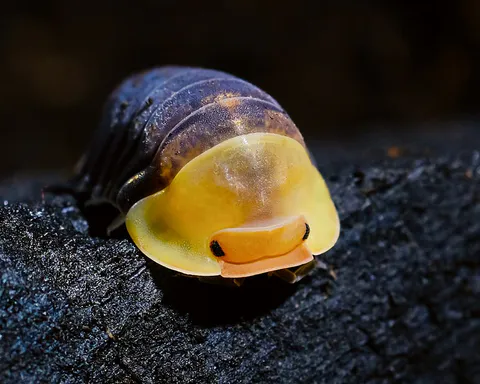
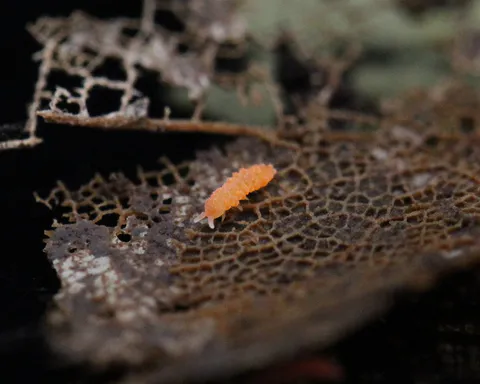


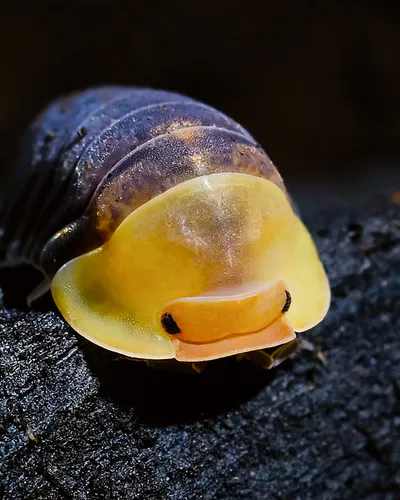
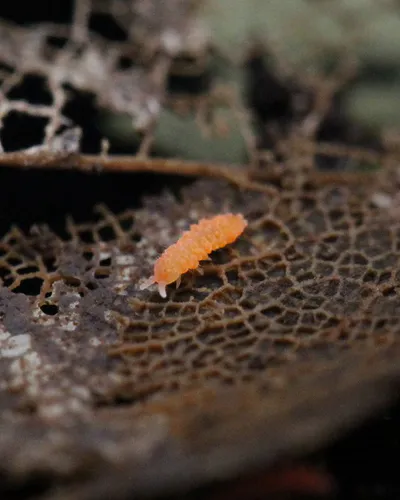

Frosty Gator is one of several trade names for Reductoniscus tuberculatus, a 4–5 mm armored isopod described in 1997 from three females collected in Sandakan, Sabah, on Borneo. Rene rates it Intermediate, though nothing about its tub is unusual. The hard part is size: a new group disappears into the substrate, and nobody has published how fast a colony builds.
Frosty Gator at a glance
| What | Frosty Gator | How sure |
|---|---|---|
| Temperature | 70–80°F | Most sources we read agree; the lowest figure in them is 68°F |
| Humidity and moisture | Moderately humid with a damp third; published figures run about 60–90% | Thin: one number we could read, one we could not, the rest words; the damp third is one seller’s (The Reptile Jungle) |
| Substrate depth | ≈ deep, 3 in or more | One source: the only number is a listing we could not read in full; one keeper uses about 2 in |
| Adult size | 4–5 mm | Settled: the 1997 description measured a 5 mm maximum |
| Breeding pace | No published figure, “slow to get started” | Unknown: sellers give impressions, not timelines |
| Lifespan | Estimated, not measured: one seller estimates up to about 3 years | One seller |
| Difficulty | Intermediate | Rene’s rating; one seller agrees, others call it easy |
Reductoniscus costulatus: another species in the same genus, about 2 mm, recorded in British tropical glasshouses (BMIG); Tropical Isopods sells a pink animal under this name as "Pink Togezo".
Tuberillo borneanus or "Turbellio borneonus": isopod.site says this animal is often misidentified under these names, but T. borneanus is also a real species recorded from Sabah (Taiti and Gruber, 2010). Check the photo.
"Shiny Gator": a different isopod, not identified to species, sold by Poppler Demand as Isopoda sp. (tagged Armadillidae).
Other spiky isopods: the larger Spiky Pineapple and Durian, in other genera.
Dwarf Gator, Borneo Gator, Ankylosaur: what “Frosty” means to each seller
Tropical Isopods sells pied “Frosty Gators” beside a plain “Spiky” listing for its normal-colored animals, so at that shop the two names split one species by color. Other listing titles in search results tie the name to pied animals too, such as MorphMarket’s “6x ‘Frosty Gator’ PIED”, while some use it for any R. tuberculatus, and it is searched as “frosted gator” as well. No seller we read explains the word “Frosty”, so treat it as a label, not a description of the animal.
| Name | Who uses it | What it refers to |
|---|---|---|
| Frosty Gator | Tropical Isopods, for its pied animals | First used for pied stock, now also used loosely for the species |
| Spiky | Tropical Isopods, for its normal-colored animals | The normal form |
| Borneo Dwarf Gator, Dwarf Gator | Poppler Demand (“Borneo Dwarf Gator”); “Dwarf Gator” in MorphMarket listing titles (search results, not read) | The normal form |
| Borneo Gator | One US listing we could not read in full; also a Google related search | The species (form not stated) |
| Borneo Alligator | The Reptile Jungle | The normal form |
| Ankylosaur, Ankylosaurus | isopod.site, BCO Mushi | The species |
If the animals that arrive don’t match the listing, a name mix-up may be why: check them against the ridges, bumps and rear hump the 1997 description gives below.
Reductoniscus is a genus of four described species in the family Armadillidae: R. costulatus (1930), R. novaehiberniae and R. pulcher (both 1990), and R. tuberculatus (1997).
Reductoniscus tuberculatus: what the 1997 description says
Leistikow named the species in Revue suisse de Zoologie from three animals collected on 21 December 1995 at War Memorial Park in Sandakan, Sabah, Malaysian Borneo. All three were female: the holotype, 5 mm long and held in Berlin as no. 27182 (ZMHB in the paper, ZMB in GBIF), and two paratypes of 2–3 mm. He wrote that he was describing it “in the absence of males”.
| The 1997 description says | What it means in your tub |
|---|---|
| A maximum length of 5 mm | Adults top out at 5 mm; this page’s 4 mm low end is The Reptile Jungle’s “up to 4 mm” |
| Buff to rosy-cream, without mottling; the front of the head, underside and legs unpigmented | That is the normal form, which Poppler Demand calls earthy. No published wild record describes a pied animal, so pied stock is a hobby line |
| A back “heavily ornamented with costae and tubercles” (ridges and bumps), three rows of tubercles on top of the head, and a hump on the seventh segment behind the head that juts back over the tail end | These are what to match when you check an animal or a listing photo. The paper tells it from the rest of its genus by the ridges on its side plates and that hump |
| Grooves on the front of the head that take the antennae “during volvation” (rolling up) | Rolling into a ball is part of how it is built; Poppler Demand reports its animals curling up |
Setting up a tub for a 4–5 mm isopod
What changes for an animal this small is scale: the tub has to be easy to keep damp and easy to search.
- A small vented tub with a lid that closes. One US listing we could not read in full suggests a small starter tub, so a new group stays findable. Move up as the colony grows.
- Deep substrate, ≈ 3 in or more (about 8 cm). Poppler Demand calls for deep substrate and The Reptile Jungle says they love to dig. The only published number is from a listing we could not read in full; one keeper, Invertebrate Dude, uses about 2 in (5 cm) of coco fiber and bark chips.
- Leaf litter and rotting wood on top, as cover and food (Poppler Demand lists wood rot and leaf litter as both; Invertebrate Dude tops his with leaf litter).
- A piece of flat bark on the damp end as a hide (flat or cork bark is on Poppler Demand's cover list).
- A permanent calcium source, such as the cuttlebone or eggshell on Poppler Demand's list.
- Ventilation. All three read sources that mention air call for a ventilated tub (Poppler Demand and Invertebrate Dude say well ventilated).
No Frosty Gator source names a food or molt need of its own, so feed it and keep calcium in as in the isopod care basics; Invertebrate Dude adds dog food as an extra.
How many to start with. No source gives a starting count for this species, and at this size the tub matters more than the count. Colony sizes and stock are on the Frosty Gator starter colony page.
Frosty Gator humidity and temperature: a damp third, never stale
Ordinary tropical warmth suits it: 70–80°F (21–27°C), held steady. Poppler Demand gives 70–80°F, The Reptile Jungle 68–77°F (20–25°C), and Invertebrate Dude keeps his at 75–80°F (24–27°C). Keep it under about 80°F; no tested lethal temperature has been published for this species.
For moisture, aim for moderately humid with a damp third: about a third of the tub damp all the way down, the rest drier, and enough air that it never smells stale. The third comes from The Reptile Jungle (“1/3 moist”); Tropical Isopods says “Medium” on both of its listings, BCO Mushi says moderate and Invertebrate Dude says humid. Published figures run about 60–90%: Poppler Demand lists 70–90%, with a moisture gradient, and a UK listing we could not read in full is reported at 60–70%. Nobody has published a hygrometer reading from a Frosty Gator tub, so none is printed here.
Frosty Gator breeding: impressions, no timeline
The first open question is males: the 1997 description had only females to work from, and nobody has published whether hobby colonies contain any. Four sources describe the pace in a phrase each: Poppler Demand gives its breed rate as “Slow” and calls them “best suited for patient keepers”, The Reptile Jungle says “prolific once established”, BCO Mushi says they “produce pretty well”, and one keeper, Invertebrate Dude, thought his group had started breeding a couple of months after a trade (post of 14 April 2024). No maturity age, brood size or time to a colony you can split has been published.
Checking on a colony without digging
Sources describe burrowers that stay mostly under the surface and come out mostly at night, though BCO Mushi says you can still see them out and about by day. As general guidance for any isopod, the young are much smaller than the adults, and digging through the substrate is the check most likely to harm them.
- Look after dark first. With a dim light, lift the bark at the damp end and check its underside and the litter around it.
- Sift one scoop, not the tub. Take a spoonful from the damp end, spread it thin on a white plate or tray, and give it a minute. A rolled-up animal has to unroll before it walks.
- Watch for movement. Normal animals are buff to earthy and pied ones carry pale patches; on a white tray, any of them shows up once it moves.
- Put the scoop back on the damp end, where you took it from, and leave the tub alone for a while before the next check.
No source names a way Frosty Gator colonies fail that is their own. For anything the steps don’t settle, the ten common isopod problems on our isopod care page apply here too.
Open questions: males, pied young, newborn size
- How to sex an animal this small, if hobby colonies have males at all.
- Whether pied adults produce pied young.
- How big newborn young are.
- A humidity reading from a working Frosty Gator tub.
Frequently Asked Questions
Is a Frosty Gator the same as a Dwarf Gator?
Yes, as a species: both names are sold for Reductoniscus tuberculatus, and so are Borneo Gator, Borneo Alligator and Ankylosaur. Poppler Demand sells the normal form as “Borneo Dwarf Gator”. “Frosty Gator” started on pied stock, though some sellers now use it for any animal of the species. Tropical Isopods keeps the two apart, with pied “Frosty Gators” listed beside a plain “Spiky” listing for its normal-colored animals.
Where do Frosty Gator isopods come from?
Borneo. The species was named from three animals collected in 1995 in a park in Sandakan, Sabah, on Malaysian Borneo. The only other wild records in GBIF are two 2022 iNaturalist observations from Hindhede Nature Park in Singapore. One US listing says “Thailand”, and AI answers repeat it, but no published record places the species there.
How big is Reductoniscus tuberculatus?
4–5 mm as an adult. The 1997 description gives 5 mm as the maximum, and its two smaller animals measured 2–3 mm. Among sellers, The Reptile Jungle says up to 4 mm and Poppler Demand gives 5–6 mm, the only figure above the measured maximum.
Are Frosty Gators a good first isopod?
Rene rates them Intermediate rather than beginner. The Reptile Jungle also says Intermediate and Poppler Demand calls them best suited for patient keepers, while Tropical Isopods calls them easy and BCO Mushi beginner-friendly. Read from the sources, the setup is simple; the hard part is keeping track of a 4–5 mm animal that lives in the substrate, with no published timeline for a colony to build.
Is the Frosty Gator a Cubaris?
No. It belongs to Reductoniscus, a separate genus in the same family, Armadillidae. Some listings file it under Cubaris (Tropical Isopods’ product type is “cubaris”), which may be one source of the mix-up. It matters for planning: Cubaris breeding timelines were not measured on this animal, and no Frosty Gator timeline has been published, so a slow start tells you nothing either way.
Do Frosty Gator colonies have males?
Nobody knows yet. The species was described from three females, with no males to examine. No seller or keeper has published whether hobby colonies contain males, how to sex an animal this small, or whether females breed without them, so don’t assume either way, and don’t read a missing male as a problem with your group.
How long do Frosty Gator isopods live?
No one has measured it; one seller, The Reptile Jungle, gives “up to 3 years”, in wording that looks shared across that store’s listings. Nothing has been published for the genus either. Treat it as a rough estimate, not a lifespan you can plan around.
How do I check on a tiny Frosty Gator colony?
Sift a sample instead of digging. Lift the bark on the damp end after dark, then tip one spoonful of substrate from that end onto a white tray and watch for a minute: a rolled animal has to unroll before you see it move. An empty sift on its own doesn’t mean the colony has died; check the damp end and try again another night.