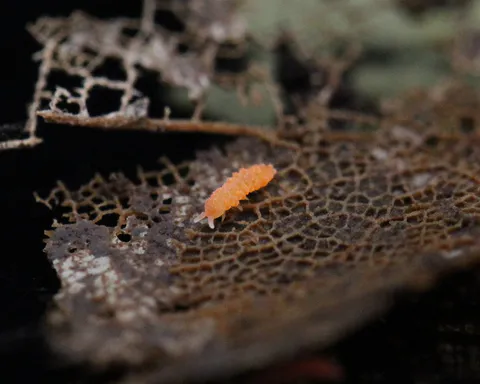


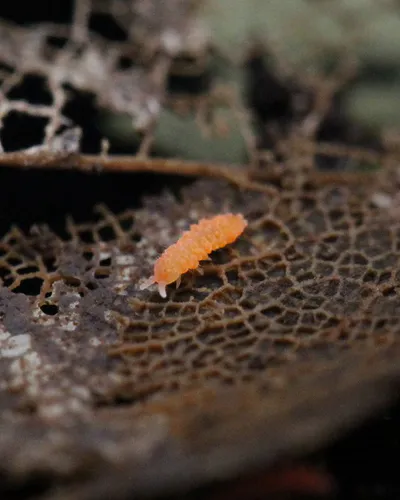

Yuukianura aphoruroides is the bright orange springtail sold as Orange, Asian Orange or Spanish Orange: about 4 mm, described from Japan in 1953, and a walker that barely jumps. Most sellers we read list it as a beginner culture. A new culture starts slowly and looks quiet beside a white one, then builds quickly once established.
Orange springtails at a glance
| What | Orange springtails | How sure |
|---|---|---|
| Temperature | 68–80°F | Most sources; none starts below 68°F; The Bio Dude and the Florida listings run warmer |
| Moisture | Damp soil that never dries out or pools; no percentage to chase | Settled |
| Medium | Organic soil, leaf litter, bark on top | Most sellers; one ships them on clay |
| Food | Yeast with a little fish food, 1–3 times a week | Several sellers add protein; none makes it the staple |
| Adult size | About 4 mm | Sellers’ figures; no scientific length found |
| Jumps | Barely, if at all; it walks | Settled for its subfamily |
| Breeding pace | Slow to start, then builds | Sellers split; nobody has published a timeline |
| Difficulty | Beginner, by most sellers’ ratings | springtails.us says Intermediate |
Tropical White (Coecobrya sp.): white, smaller and quick to jump; compared below.
Thai Red (Lobella sp.): red, another genus in the same subfamily, also a walker.
Red Thai Spiky (Rambutanura sp.): red, knobbly, and dependent on live slime mold.
Bilobella braunerae and Neanura growae: real, separate species. B. braunerae is a wrong label for these; whether Florida Orange is N. growae or Y. aphoruroides is not settled (below).
What orange springtails are
Yuukianura aphoruroides belongs to the Neanuridae, a family of stout, short-legged springtails. Yosii described it from Japan in 1953 as Protanura aphoruroides, and in 1955 made it the type species of his new genus, Yuukianura. The world checklist of springtails that Frans Janssens maintains at collembola.org also records it from China.
The same checklist shows where it has turned up outside East Asia: a British record from earthworm cultures, records from the USA and Canada marked as introduced (the Canadian one in culture), and a record from a commercial culture in Taiwan. springtails.us, a US breeder that keeps a springtail identification and common-name list, says the species entered the hobby in 2022 as “Spanish Orange”, collected in Spain. It reached Europe with earthworm imports, the site says, and perhaps the USA the same way.
Adults are one even, bright orange. Sellers that give a figure say about 4 mm, and several describe a larger, chunkier animal than a white springtail. The checklist’s photo notes count three unpigmented eyes (ocelli) on each side of the head.
Why they walk instead of jumping
Most springtails flick themselves away with a forked organ, the furca, folded under the body. In the Neanurinae, this species’ subfamily, that organ is missing or reduced to a stub, so they crawl. PostPods says they jump barely if at all; MI Beneficials and The Philo Den describe slow movers. That changes how you check, harvest and seed them.
One springtail, many labels
The species name is settled; the trade names aren’t.
| Name on the culture | Where we read it | What it refers to |
|---|---|---|
| Orange, Asian Orange | Most US listings; “Asian Orange” at TC Insects | Y. aphoruroides |
| Spanish Orange | springtails.us; an I Heart Bugs product URL | Y. aphoruroides: the line that reached the hobby through Spain |
| Tropical Orange | The Bio Dude | Y. aphoruroides |
| Cheeto | springtails.us | A nickname for Y. aphoruroides |
| Florida Orange, US Orange, Native Orange | MI Beneficials, Stella’s, TC Insects, The Philo Den, springtails.us | A US line, often sold as Neanura growae; which species it is has not been settled (below) |
| Bilobella braunerae | Terrarium Tribe | A wrong label: a separate species, described in 1981 |
| Bilobella sp. | springtails.us’s list of names it has been sold under | An old label for Y. aphoruroides |
| Protanura sp. | springtails.us; old product URLs at MI Beneficials and I Heart Bugs | An early identification from photos; the species was first described in Protanura and then moved |
springtails.us tells the identification story: Janssens first placed hobby orange springtails in Protanura from photos, sharper photos pointed to Yuukianura, and a microscope confirmed it. The same site says it has yet to see a true Bilobella sold anywhere.
Is Florida Orange the same animal?
Nobody has settled it. springtails.us says the Florida line is Y. aphoruroides, collected from a population living wild in the USA. Other sellers still sell it as Neanura growae, and The Philo Den sells N. growae as a separate culture it calls slightly larger. N. growae is a real species, described in 1980. Janssens’ checklist has US photos of it and, separately, of introduced Y. aphoruroides, with nothing tying the Florida trade line to either name.
Orange vs white springtails
If you already run a white culture, most of your routine changes with this one. The Tropical White care guide is the full guide to that species; here are the two side by side.
| Orange | Tropical White | |
|---|---|---|
| Scientific name | Yuukianura aphoruroides | Coecobrya sp. |
| Color | Bright orange | White |
| Adult size | About 4 mm | ≈ 1–3 mm (no adult measured) |
| Jumps | Barely, if at all; it walks | Yes |
| Medium | Organic soil, for most sellers | Clay, charcoal or soil |
| Food | Yeast with a little fish food | Yeast, or a few grains of uncooked rice |
| Temperature | 68–80°F | ≈ 65–80°F (a general springtail range) |
| Pace | Slow to start, then builds | ≈ boom in about 4–6 weeks (a general springtail figure) |
| Harvest | Lift the bark, or move the soil | Flood and pour off clay or charcoal |
| Best at | A cleanup crew you can see; also a froglet feeder | Fast mold control, by breeder ratings; also a dart frog feeder |
The pace gap is the one to plan around. springtails.us scores this species 4 out of 10 for reproduction and the Tropical Pink, its name for the Tropical White, 9, and PostPods calls orange springtails a help with mold rather than a cure. For mold in a new build today, white is the quicker fix; orange is the one you’ll see working. Thai Red, the other soil-and-protein walker we sell, is red, wants a warmer room, and we list it as a display culture.
Soil, bark and the clay question
Most sellers keep this species on damp organic soil, and the mixes they name differ: Studio Zoologic uses plain coconut coir with some sphagnum moss, and I Heart Bugs uses peat moss and organic topsoil. Work leaf litter into the top and lay a flat piece of bark over it. With a walker the bark does real work: they gather underneath it, so it is where you check on the culture and where you harvest. The cup, vents and water are the same as for any springtail; the springtail care guide covers them.
Some sellers use clay or charcoal instead, and nobody has tested one medium against another; the clay and charcoal answer below has who uses what.
A 68–80°F room and damp soil
Keep the room at 68–80°F (20–27°C). No source we read gives a range that starts below 68°F, and most listings include the band TC Insects aims for, about 70–78°F (21–26°C). The Bio Dude and the Florida listings run them warmer, up into the 80s.
A cooler room slows breeding rather than harming them, PostPods says, so a culture may only tick over through winter. Keep it at or under about 80°F; no tested lethal temperature has been published.
The soil should stay damp all the way down, never dry and never with water standing on top; TC Insects calls it damp but not swampy. Under a closed lid, damp soil gives the high humidity sellers ask for, so there’s no percentage to chase.
Yeast first, a little protein
Offer yeast with a little fish food 1–3 times a week, a small amount each time; The Bio Dude feeds a few times a week. Studio Zoologic lists brewer’s yeast, active dry yeast and fish flakes for this species and says they seem to prefer the yeast, so treat protein as an addition, not a second staple. That is the difference from Thai Red: every Thai Red routine we read includes protein, while the one orange seller that reports a preference names yeast. springtails.us, I Heart Bugs and MI Beneficials still add protein for orange, as fish flakes or a protein-rich springtail food; the first two give that advice for orange and red springtails alike.
No rice is needed. springtails.us, which calls rice a good food for most species, points orange keepers to fish flakes instead.
Breeding: slow first, then quick
Sellers fall into two camps. springtails.us, PostPods, I Heart Bugs and The Bio Dude describe a moderate breeder; PostPods puts it slower than the temperate white Folsomia candida and faster than Thai Red, though springtails.us scores Thai Red the same 4 of 10 it gives this species. Dubia, LA Reptile Lounge, The World of Isopods and Stella’s (for its Florida line) say it breeds quickly.
Studio Zoologic’s note fits both: they are slower than most springtails to begin breeding, then the numbers take off once a bigger population is established. Sellers judging young and old cultures would see different animals; that may explain the split, though nobody has tested it. Give a new orange culture longer than a white one before you decide it isn’t working; the quick boom quoted for white cultures is a general springtail figure.
Hold off on the first split until plenty show under the bark. Split earlier and you take from a culture that hasn’t reached the point where, by Studio Zoologic’s account, it starts to build. The springtail care guide has the splitting method. If you need more than your cultures give, orange springtail cultures are for sale on our shop page.
Lift the bark: harvesting a walker
Because they crawl, the usual ways in are hands-on.
- Lift and tap. Lift the bark or leaf on top, where they gather, and tap them off into the enclosure. PostPods, springtails.us and I Heart Bugs all do this; springtails.us also uses an aspirator.
- Move the soil. Spoon part of the culture, soil and all, into the new build. The eggs in it go too.
- Flood one corner. PostPods floods a corner and pours off the animals that float up; use dechlorinated water. On soil this is messier than on clay.
Pairing them with isopods? See the answer below and the isopod care guide.
Open questions
- Soil or surface. The Philo Den has them mostly down in the substrate, coming up to swarm food; LA Reptile Lounge and Tiny Green Tails describe surface foragers. No source we read explains the difference.
- Whether a culture needs males. No source says. PostPods makes the practical point: there is nothing to sex or pair up, so you never set up a breeding group.
When the culture stalls or looks empty
Frequently Asked Questions
How big do orange springtails get?
Adults reach about 4 mm. PostPods, The World of Isopods and Studio Zoologic all give about 4 mm, and Glass Box Tropicals says under half a centimeter. TC Insects lists 1–3 mm, but its two orange listings share one template. None of the scientific sources we could read gives a body length; the 1953 description and the 2007 UK key were not read.
Do orange springtails jump?
Barely, if at all. Their subfamily, the Neanurinae, has lost the forked jumping organ most springtails use, or kept only a stub of it, so they walk. That’s why a tapped cup doesn’t ripple the way a white culture does, and why you harvest them by lifting bark rather than flooding the whole cup.
Can orange springtails live on clay or charcoal?
Some sellers keep them that way, but most use soil. Glass Box Tropicals ships orange cultures on clay, and Tiny Green Tails and PostPods’ listing say charcoal works too, while The Bio Dude says it doesn’t culture this species on clay at all. Nobody has published a side-by-side test, so start a new culture on damp soil and leave a producing clay culture as it is.
Are Florida, Spanish and Asian orange springtails the same?
Spanish and Asian Orange are both Yuukianura aphoruroides; Florida Orange is unsettled. According to springtails.us, which keeps a hobby name list, the Florida line is the same species, collected from a US population. Some sellers still sell it as Neanura growae, a separate species described in 1980. Until a published identification settles it, treat the Florida name as open. For care it changes little: the Florida listings we read describe the same slow soil dweller, some kept a little warmer, and none gives it a diet of its own.
How fast do orange springtails breed?
Slowly at first, then faster once the culture is established. Studio Zoologic says they are slow to begin breeding and then build quickly; springtails.us gives them 4 on its 10-point reproduction scale, and PostPods puts them slower than Folsomia candida but faster than Thai Red. Nobody has published how long a new culture takes to fill out, so give it longer than a white one.
Can orange springtails live with isopods?
Yes. PostPods says they fill slightly different niches: springtails take mold and microfauna, isopods the larger debris. Its listing pairs orange springtails with dwarf white isopods for small setups. Give them the damp soil and leaf litter both like, and don’t let the substrate dry out. One isopod species per enclosure is still the rule; the springtails go in alongside it.
Are orange springtails good feeders for dart frogs?
They’re a supplemental feeder for froglets, not a staple, and too small for a mantis. Glass Box Tropicals says they suit many adult and young frogs and froglets but shouldn’t be the only food, and LA Reptile Lounge sells them as a feeder for froglets. Seed the enclosure well before the frogs go in, or, as Studio Zoologic warns, the frogs may eat the population before it gets going.