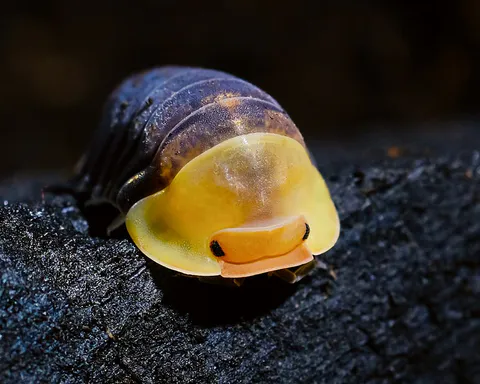


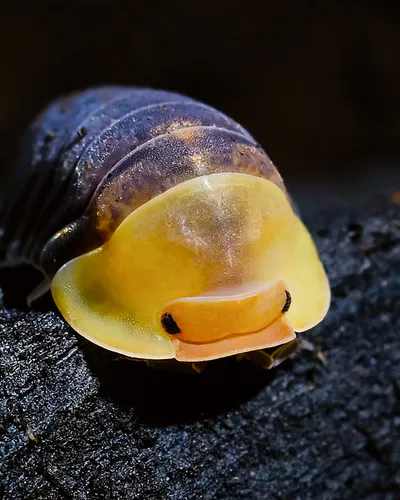

Panda King is the Cubaris sellers reach for when they want a forgiving one: Insektenliebe calls it a good starter species, isopod.site lists it as a starter isopod, and Terrarium Tribe finds it more forgiving on temperature than its relatives. It also carries two pieces of baggage. Some listings sell it as Cubaris murina, which it is not, and two pages call it protein-hungry, which nothing supports. It is a black-and-white trade line, Cubaris sp. “Panda King”, reported from Vietnam and not identified to species, with adults of 10–13 mm. Our rating is Beginner. Its catch is the vivarium: the Dubia Roaches FAQ warns that geckos and frogs can eat a young colony before it gets going.
At a glance
| Parameter | Panda King | Where its sources differ |
|---|---|---|
| Temperature | 70–80°F, held steady | Terrarium Tribe 70–80°F; Insektenliebe 72–79°F; two UK sellers run cooler (AntsDavey 64–72°F, BugzUK 68–75°F); Josh’s Frogs takes its Red Pandas to 85°F |
| Humidity and moisture | Damp end 75–85%; most of the substrate moist, one small drier patch | Insektenliebe 75–85%, InvertKeeping 70–85%. TopFlight Dubia and JRAAR call it tolerant of humidity swings |
| Substrate depth | 3 in (about 8 cm) or more | InvertKeeping 3–4 in; TopFlight Dubia 3 in or more |
| Adult size | 10–13 mm, smaller than a Rubber Ducky | Most pages land at 10–13 mm; InvertKeeping 15 mm; three pages print 15–22 mm with nothing behind them (FAQ) |
| Breeding pace | Slow to start, ≈ 3–6 months to first young, then a split verdict | Reports run from one month to several; sellers disagree on how well it breeds once settled |
| Lifespan | Not measured | Josh’s Frogs estimates 2–3 years; TopFlight Dubia gives the same for wild animals, though none has been studied |
| Difficulty | Beginner, our rating | Insektenliebe forgiving; InvertKeeping Intermediate; JRAAR intermediate to advanced |
Food, calcium and the protein question
Feeding basics, from leaf litter to vegetables, are the same as for any Cubaris and sit in the isopod guide’s feeding pillar. The question that is Panda King’s own is protein.
Two sources call Panda Kings protein-hungry: the Dubia Roaches FAQ says they need more than your average isopod, and InvertKeeping says to offer it regularly. Neither gives a reason. Terrarium Tribe treats protein as a snack, and Insektenliebe's and AntsInvasion's care notes leave it out, so nothing shows a special need. A pinch of fish flake or dried shrimp once or twice a week covers it; clear what's left after a day, because leftover protein feeds mold and mites.
Limestone is optional. Josh’s Frogs calls its Red Panda a stone eater, and several Panda King sellers add limestone, but InvertKeeping calls it not strictly required. Cuttlebone or eggshell will do, as long as the tub never runs out (InvertKeeping, Josh’s Frogs).
They may nibble plants. TopFlight Dubia says they eat live plants when food is scarce, and Josh’s Frogs says its Red Pandas “have a knack for eating live plants”. In a planted vivarium, keep the leaf litter thick and expect some nibbling.
Setup: deep, damp, and only a few vents
The setup every Cubaris shares is in the Cubaris care section of the isopod guide; Panda King’s numbers are in the table above. For the mix, Terrarium Tribe uses coir and InvertKeeping half coir and half topsoil. Keep the lid on; one Arachnoboards keeper saw theirs climb holey limestone. Cold matters more than heat in the reports: InvertKeeping warns that long stretches below 65°F (18°C) slow breeding and can kill, while no tested lethal temperature in either direction has been published.
Vents: few and small
Most Panda King care pages agree on small and few, and differ only on placement. TopFlight Dubia drills five or six small holes on each side, Terrarium Tribe keeps them few but spread out, InvertKeeping wants less airflow than for a Porcellio, and Insektenliebe says no chimney ventilation is needed. JRAAR alone asks for “good airflow with partial seals or mesh-covered vents”. None of the others recommends mesh panels or strong airflow. Aim for enough air that the substrate never smells sour, and not so much that the damp end dries between waterings.
Panda King vs Rubber Ducky: what sellers say differs
Set beside Rubber Ducky, sellers report four differences, none of them measured. It is smaller: 10–13 mm on most Panda King pages, against 15–18 mm. It breeds better or faster once settled, say Terrarium Tribe (“a lot better”), InvertKeeping and JRAAR, though AntsInvasion disagrees: “not considered an easy species to breed”. It tolerates humidity swings, say TopFlight Dubia and JRAAR, though JRAAR still calls stable levels ideal, and neither compares it with Rubber Ducky. And on the same 70–80°F, Terrarium Tribe finds Panda Kings “more forgiving on the temperature front”. Read it as a smaller animal on the same setup, which some sellers find more forgiving.
Breeding: a slow start, then a split verdict
Panda King’s own reports run from one month to several. InvertKeeping gives 2–4 months, Terrarium Tribe and TopFlight Dubia say several months, and an Arachnoboards keeper saw young about a month after the animals arrived, in 2022. Plan on the ≈ 3–6 months typical for Cubaris and count anything sooner as a bonus.
After that the sources split, as the Rubber Ducky comparison shows. Insektenliebe calls breeding relatively easy, and an Arachnoboards keeper reported a colony that had outgrown three containers, so they do build.
You may not see the young. isopod.site says Panda Kings burrow most of the time, while Insektenliebe says its adults often sit on the surface. One Arachnoboards keeper (2022) judged breeding without digging: little ones popping up and food getting eaten.
What is missing is any number. Nobody has published a counted brood: InvertKeeping’s 6–15 and Furry Critter’s 10–30 have no counts behind them. Nor how often a female broods, nor a split time we could read in full. How rare they are at any moment is a stock question, and the Panda King isopods for sale page shows it.
Telling males from females
Josh’s Frogs, a US seller, explains sexing on its Red Panda listing: on the underside of the tail, males show penile papillae, and their pleopods look more angular where females’ look more square. A hand lens helps. No other Panda King source we read covers it.
Panda King scientific name: a Cubaris not identified to species
Panda King is a trade name, written Cubaris sp. “Panda King”; isopod.site and Insektenliebe list it no further than that. You will also see Panda King Cubaris and Panda isopod. No formal description has been found, and none of the named Cubaris species on GBIF is Panda King.
Cubaris murina: a described species and a different animal; the FAQ below explains. Yellow Panda: not a Cubaris. It is sold as Merulanella bicolorata, and isopod.site lists it in Ardentiella; see the Ardentiella care guide. Red Panda and White Panda King: color forms of Panda King, below.
The genus is a catch-all that needs revision (Wikipedia calls it a wastebasket genus, and Formiculture says Asian imports get “shoved into” it), so even “Cubaris” may change. The right label, then, is “not identified to species; thought to be undescribed”. Nobody has shown it is new to science.
Most sellers report it from Vietnam (Insektenliebe, AntsInvasion, Exuvium, TopFlight Dubia). isopod.site says Thailand, and Josh’s Frogs gives Thailand and Southeast Asia for its Red Pandas. No collection record or locality has been published, so “Vietnam” is the trade’s origin story, not a field record, and there is no wild habitat to copy. InvertKeeping, TopFlight Dubia and the Dubia Roaches FAQ mention caves (InvertKeeping: limestone caves and humid forest floor in central and northeastern Vietnam), but none names a site.
AntsInvasion describes a charcoal body with two or three white middle segments and a white spot on the tail section. TopFlight Dubia calls the body gray and Terrarium Tribe calls the banding black and white, so descriptions of the dark parts run from gray to black.
Red Panda and other Panda King morphs
| Form | What sources say | How solid |
|---|---|---|
| Panda King | Gray or charcoal to black, white bands across the middle | The standard line |
| Red Panda (Red Panda King) | Orange “in lieu of gray” (Josh’s Frogs). Exuvium, a Dutch breeder, says it was selected in the US from one brownish animal | Sold by Josh’s Frogs and Exuvium; the origin story is Exuvium’s alone |
| White Panda King | Sold by Exuvium as an albino form, 10–12 mm | One seller |
| Pink, Citrus | Names that turn up in searches | No page we read describes either line |
No seller explains a care difference between the forms. Josh’s Frogs calls its Red Panda an “active isopod” with “an outgoing personality”, against the shy burrower most pages describe.
When a Panda King colony struggles
Frequently Asked Questions
Is Panda King the most forgiving Cubaris?
Several sellers treat it that way, which is why we rate it Beginner. Insektenliebe calls it forgiving and a “good starter species”, isopod.site calls it a “very popular starter isopod”, Terrarium Tribe finds it more forgiving on temperature, and TopFlight Dubia and JRAAR say it tolerates humidity changes. Not everyone agrees: InvertKeeping says Intermediate and warns that starting with fewer than 10 animals makes a breeding colony much harder to establish, and JRAAR says intermediate to advanced.
Does Panda King breed faster than Rubber Ducky?
Three sellers say so and one says no, and none has measured it. Terrarium Tribe says Panda King breeds “a lot better”, and InvertKeeping and JRAAR say faster; AntsInvasion calls it “not considered an easy species to breed”. For the start, InvertKeeping gives 2–4 months to the first young, and one Arachnoboards keeper saw babies about a month after the animals arrived, in 2022.
How big do Panda King isopods get?
Smaller than a Rubber Ducky (15–18 mm): adults reach about 10–13 mm, roughly 1 cm. Most Panda King pages land there: isopod.site 10 mm, Insektenliebe under 12 mm, AntsInvasion 12–13 mm, Terrarium Tribe about 1 cm. InvertKeeping alone goes to 15 mm. Exuvium’s Panda King and Red Panda pages print 22 mm, likely a template error beside its 10–12 mm White Panda King page, and Furry Critter Network (15–20 mm) and Blooming Biomes (about 2 cm) cite nothing. None of these pages says how it measured.
What is the Panda King isopod’s scientific name?
No species name has been confirmed. Sellers write Cubaris sp. “Panda King”, meaning a Cubaris not identified to species; it is thought to be undescribed, but nobody has shown that. GBIF’s named Cubaris species don’t include it, and the genus is due for revision, so even “Cubaris” may change. No published identification supports any species name.
Is Panda King the same as Cubaris murina?
No. Cubaris murina is a described species (Brandt, 1833) found across the tropics and reaching about 11 mm. Panda King is a separate trade line, not identified to species and reported from Vietnam. Some listings, JRAAR’s among them, call Panda King C. murina; that is a mistake, not a synonym. If a seller offers a Panda King under that name, ask where the line came from.
What humidity do Panda King isopods need?
Keep the damp end at 75–85%, with most of the substrate moist and one small drier patch. Insektenliebe gives 75–85% and InvertKeeping 70–85%. Two sellers, TopFlight Dubia and JRAAR, call them tolerant of humidity changes, and JRAAR still calls stable levels ideal. Treat that as a margin for error, not a lower target: the damp end still has to stay damp.
Do Panda King isopods need extra protein?
No page we read gives evidence that they do. The Dubia Roaches FAQ and InvertKeeping call them protein-hungry without saying why; Terrarium Tribe calls protein a snack, and Insektenliebe and AntsInvasion leave it out. Feed them like any isopod: leaf litter and rotting hardwood kept topped up, a small piece of squash, zucchini, carrot or sweet potato now and then, a pinch of protein once or twice a week with the leftovers out within a day, and a calcium source left in permanently.
Do Red Panda King isopods need different care?
No seller says the Red Panda needs different care. It is a color form of the same line. Josh’s Frogs, which sells it, describes it as orange where the standard form is gray and lists slightly wider ranges (70–85°F, 60–85%) with no reason given. Set it up like a standard Panda King: 70–80°F, a damp end at 75–85% and 3 in or more of substrate.
Are Panda King isopods good for crested geckos?
As residents, maybe; as the cleanup crew, no. The Dubia Roaches FAQ says geckos and frogs may snack on a whole Panda King colony before it can establish itself, and Josh’s Frogs says its Red Pandas breed too slowly to make a good long-term cleanup crew. Start the colony in a separate tub and keep the vivarium within their 70–80°F. For mold control, add tropical white springtails.