


Most breeders keep Cristarmadillidium muricatum drier and airier than a tropical isopod, with one corner damp, though in the wild it lives mostly in limestone caves. It is a pill isopod from eastern Spain and Ibiza, sold as Spiky Pineapple, Pineapple Spiky or Crystal Pineapple, and adults reach 6–8 mm. Rene rates it Beginner; a new colony starts slowly.
Spiky Pineapple at a glance
| What | Spiky Pineapple | How sure |
|---|---|---|
| Temperature | 65–77°F | Most sources sit within 64–80°F; the 77°F top is Herpeton’s limit for long spells |
| Humidity and moisture | One corner damp all the way down; ≈ 50–70% | Disputed: the corner is Herpeton’s method, the percentage two sellers’ (Exuvium, Poppler Demand); a smaller camp keeps it humid |
| Substrate depth | ≈ about 2 in or more | One source (xoticbugs); most others say deep, with no number |
| Adult size | 6–8 mm | Most sources agree; one seller gives 7–9 mm |
| Breeding pace | Slow to start, then can be quick; no published figure for the first young | Ten sources call it slow, at least at first; nobody has published a timeline |
| Lifespan | ≈ 2–3 years, estimated, not measured | One breeder (Exuvium) |
| Difficulty | Beginner | Rene’s rating; some sellers rate it harder, mostly those who keep it humid |
Durian, or Durian Spiky: Laureola sp. "Durian", a larger spiky climber (≈ 8–14 mm) reported from Vietnam, in a different family. The Durian care guide sets the two side by side.
Frosty Gator: Reductoniscus tuberculatus, a 4–5 mm Bornean isopod from another family, kept warmer. See the Frosty Gator care guide.
Crystal Pineapple, Spanish Spiky, Orange Spiky: the trade names
| Trade name | Where we read it |
|---|---|
| Spiky Pineapple, Spikey Pineapple | xoticbugs and Sam’s Reptile Shop spell it “Spikey” |
| Pineapple Spiky, Pineapple isopod | The Bio Dude, Poppler Demand, Tropical Isopods; Rubber Ducky Isopods (Colorado) says “Pineapple” isopods |
| Crystal Pineapple | PostPods, a UK breeder |
| Spanish Spiny Pineapple | KMK Isopods |
| Spanish Spiky, Orange Spiky | Herpeton Academy, as trade names for this species, not separate ones |
| Spain Spiky | PodHaus, a US breeder |
| European Spiny Pill Woodlouse | Exuvium, a Dutch breeder |
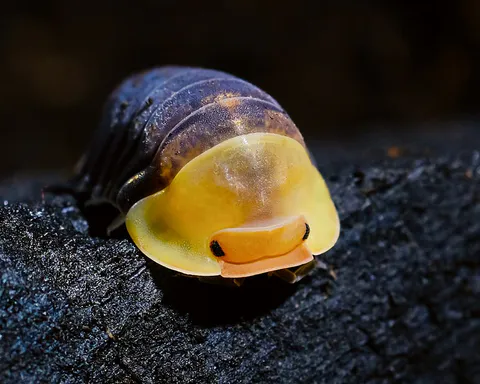
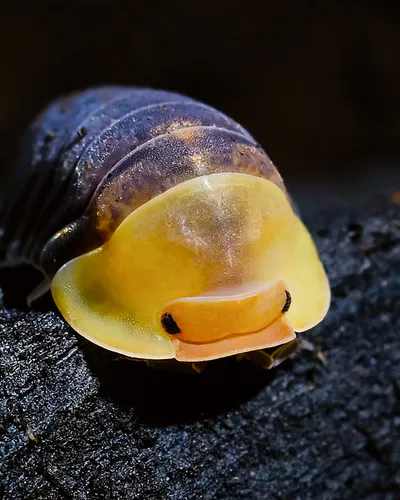
Adults are pale yellow to a washed-out peach-orange, covered in rows of raised, ridged spines. None of the sellers we read offers a selected color line.
One keeper, Invertebrate Dude, wrote in October 2025 that Dalmatian-like patterned animals in his culture appeared to have a viral infection, not an inherited trait. It is one untested report, but a reason to be wary of patterned animals sold as a morph; as a general precaution, keep any in a separate tub and watch them.
Where it lives: limestone caves in eastern Spain
A 2022 paper by Recuero, Rodríguez-Flores and García-París in the Zoological Journal of the Linnean Society gives the mainland range, after Schmölzer (1971), as at least Cartagena, in Murcia, north to Carcagente, in Valencia. It calls the species troglophilic: most known populations live in limestone (karst) caves, some in limestone soils. Its Ibiza animals are genetically close to those from Alicante, so the authors treat the island population as a probably recent arrival, by rafting or with people.
Public GBIF and iNaturalist records cluster in Alicante and Valencia, inside the paper’s range. No source we read describes its wild home as arid or desert.
The genus. Cristarmadillidium (Arcangeli, 1935, as WoRMS gives it) is a genus of Armadillidiidae, the pill woodlice. WoRMS lists six accepted species. Four were named between 2020 and 2023 from central and southern Spain, among them C. myrmecophilum, an ant-nest species described in that paper. C. muricatum itself was described by Budde-Lund in 1885 as Armadillidium muricatum, in the genus of the Zebra isopod, and it is the only one of the six in any seller listing we read.
Setting up a Spiky Pineapple tub
A normal isopod tub, tuned toward air and drainage:
- Vents on two opposite sides, for the strong cross-ventilation PostPods asks for.
- A free-draining organic substrate: flake soil, white-rotted hardwood or organic topsoil, under a thick layer of leaf litter such as oak, beech, maple, chestnut or magnolia.
- Depth of ≈ about 2 in or more. The only published number is xoticbugs' 4–5 cm or more; most others just say deep.
- Thin bark pieces in both the damp and the dry zone, as Herpeton sets it up. Six of the sources we read find them gathered under cork bark.
- Moss on the damp side; six sources put it there.
- Calcium in the tub at all times.
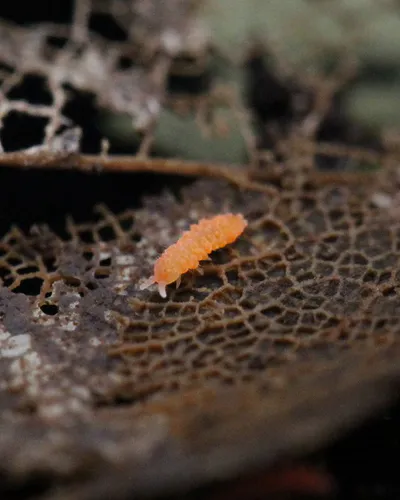
- One isopod species per tub. Springtails are welcome alongside.
PostPods advises against coco coir as the base, though Invertebrate Dude bred them over a thin layer of coconut fiber.
Temperature and airflow: cool, airy, one damp corner
≈ 50–70% is Exuvium's and Poppler Demand's figure; the damp corner, damp all the way down, matters more.
Temperature
Hold the tub at 65–77°F (18–25°C), and keep it steady. Herpeton Academy’s care sheet, springtails.eu, an EU seller, and PostPods all give 64–75°F (18–24°C), and Herpeton warns against long spells above 77°F (25°C). Six US sellers run a few degrees warmer, mostly within 68–80°F (20–27°C): Sam’s Reptile Shop, KMK Isopods, The Bio Dude, Rubber Ducky Isopods, Poppler Demand and xoticbugs. Insektenliebe, a German seller, sits warmer at 75–82°F (24–28°C), and Exuvium gives the widest span, 63–86°F (17–30°C).
No tested lethal temperature has been published. The only stated cold limit is Sam’s Reptile Shop’s: don’t let it drop below 60°F (16°C). Herpeton also gives a cooler night zone of 61–68°F (16–20°C).
PostPods says this species copes with drier room air better than a Cubaris. So in a hot, dry home, watch the thermometer before the hygrometer: the room can pass 77°F in summer, and the damp corner dries faster. The dry-climate section of the isopod guide has the general method.
Spiky Pineapple humidity: a cave animal kept on the drier side
This is where Spiky Pineapple sources disagree most. Caves are typically damp and stable, yet in tubs most breeders keep it drier, and a smaller group keeps it humid:
| Camp | Source | What it says |
|---|---|---|
| Drier, with a damp zone | Exuvium; Poppler Demand | 50–70% |
| xoticbugs | 40–50%, the driest figure we found | |
| PostPods; Herpeton; PodHaus; Insektenliebe; Rubber Ducky Isopods; Tropical Isopods | No percentage: drier ground with a damp retreat, moderate or medium humidity | |
| Humid | The Bio Dude; Sam’s Reptile Shop | 70–85% |
| KMK Isopods | 80–90%, with very little dry ground | |
| springtails.eu; Invertebrate Dude | High humidity balanced by ventilation; bred humid in a well-ventilated deli cup |
What the camps share is ventilation. PostPods wants strong cross-ventilation, Herpeton strong ventilation, Poppler Demand steady, gentle airflow, and the humid keepers who report success run ventilated tubs. Even KMK, which wants a well-sealed tub, gives it adjustable vents. The failures they describe are wet and still together. PostPods names stagnant, humid air as what kills this species in its keeping, Herpeton reads constant condensation or mold as too much water, and The Bio Dude ties molt trouble to waterlogged or stagnant substrate. None says humidity alone kills it. A wet, sealed tub with no airflow is how you lose them.
This guide works from the damp corner and treats the two-seller ≈ 50–70% as a rough guide. If you keep yours humid, keep the air moving.
How much of the tub to keep damp
Herpeton keeps one moss corner damp through the full depth of the substrate and the rest relatively dry. xoticbugs uses a damp moss zone of about a sixth of the tub, PodHaus a wet side of about 30–40%, and Exuvium and Insektenliebe keep about half moist. This guide uses Herpeton’s corner: one corner damp all the way down, not a damp surface over dry substrate. Building the gradient and re-wetting it are covered on the isopod care page.
Feeding a light eater
The Bio Dude calls it a lighter feeder and xoticbugs says it is not driven by food. So the diet is mostly leaf litter and rotting hardwood, topped up as it goes, with a little zucchini, sweet potato or carrot now and then, and calcium always in the tub (PostPods calls it essential). Protein is a pinch: once or twice a week at most (xoticbugs, Exuvium), or only occasionally (PostPods). Take out leftovers within a day or two; sources name overfeeding as a failure for this species, because uneaten food turns into mold and mites.
Spiky Pineapple breeding and colony growth
Expect a slow start. Ten of the sources we read call it slow, at least at first, and several warn that a new group can look idle for months. Once settled it can speed up: PodHaus says they breed rather quickly once established, Rubber Ducky Isopods and Tropical Isopods call them prolific, and Invertebrate Dude described his culture taking off in October 2025.
Leave a new colony alone while it settles. The Bio Dude and xoticbugs name disturbing a new colony as a cause of failure, and KMK asks for minimal disturbance, so check under the bark rather than through the substrate.
Nobody has published an age at maturity, a time to the first young, or a time to a colony you can split. xoticbugs, a US seller, estimates 6–12 young per brood; Herpeton says only that broods are smaller than in the fast cleanup species, and advises waiting to split until you can see several age groups in the tub.
Starting a colony? The Spiky Pineapple starter colony page shows what is in stock.
What you will see in the tub
Not much, most of the time. Spiky Pineapples gather under cork bark and in the leaf litter, partly down in the substrate, and come out more in damp spells. Disturbed, one rolls into a tight, spiky ball. Sellers describe them as calm and unhurried. Three sellers call them night-active (xoticbugs, Poppler Demand, Exuvium; Exuvium adds early morning); no other source we read addresses it.
PostPods, Rubber Ducky Isopods and The Bio Dude treat it as a minor detritivore that pairs well with springtails.
Problems: wet and still, or overfed
Still unknown
- Climbing: no source says whether it climbs. Use a lid that closes, as with any isopod.
- Day or night: three sellers call them night-active; no other source we read addresses it.
- The original size: PostPods cites 10 mm from the 1885 description. We have not been able to check that text, and every modern figure is smaller.
- The humidity camps over time: nobody has compared humid, ventilated colonies with drier ones over years.
Frequently Asked Questions
What humidity do Pineapple Spiky isopods need?
Moderate humidity, with one corner damp all the way down and air moving through the rest of the tub. Exuvium and Poppler Demand give ≈ 50–70%, a two-seller figure in a disputed field. A smaller camp runs 70–85% (The Bio Dude, Sam’s Reptile Shop) or more, and one keeper, Invertebrate Dude, bred them humid in a well-ventilated deli cup. Both camps agree on airflow, so get the vents right before you chase a percentage.
Why do Spiky Pineapple isopods die in a humid tub?
Usually because the tub is wet and still, not because it is humid. No source we read blames humidity on its own: PostPods blames stagnant, humid air in its own keeping. Invertebrate Dude bred them humid in a well-ventilated deli cup, and springtails.eu balances high humidity with ventilation. So in a humid tub, add vents on two opposite sides and treat condensation that never clears as a warning.
Are Pineapple Spiky isopods hard to care for?
No. Rene rates them Beginner. PodHaus calls them hardy, and the real ask is patience while a new colony gets going. Other sellers rate them harder. PostPods calls them intermediate rather than a first isopod, and The Bio Dude, KMK Isopods and springtails.eu go further; three of those four keep them humid.
How big do Spiky Pineapple isopods get?
Adults reach about 6–8 mm, under a centimeter. Herpeton gives 6–8 mm, Exuvium 6–7 mm and Insektenliebe under 7 mm, while xoticbugs gives 7–9 mm, the high end. PostPods cites 10 mm from the 1885 description, which we have not been able to check. Of the isopods we carry with a published size, only the 4–5 mm Frosty Gator is smaller.
What is the scientific name of the Spiky Pineapple isopod?
Cristarmadillidium muricatum (Budde-Lund, 1885). It was first described as Armadillidium muricatum and is accepted under its current name in WoRMS and GBIF. It sits in Armadillidiidae, the same pill-woodlouse family as the Zebra isopod, but in a different genus. WoRMS lists six accepted Cristarmadillidium species, and this is the only one in any seller listing we read.
Are Orange Spiky Pineapple isopods a separate color morph?
No. Herpeton Academy lists Orange Spiky as a trade name for Cristarmadillidium muricatum, not a separate animal. Adults run from pale yellow to a washed-out peach-orange, and none of the sellers we read offers a selected color line. Be wary of patterned animals sold as a morph: one keeper, Invertebrate Dude, thought the pattern in his culture was a viral infection.
Are Crystal Pineapple and Spanish Spiky isopods the same animal?
Yes. Both are trade names for Cristarmadillidium muricatum, the Spiky Pineapple, not separate species. Herpeton lists Spanish Spiky beside Pineapple Spiky and Orange Spiky as trade names for it, and PodHaus puts two of the names on one listing, “Pineapple/Spain Spiky”. Crystal Pineapple is the name PostPods, a UK breeder, sells it under.