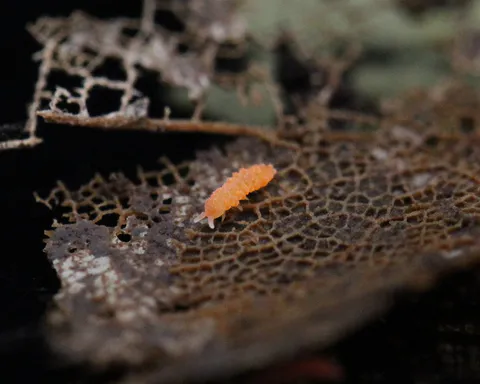


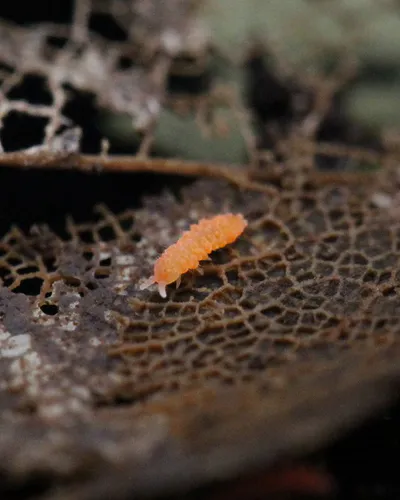

Sold for years as Sinella curviseta, the Tropical White springtail is a Coecobrya, probably C. tenebricosa, a species described from the United States. It is a white jumper of ≈ 1–3 mm, none yet measured. Sellers rate it easy (springtails.us: Beginner; TC Insects: Easy to Intermediate). The name may not mean one animal at every seller, so check the label.
Tropical White springtails at a glance
| What | Tropical White | How sure |
|---|---|---|
| Temperature | ≈ 65–80°F; best ≈ 70–80°F | Provisional: a general range; its sellers run it warmer |
| Moisture | Damp medium, never dry, never under standing water; no humidity % printed | Settled |
| Medium | Clay, charcoal or soil. Soil or coco often breeds fastest; clay or charcoal stays cleaner | All work; trade-off below |
| Food | Yeast or a few grains of uncooked rice, a little at a time | Most sources agree |
| Adult size | ≈ 1–3 mm | Disputed: no adult measured; two sellers (TC Insects, The Bio Dude) give 1–4 mm |
| Jumps | Yes | Genus level: Coecobrya has a working furcula, the springing tail |
| Breeding pace | ≈ boom in about 4–6 weeks | A general springtail figure |
| Difficulty | Easy, by seller ratings | springtails.us: Beginner; TC Insects: Easy to Intermediate |
Temperate White springtails (Folsomia candida): also tiny and white, and, per springtails.us, sometimes sold under the Tropical White name. A different animal, compared below.
Tropical Pink: a trade name that one specialist seller says covers the same stock. See the name table.
Orange springtails (Yuukianura aphoruroides): bigger, bright orange, and a walker that barely jumps. The orange vs white springtails comparison lives in the Orange guide.
What a Tropical White springtail is
A springtail of the family Entomobryidae, genus Coecobrya Yosii, 1956: a worldwide genus, very abundant in Southeast and East Asia, with about 47 species known in 2015 (Xu and Zhang 2015; Wikispecies). The hobby sold it for years as Sinella curviseta. Specialist sellers have since moved it to Coecobrya. The best-supported species name is Coecobrya tenebricosa (Folsom, 1902), first named Sinella tenebricosa and moved to Coecobrya in 2000 (Catalogue of Life; GBIF). Folsom described it in Psyche (Xu and Zhang 2015, references), and Jaskuła et al. give its origin as the USA.
Only a microscope separates Coecobrya species. The 2015 key to the Chinese species tells C. tenebricosa from relatives such as C. communis by which bristles are present and how many, and places it among the eyeless species (Xu and Zhang 2015). Hence “probably C. tenebricosa” on this page, and Coecobrya sp. on our listing.
The names on the label, and what each claims
| Name you will see | Who uses it | What it means |
|---|---|---|
| Tropical Pink | springtails.us, TC Insects, iHeartBugs | A trade name; springtails.us says it is the same stock and prefers it, to avoid confusion with Folsomia candida |
| Sinella curviseta | Years of hobby listings; still in one iHeartBugs web address | The old hobby label, borrowed from a separate described species (Brook, 1882) |
| Coecobrya tenebricosa | springtails.us (2026); Jaskuła et al. 2019, for springtails from Polish hobby vivaria | The best-supported species name |
| Coecobrya cf. tenebricosa | TC Insects and PostPods, for their pink | ”cf.” means “compare with”: close, not confirmed |
| Collembola sp. | TC Insects and PostPods, for their white | Just “a springtail” |
| Coecobrya communis | iHeartBugs, for its Pink Tropical | Another species name; iHeartBugs lists its own master culture as C. tenebricosa |
| ”Tropical White” on Folsomia candida | Some sellers, per springtails.us | A different animal under this trade name |
What the 2019 study showed, and what it didn’t
The only peer-reviewed support we found for the name comes from Jaskuła and colleagues (2019, PeerJ). They collected springtails from dart frog and orchid vivaria in Poland, identified them with keys as C. tenebricosa, and confirmed the ID with DNA barcodes. Polish wholesalers sell the species as dart frog food. The paper gives its origin as the USA and its distribution as the USA, Spain, the Netherlands, Denmark, France and Poland.
It sampled Polish vivaria, not US cultures. springtails.us, a US seller, reported the same name in March 2026 from a collembologist it does not name, without showing evidence. Two separate lines pointing at one name justify “probably”, not yet more.
Tropical vs Temperate White springtails
Temperate White springtails are Folsomia candida, the standard laboratory springtail and, by NEHERP’s account, the most commonly used one in the hobby. NEHERP and Josh’s Frogs sell only that one; we sell only Tropical White. Both are white, and C. tenebricosa, like F. candida, has no eyes, so neither color nor eyes tell them apart.
| Tropical White | Temperate White | |
|---|---|---|
| Scientific name | Coecobrya, probably C. tenebricosa | Folsomia candida |
| Eyes and color | No eyes (as C. tenebricosa). White, sometimes faintly pink | No eyes. White |
| Shape, by one hobby account | ”A bit more ant-like”, with more obvious antennae | A longer, thinner body |
| Adult size | ≈ 1–3 mm (TC Insects, The Bio Dude: 1–4 mm) | Up to about 3 mm (TC Insects: 1 to 3 mm) |
| Reproduction | Unknown whether it needs males | All-female: females lay fertile eggs without males |
| TC Insects’ temperatures | 72–82°F, aiming for 74–80°F | 65 to 80°F, aiming for 70–76°F |
| Breeding speed | springtails.us 9 of 10; TC: usually slower than its Temperate White | springtails.us 10 of 10; NEHERP: the fastest to reproduce |
The shape clue is Terrarium Tribe’s, whose author admits he could not settle the question. Size won’t decide it either: The Bio Dude says tropicals are larger, Terrarium Tribe smaller. Ask the seller for the scientific name.
Which to get? Both clean a vivarium. By TC Insects’ figures in the table, Tropical White suits a warm build and Temperate White a cooler room. Here are our Tropical White springtail cultures for sale.
Choosing a medium: soil often breeds faster, clay stays cleaner
The real choice is the medium. Sellers list soil, coco, clay, plaster, charcoal and mixes; each buys something different.
| Medium | What it does well | The cost |
|---|---|---|
| Soil, coco or a mix | Often breeds fastest: springtails.us gets its highest reproduction on soil, TC Insects’ standard culture is on coco, and NEHERP says pink springtails breed fastest on mixed media (though most species it keeps breed best on charcoal) | Sours and picks up mites sooner (NEHERP’s general springtail sheet) |
| Calcium clay | Holds moisture, stays clean, flood-harvests well. Frog and Frond, which cultures Temperate Whites on clay, finds it much less likely than charcoal to get mites | Frog and Frond’s clay cultures often slow after about six months; some last a year or two |
| Horticultural charcoal | Resists mold, lasts, floats springtails off cleanly | Hard on shipping: NEHERP’s general springtail sheet reports 90% or more of a culture can die in transit on charcoal; Terrarium Tribe says loose chunks knock the animals around |
On mites, Terrarium Tribe disagrees: it says charcoal resists mold and pests. Pick soil or coco for the most springtails fastest, if you will start fresh cups often. Pick clay or charcoal for a culture you keep for months and flood-harvest. New cups start from a scoop of an old one, so you can switch later.
Temperature: warm, never hot
Keep a Tropical White culture at ≈ 65–80°F (18–27°C), best ≈ 70–80°F (21–27°C), and under about 80°F (27°C). TC Insects, the one seller with a figure for this animal, runs it at 72–82°F (22–28°C), aiming for 74–80°F (23–27°C). That is one seller’s practice, not a study, and nothing we read shows the cool end harms it, so this page prints the general range, marked provisional. Above about 80–82°F (27–28°C) cultures slow or crash. TC Insects’ Tropical White and Tropical Pink listings warn that overheating can crash one, and that a windowsill, heat lamp, direct sun or a parked car gets a cup there fast. No tested lethal temperature has been published.
Feeding: yeast or rice, and how much
Feed yeast (brewer’s yeast in most sources) or a commercial springtail food, lightly (springtails.us, TC Insects, Terrarium Tribe). springtails.us feeds once or twice a week. NEHERP’s general springtail sheet feeds only brewer’s yeast, a light sprinkle every 2 to 4 days, and warns that mushroom, dog food and fish flakes bring mites, so treat fish food, which springtails.us lists, as optional at most. Add uncooked rice a few grains at a time, not a handful, as Terrarium Tribe does once a culture grows.
Sources argue over whether springtails eat the mold or only the fresh food (springtails.us against Penn State Extension and TC Insects). The feeding rule in the springtail care guide works either way.
Leftover yeast sours the medium and draws mites, and in a closed cup a heavy feed can use up the oxygen; NEHERP, Terrarium Tribe, The Bio Dude and Frog and Frond all name that last one. If a cup smells sour after a feed, take out what is left and skip the next one.
How fast a white culture builds
Tropical Whites are the fastest of the five springtails we sell, by breeder ratings, though not the fastest white springtail (the comparison table above has the scores). Nobody has timed a new culture of this animal. The figure used here, ≈ boom in about 4–6 weeks, is a general springtail figure. It fits what sellers describe: Terrarium Tribe says fast breeding usually starts after about a month, and The Bio Dude says the pink form can double its numbers within weeks.
Start a new cup from a scoop of a producing culture, not a few animals picked out. On clay, split well before the six-month slowdown Frog and Frond reports for Temperate Whites; nobody has published an interval for Tropical White.
Flood-harvesting and feeder use
Tropical White is the one springtail we sell that jumps, and it floats, so it is the one to flood off clay or charcoal. The method, and which water to use, are in the springtail care guide’s harvesting section. PostPods, a UK breeder, finds springtails more sensitive to tap water than isopods, though none of the sources we read reports tap water killing a culture. To lift animals off charcoal without flooding, NEHERP’s general springtail sheet says to bait overnight with a little yeast on a piece of charcoal or tree fern and move that piece.
As live food, TC Insects calls them supplemental feeders for small frogs, micro geckos and other micro insectivores; The Bio Dude and Terrarium Tribe also mention feeder use.
When a white culture goes wrong
What is still unknown
- A published ID of US hobby stock.
- Whether every seller’s Tropical Pink is every seller’s Tropical White.
- Its native range.
- Any temperature study: every figure here is a seller’s.
- Whether C. tenebricosa is all-female, as F. candida is. That is why a new cup starts from a scoop, not a few animals.
Frequently Asked Questions
What is the scientific name of tropical white springtails?
Most likely Coecobrya tenebricosa (Folsom, 1902), though we list ours as Coecobrya sp. The hobby sold it for years as Sinella curviseta. A 2019 study (keys plus DNA barcodes) identified springtails from Polish hobby vivaria as C. tenebricosa, and springtails.us reached the same name in 2026. No published study covers US stock, and only a microscope separates Coecobrya species.
Should I get tropical or temperate springtails?
By TC Insects’ figures, Tropical Whites suit a warm build and Temperate Whites a cooler room. TC, the only seller we found with figures for both, keeps its Tropical White at 72–82°F and its Temperate White, Folsomia candida, at 65 to 80°F. Both clean a vivarium, and Temperate Whites are rated as fast or faster breeders.
Are tropical pink and tropical white springtails the same?
Possibly; sellers disagree. springtails.us says Tropical Pink is the same stock and prefers that name. TC Insects and PostPods sell the white as Collembola sp. and the pink as Coecobrya cf. tenebricosa, and iHeartBugs sells its pink as C. communis. The pink is pale, more peach or salmon than bright pink.
How big do tropical white springtails get?
Sellers say 1–4 mm (TC Insects, The Bio Dude), and this page uses ≈ 1–3 mm, because no adult has been measured. Two hobby sources also disagree on whether tropicals are bigger or smaller than Temperate Whites, which reach about 3 mm: The Bio Dude says larger, Terrarium Tribe smaller.
What temperature do tropical white springtails need?
Keep them at ≈ 65–80°F, best ≈ 70–80°F, and under about 80°F: above about 80–82°F cultures slow or crash. The range is a general springtail figure, marked provisional; TC Insects, the one seller with a figure for this animal, runs it at 72–82°F. No tested lethal temperature has been published.
Why are they called tropical springtails?
Because of how they are sold, not where they come from. The species they most likely are was described from the United States in 1902. Most of GBIF’s 112 records (October 2026) come from Spain, Germany, the US, China, Norway, France and the UK, and its native range is unknown. “Tropical” marks springtails sold for warm, humid vivariums.
Can tropical white springtails live with isopods?
Flood a clay or charcoal culture and pour the floating springtails into the bin. TC Insects says its loose coco culture is not the one it prefers for tipping straight into an isopod enclosure, so if yours came on coco, start a clay or charcoal cup from it first. The bin itself is covered in isopod care.