

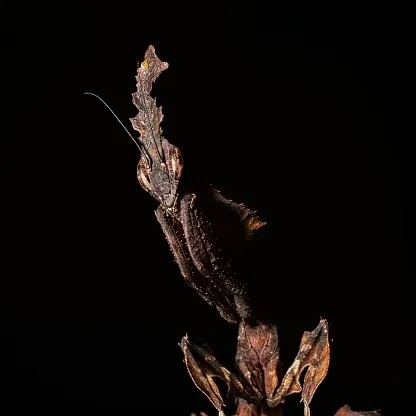
Overview
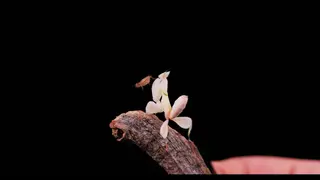
If we could only recommend one exotic mantis to first-time keepers, it would be the Ghost Mantis (Phyllocrania paradoxa). Native to sub-Saharan Africa and Madagascar, this species combines a stunning leaf-and-twig camouflage (including a forked head crest that looks like a withered leaf vein) with a husbandry profile so forgiving that most beginner mistakes don’t kill it.
- Communal-tolerant. Unusual among mantids, Ghost nymphs can be group-housed past L3 with reasonable food density. That makes them a favorite for classroom and display enclosures run by experienced keepers; a first mantis is best kept alone.
- Room-temperature happy. They thrive in the 70–80°F range that most homes already are.
- Long lifespan. Total lifespan is 8–12 months for males, 12–18 for females: well over a year for females. See how this compares in our praying mantis lifespan by species breakdown.
Adults reach about 5 cm (2 in) for a female and 4.5 cm (1.8 in) for a male. Sexual dimorphism is mild compared to Orchids: the sexes are close in length, but a male is much slimmer and lighter than a female. Easy to keep, easy to love, easy to recommend.
What a nymph actually looks like
Hatchlings are tiny and almost black, and they look nothing like the leaf-mimicking adults. Color is individual and can change at each molt: Ghosts range from pale tan through reddish and mottled brown to nearly black, and some turn green or greenish gray. Keepers often link greener animals to humidity and light, but results vary, so no one can promise a nymph’s adult color. Don’t run the enclosure wetter to chase green; damp invites fungal problems. A dark nymph is not a different species and not a sick one.
How it defends itself
A startled Ghost freezes and sways like a leaf in the wind rather than bolting, and it rarely throws a threat display. Pushed further, some Ghosts drop and play dead, and an adult male may simply fly off. A mantis that stops dead and rocks gently when you open the lid is doing exactly what the species does.
Enclosure
Ghosts are the most communal-tolerant species we keep, and group-rearing nymphs works well. But cannibalism risk climbs as they mature (regardless of how well-fed they are), and adult females will take males. Group the nymphs if you like, then separate to solo housing around subadult (L5) rather than counting on food to keep the peace through adulthood. Solo housing always works.
The rule behind the sizes: total height at least 2.5× the mantis’s body length, 3× if you have the choice, with at least 2× clear drop below the perch; width at least 1.5×. Move up when the mantis is about a third of the enclosure’s height.
| Solo | Height | What we use |
|---|---|---|
| L1–L2 | 16 OZ | A 16-oz deli cup with a mesh lid. Small on purpose, so a hatchling finds its fruit flies. |
| L3–L6 | ~15 CM | Something about 15 cm (6 in) tall, like a 32-oz deli cup with a mesh lid or our medium enclosure (10×8.5×15 cm). |
| L7–adult | ≥ 20 CM | At least 20 cm (8 in) tall, like our large enclosure (12×10×20 cm). An adult Ghost is about 5 cm, so 20 cm is comfortably past 3×; 30 cm (an 8×8×12 in) is the roomy version. |
| Communal | Space | 4–5 animals, about 3 per cubic foot |
|---|---|---|
| L3–sub | 12×12×18” | Multiple perch levels and dense decor. |
Keep flies constantly available: dust the enclosure with fruit flies or houseflies daily so no one is hungry enough to predate. Food density matters, but risk also climbs as they approach maturity even when well-fed, so separate to solo housing around subadult (L5).
Ventilation: mesh top + at least one screen side panel. Substrate: dry coco fiber works fine, they don't need wet conditions. Decor: Ghosts are visual hunters and want something to camouflage against. Twigs, dried leaves, cork bark, and silk-leaf decor all work. The more varied texture, the better. For a step-by-step build, see our praying mantis terrarium setup guide.
Temperature & humidity
Fifty percent is tolerated for a few days (it won’t hurt a healthy animal), but don’t run there permanently, and don’t push above 70% either: Ghosts handle dry far better than damp, and a soggy enclosure invites fungal problems. Most homes hit this without supplemental heat or humidification.
If nights sit under 68°F, use a low-wattage heat source on a thermostat: a ceramic heat emitter above the mesh, or a small mat on a side wall (never underneath, never unregulated). No heat lamps on plastic, no UV. Hot summer apartments above 85°F are stressful. Provide ventilation and lower the basking spot.
Water: a light wall-mist daily to every other day; never soggy, never bone-dry. Stagnant, waterlogged air causes problems, so don’t soak the enclosure.
Raise wall-misting slightly and hold humidity steady at the top of the range: never spray the mantis, and no sudden spike (low humidity is a leading cause of failed sheds).
Diet & feeding
Ghost Mantises prefer flying prey but will accept some crawling prey at larger sizes. Feeder progression:
| Instar | Feeder | Amount | Frequency |
|---|---|---|---|
| L1–L2 | Melanogaster fruit flies | 4–6 | Every 1–2 days solo (keep a few present); dust daily for communal groups |
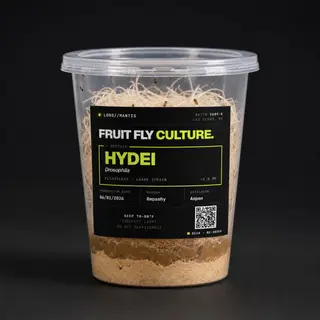
| L3–L4 | Hydei fruit flies, occasionally houseflies | 4–6 | every 2 days |
| L5–L6 | Houseflies, green bottle flies; blue bottles from L6 | 2–3 | every 2–3 days |
| L7+ / Adult | Bottle flies, moths, small dubia (1/2 inch or smaller) | 1–2 | every 3–4 days (gravid ♀ every 2–3) |
Keep prey to no more than a third of the mantis's body length. The species above are what we feed, but you'll meet feeders we haven't named: an oversized dubia, a house fly, whatever the shop had. Size is what decides whether it's safe, not what it is. Err smaller: a too-small prey item is a non-event, a too-large one risks injury. Wild-caught insects are the exception: skip them entirely, whatever the size. A moth off the porch light can carry pesticide, and there is no way to tell by looking. Our feeding guide has the sizes worked out centimetre by centimetre.
Feeding response is more relaxed than Orchids; Ghosts will sit and watch prey for minutes before striking. Don’t interpret patience as disinterest. Leave the prey in the enclosure for several hours before pulling it.
Lifecycle & molting
Adult lifespan splits hard by sex. That's normal and not something you did wrong: males are simply short-lived once mature.
Females typically molt 7 times (adult at L8), males 6 (adult at L7), with total nymph development around 4–6 months at room temperature. Adult males last 2–6 months after the final molt, females 6–12 months; total from hatch is 8–12 months for a male and 12–18 for a female.
- Refusing prey 24 h+ alongside stillness
- Hanging upside-down for extended periods
- Slight darkening at limb joints
No dramatic premolt color change like Orchids.
The premolt fast runs 2–7 days for nymphs (longer at later instars) and 1–2+ weeks before the final adult molt.
Molts are fast, 15–30 minutes once started. When one goes wrong, the usual causes are insufficient hanging height (perch too close to the substrate) or humidity that dropped too low during the shed. Give total height of at least 2.5× body length (3× if you can) with at least 2× clear drop below the perch, and in premolt raise wall-misting slightly and hold humidity steady, never spraying the mantis.
Hands off until it has hardened (moving normally, gripping firmly, colour back up). That's about 24 hours for a nymph and 48 hours or more for an adult, and no food until then: even flies can damage a soft mantis, so remove everything. Make the first post-molt meal slightly smaller than usual.
Sexing
Sex by L4 is reliable:
6 abdominal segments visible from below. Slightly broader pronotum.
8 abdominal segments visible. Slimmer overall, longer antennae proportionally. Wing buds extend farther down the abdomen at L5–L6.
The size difference at adulthood is small (about 5 cm for a female, 4.5 cm for a male), so count segments rather than measuring length.
Breeding
Pairing Ghosts is among the easiest in the hobby. Both sexes mature at similar rates and cannibalism during pairing is uncommon (though not impossible).
- Introduce a well-fed female to the male's enclosure or a neutral one.
- The male will approach within hours, mount, and pair for 6–12 hours.
- Separate after.
Females produce 1–6 ootheca over their adult life. Each ootheca yields 20–40 nymphs at 75°F and 60–70% humidity, hatching in 4–6 weeks.
Since we separate around subadult, pair deliberately: introduce a mature male to a well-fed female, watch, and remove him after. Collect oothecae as you find them and incubate separately. (If a mixed group did stay together, pairing can happen on its own, but a hungry or gravid female will eat males, so don’t rely on it.)
Ready to buy a Ghost Mantis? We breed Phyllocrania paradoxa year-round in Las Vegas and ship to most US states; checkout will tell you if yours is one we can’t ship to. See Ghost Mantis availability, or join the waitlist →
Common issues
Frequently Asked Questions
Are Ghost Mantis molts risky?
Ghosts are among the most forgiving molters in the hobby, a big part of why they’re a top beginner mantis. Give the standard setup (total height at least 2.5× body length, 3× if you can, with 2× clear drop below the perch; a mesh or twig grip under the lid, stable humidity, no feeders left in during premolt) and most molts pass without drama. If one does go wrong, our molting guide covers what to do, and what not to.
Are Ghost Mantises actually communal?
Yes, as nymphs, and more reliably than any other species we keep; African Twig nymphs also tolerate each other while fed and evenly sized, adults alone. With flies constantly available and adequate space (4–5 nymphs in a 12×12×18, about 3 per cubic foot), Ghost nymphs can be group-raised from L3. Risk rises as they mature, though, so separate to solo housing around subadult (L5) rather than pushing a mixed group all the way to adulthood. Adults live alone.
Can I handle a Ghost Mantis?
Yes, they’re the calmest species we keep. Mantises don’t bite in any meaningful sense; they grab with the front legs. A big adult female can give a sharp pinch that occasionally nicks skin; no venom, no danger. Let it walk onto an open hand rather than picking it up, and keep it gentle. The molting period is off-limits: after a molt, leave it completely alone until it has hardened (moving normally, gripping firmly, colour back up). That’s about 24 hours for a nymph and 48 hours or more for an adult. If you’d rather have one number, wait 48 hours; you will never harm a mantis by giving it longer.
Why does my Ghost have a forked “horn” on its head?
That’s the species-defining cranial crest, mimicking a torn leaf vein. Both sexes have it; size and shape vary slightly by individual.
My Ghost just laid an ootheca on the enclosure wall. Should I move it?
You can carefully cut the ootheca off and place it in an incubation container, or leave it in place and remove the parents. Don’t peel it loose with bare fingers. Use a thin blade slid behind the attachment point.
Do they need UV light?
No. Normal room light is enough; skip UV bulbs, and never put a heat lamp on a plastic enclosure.