

Setting up a mantis enclosure is straightforward once you understand a few key principles. The basics haven’t changed in decades: correct size, ventilation, something to climb, and the right humidity. But the details matter, and getting them wrong causes mismolts, stress, and dead mantises.
Here’s everything you need to know to set up a proper habitat from nymph to adult.
The sizing rule
This is the one rule you cannot break: the enclosure must be at least 2.5 times the mantis’ body length in height (3 times if you can), and at least 1.5 times in width and depth.
Why height specifically? Mantises molt by hanging upside down. They need enough vertical space to fully extend their body below the anchor point without touching the floor or walls. A mantis that runs out of room mid-molt will end up deformed or dead. See our guide to praying mantis molting problems for how to spot and prevent mismolts.
Measure your mantis from head to abdomen tip (not including the arms), multiply by 2.5 for your minimum height, and by 3 for the comfortable version. This means your enclosure will change as your mantis grows, and that’s expected. You’ll go through 2-3 enclosure sizes over a mantis’ lifetime.
Enclosure types by instar
L1-L2 nymphs: Deli cups
For the smallest instars, a 16oz deli cup with a fabric or mesh lid is all you need. These might seem too simple, but they’re actually ideal:
- Small space means the nymph can find its food easily
- Easy to maintain humidity with a quick mist
- Cheap enough to have multiple on hand
- Easy to clean and replace
Poke small ventilation holes in the sides (a thumbtack works perfectly for L1 cups; you don’t want holes big enough for fruit flies to escape or for the nymph to squeeze through). Cover the top with fabric mesh secured by the rim or a rubber band. The mesh gives them a surface to hang from for molting.
L3-L6 nymphs: 32oz cups or small acrylic enclosures
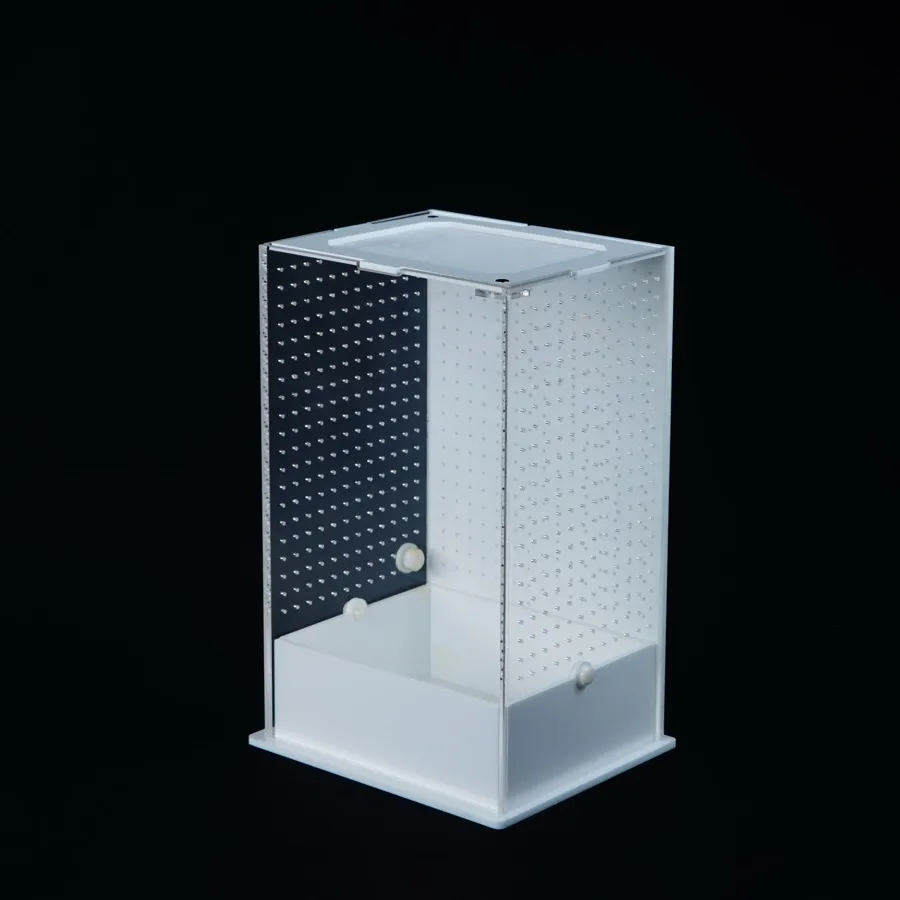
Once your mantis hits L3, move it up to something about 15 cm (6 in) tall: a 32oz deli cup with a mesh lid, or a 64-oz-class acrylic enclosure (~15 cm / 6 in tall), the clear boxes with ventilated lids you see from mantis supply companies. That size works for most species through L6.
Key features to look for:
- Cross-ventilation (holes on sides, not just the top)
- Mesh or textured ceiling for hanging
- A door that opens from the front or side (top-opening stresses mantises because your hand comes from above, a predator direction)
Sub-adults and adults: Mesh cages or large acrylic
Adults need their final enclosure: at least 20 cm (8 in) tall for species up to 8 cm (Ghost, Spiny Flower, Orchid, African Twig), and 25–30 cm (an 8x8x12 inch enclosure or bigger) for the large Dead Leaf and Double Shield. You have two main options:
Mesh/screen cages offer excellent ventilation and grip surfaces on every wall. Great for species that need airflow and lower humidity like African Twig Mantis. The downside is they don’t retain humidity well.
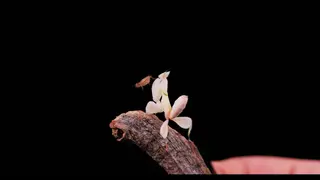
Glass or large acrylic terrariums retain humidity better and look good on display. Good for species that need higher humidity like Orchid Mantis. Make sure there’s adequate ventilation. A fully sealed glass tank will grow mold in days.
For most of our species, I recommend acrylic enclosures with mesh ventilation panels. They balance humidity retention with airflow and give you a clear view of the animal.
Ventilation
Stagnant air kills mantises. It grows mold, creates respiratory problems, and makes humidity impossible to regulate. Every enclosure needs cross-ventilation: air flowing in one opening and out another.
For deli cups: holes on the sides plus a mesh top creates natural convection. Warm air rises out the mesh, pulling fresh air in through the side holes.
For larger enclosures: mesh panels on at least two sides (or one side plus the top) gives adequate airflow. If you’re using a glass terrarium, make sure it has a screen top and is not sealed on all sides.
If you’re seeing condensation on the walls that never evaporates, or mold growing on surfaces, you don’t have enough ventilation.
Substrate
Keep it simple, especially when you’re starting out.
Paper towel is the best substrate for beginners. It’s absorbent, easy to replace, lets you see mold or mites immediately, and costs nothing. Change it weekly or when it gets dirty. Fold it to fit the bottom of the enclosure.
Coconut fiber (coco coir) is good for species that need sustained higher humidity. It holds moisture without molding quickly. The downside is you can’t spot problems as easily, and it can harbor mites if you’re not careful.
Sphagnum moss works well as a humidity layer under paper towel or on its own for tropical species. Keep it damp, not soaked.
What not to use: Soil from outside (parasites, pesticides), sand (no humidity retention, irritates the mantis), cedar or pine shavings (toxic oils), loose vermiculite (mantises can ingest it).
For species-specific substrate recommendations, check the individual care guides: Ghost Mantis care, Spiny Flower Mantis care, Dead Leaf Mantis care, Double Shield Mantis care.
Perches and decor
Mantises need things to climb on and hang from. This isn’t optional decoration. It’s essential infrastructure for hunting and molting.
Minimum requirements:
- Something textured on the ceiling (mesh, fabric, cork) for molting
- At least one vertical perch (stick, dowel, fake plant stem) for resting and hunting
- A horizontal surface at mid-height for ambush positioning
Good perch materials:
- Natural twigs and branches (sanitize by baking at 200-215F for 1-2 hours, checking that the wood doesn’t smoke or char, then let it cool fully before use)
- Cork bark pieces
- Fake plants and vines from craft stores
- Bamboo skewers for small enclosures
Avoid smooth surfaces that the mantis can’t grip. Smooth plastic walls with no perches means your mantis has nowhere to station itself and will spend all its time on the mesh lid.
Don’t overcrowd the enclosure. Your mantis needs space to move, hunt, and molt without hitting obstacles. One or two well-placed perches plus some fake foliage is plenty. Leave the center area open.
Temperature
Most exotic mantis species thrive between 72-82F (22-28C). This is conveniently close to normal room temperature in most homes.
Heating options if your room runs cold (low-wattage, and always on a thermostat):
- Ceramic heat emitter above the mesh top (careful not to dry out the air)
- Small heat mat on a side wall of the enclosure (never underneath, since mantises hang at the top, and never unregulated)
- Space heater to warm the room overall
- No heat lamps on plastic enclosures
Critical rules:
- Create a temperature gradient if possible: one side slightly warmer than the other
- Never place enclosures in direct sunlight (creates a greenhouse effect, instant overheating)
- Monitor with a thermometer inside the enclosure, not outside it
- Keep nights at 72F or above for tropical species (Orchid, Dead Leaf) and 68F or above for the rest
Species-specific ranges matter. Orchid Mantis wants 75-85F (78-82 by day, low 70s at night). Ghost Mantis is comfortable at 70-80F. African Twig Mantis runs 72-86F and only needs added heat if the room drops below 68F. Check the care guides for your species.
Humidity
Humidity requirements vary significantly by species, but the method is the same: mist the enclosure walls with a spray bottle.
General guidelines:
- Mist once daily for true tropical species (Orchid)
- Mist every other day for Spiny Flower; it’s a dry-biome species, and over-misting causes fatal fungal infection, so let the enclosure dry out fully between mistings
- Ghost: a light wall mist daily to every other day
- African Twig: 1-3 light mists a week, letting everything dry fully in between
- Dead Leaf: a daily wall mist over lightly damp substrate with real cross-ventilation; through premolt, ease toward the top of its range and hold it steady, no spike
- Let the enclosure dry between mistings; constant wetness grows mold
- Mist the walls and decor, never spray the mantis directly
- Your mantis will drink water droplets off the walls
A hygrometer inside the enclosure helps you calibrate, but honestly, most experienced keepers work by feel. If the walls dry within a few hours of misting, you might need to reduce ventilation slightly or mist more often. If they’re perpetually wet, you need more airflow.
The goal is a cycle: mist, humidity rises, it gradually drops as water evaporates, you mist again. This mimics natural conditions better than trying to maintain a constant 70% humidity.
Lighting
Mantises don’t need special lighting. Ambient room light or indirect natural light from a nearby window provides enough of a day/night cycle.
What to avoid:
- Direct sunlight hitting the enclosure (overheating risk)
- UV bulbs (unnecessary and can overheat small enclosures)
- Leaving bright lights on 24/7 (mantises need a dark period)
If your mantis room is dim, a low-wattage LED desk lamp on a 12-hour timer works fine. Some keepers use small LED strips on enclosures for display purposes. Just make sure they don’t produce significant heat.
Putting it all together
Here’s your setup checklist, broken down by stage:
For a new L1-L2 nymph:
- 16oz deli cup with mesh lid
- Paper towel substrate
- Small twig or piece of fake plant
- Fruit flies (D. melanogaster) on hand
- Spray bottle for misting
For L3-L6 nymphs:
- 32oz cup or ~15 cm (6 in) acrylic enclosure with cross-ventilation
- Paper towel or coco fiber substrate
- 1-2 perches plus fake foliage
- Thermometer/hygrometer combo
- Appropriate feeders (D. hydei, house flies)
For sub-adults and adults:
- Full-sized enclosure (at least 2.5x body length tall, 3x if you can)
- Substrate of choice
- Multiple perches and climbing surfaces
- Temperature control if needed
- Feeding tongs for offering prey
- Appropriately sized feeders (blue bottle flies, small roaches, moths); see our guide to feeder insects for praying mantises
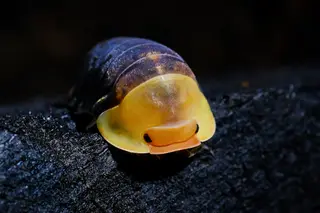
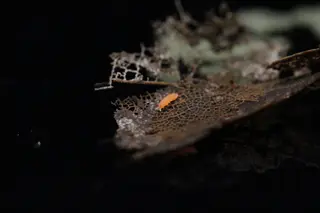
Want the enclosure to help clean itself? Once your mantis is in a full-size planted setup, a bioactive terrarium with springtails and dwarf-white isopods keeps waste and mold down for you.
Get the enclosure set up and running at least 24 hours before your mantis arrives. Check that humidity and temperature are stable. Make sure feeders are alive and ready. When your mantis shows up, it’s going straight into a perfect home, not a rushed setup. For the arrival itself, follow our step-by-step guide to unboxing your shipped mantis.
Need a mantis to put in your new setup? Browse our available species (the beginner-friendly Ghost Mantis and the show-stopping Orchid Mantis are great places to start) and check current availability. Every species page links to its full care guide with specific terrarium requirements.