

The Carolina mantis is the one that actually belongs here. While the big Chinese and European mantises everyone notices were shipped in from overseas, Stagmomantis carolina has been hunting in American grasslands and gardens the whole time. It’s smaller, subtler, and, in my opinion, deserves a lot more respect than it gets.
I breed exotic mantises, not natives. But people ask me about the Carolina mantis constantly, usually after finding one in the yard, so here’s the honest rundown.
What does a Carolina mantis look like?
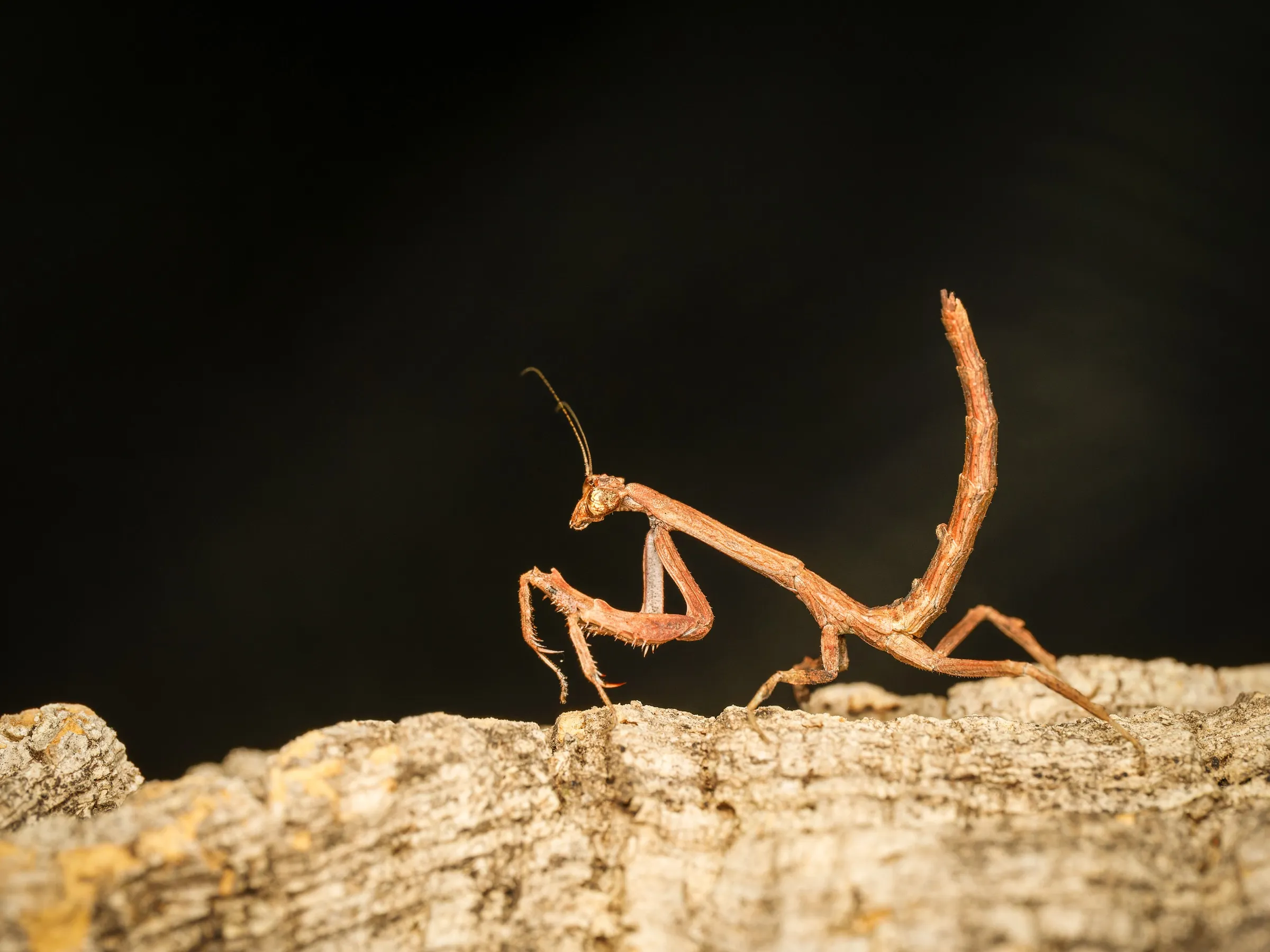
The Carolina mantis (Stagmomantis carolina) is a small, mottled, easy-to-overlook native. Adults run about 2 to 2.5 inches (with heavy females at the top of that range and slimmer males a bit smaller), noticeably smaller than the 4-inch Chinese mantis. That size difference alone is the fastest field ID.
Look for:
- Dusty gray, green, or tan coloring with a mottled, lichen-like pattern. They blend into bark and dry vegetation beautifully.
- A compact, stocky build compared to the long, stretched-out Chinese mantis.
- Wings that don’t reach the abdomen tip in females: females are heavy-bodied and often can’t fly well, while the slimmer males can.
- A relatively short pronotum: they don’t have the long “neck” of Tenodera.
If you find a smallish, blotchy gray-green mantis in the southern or central US, odds are good it’s a Carolina.
The state insect of South Carolina
The Carolina mantis has an official honor: it became the state insect of South Carolina in 1988. That’s a nice bit of recognition for a native predator that quietly does its job in gardens across much of the country.
It’s worth pausing on, because the Carolina mantis is having a hard time in some places, and not because of anything people did on purpose.
Why native mantises are losing ground
Here’s the conservation angle that matters. The Carolina mantis is increasingly outcompeted by introduced species. The larger Chinese mantis (introduced around 1896) and the European mantis (Mantis religiosa, also introduced) are bigger, hatch in large numbers from garden-store egg cases, and will eat smaller mantises, including native Carolina nymphs.
So when a gardener buys a card of Chinese mantis oothecae for “natural pest control,” they may be quietly tilting the field against the native that was already there.
What helps:
- Leave native mantises outside. A Carolina mantis in your garden is doing exactly what it evolved to do. It belongs in the yard, not a tank.
- Leave wild egg cases alone. A Carolina ootheca in your shrubs is a feature, not a problem. Those nymphs are beneficial.
- Skip the imported egg cases. If you want garden predators, let the natives do it. We don’t sell oothecae of any species, native or exotic. For pets, an egg case is the wrong product anyway.
This is the rare case where the best thing you can do for an animal is nothing at all.
Does the Carolina mantis make a good pet?
It can. Carolina mantises are hardy little generalists, tolerant of normal room conditions, and not difficult to feed. If you catch a nymph early in the season, raising it is straightforward beginner practice.
But the same caveats apply as with any wild mantis, and I won’t pretend otherwise:
- A wild adult is already old. Mantises live a single season. A Carolina adult found in late summer is near the end of its life.
- Wild mantises can be parasitized. Horsehair worms turn up in wild mantises, and you can’t see them until it’s too late.
- They’re small and cryptic. A gray-green 2.5-inch bug that hides against bark is a cool animal but not a showpiece.
And there’s the conservation point: the Carolina is a struggling native. I’d genuinely rather you leave it in your garden to breed than take it indoors for a few weeks.
Care basics if you raise one
If you do raise a backyard nymph, the rules are universal:
- One mantis per enclosure: they will cannibalize.
- Paper towel substrate: simple and clean.
- Prey about ⅓ of body length: small nymphs take fruit fly clusters every 1–2 days; larger nymphs take a fly or two every few days.
- A light mist on the walls for drinking water.
- Room temperature suits this temperate native fine; a warm spot in the high 70s to low 80s F speeds growth and appetite.
Full method in our feeding guide. If you want a clean feeder supply instead of risking pesticide-exposed yard bugs, a melanogaster culture covers a small nymph for weeks; step up to hydei as it grows.
If you want a pet, start with a captive-bred exotic
Here’s my honest recommendation. If watching a Carolina mantis hunt in your garden made you want one of your own, do two things: leave that one outside, and get a captive-bred exotic nymph to keep indoors.
You get the same fascinating predator behavior (the head-tracking, the patient stalk, the lightning strike), but you start at the beginning of the animal’s life, with a known species, known care, and no parasite roulette. And you support natives by not pulling one out of the ecosystem.
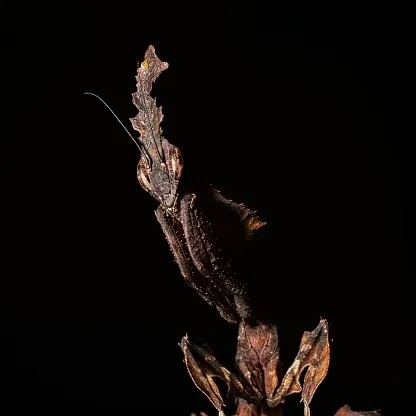
The exotics also deliver far more visual drama than a gray-green native. A Ghost Mantis is a forgiving, leaf-mimic beginner favorite. A Spiny Flower Mantis adds color and a bullseye threat display. Not sure where to start? Our beginner ranking or the quiz will point you.
The Carolina mantis is a small American success story that needs a little help. The best help is restraint.
Frequently Asked Questions
Is the Carolina mantis endangered?
Not formally listed as endangered, but it’s under pressure from larger introduced mantises that outcompete and prey on it. Locally it can become scarce where Chinese and European mantises are abundant. Leaving natives and their egg cases undisturbed is the simplest way to support them.
How do I tell a Carolina mantis from a Chinese mantis?
Size and shape. Carolina is small (~2.5 in), stocky, and mottled gray-green. Chinese is large (~4 in), long, and narrow with a vertical wing stripe. If it’s hand-length, it’s not a Carolina.
Can I keep a Carolina mantis I found in my yard?
In most states, collecting a common native mantis is legal, but rules vary. Check your local regulations, and never take protected wildlife. Given the conservation pressure on natives, I’d encourage leaving it outside and buying a captive-bred nymph instead.
What do Carolina mantises eat?
Whatever they can catch: flies, moths, small grasshoppers, and other insects. In captivity, fruit flies for nymphs and houseflies or bottle flies for adults, sized to about a third of the mantis’s body length.
Are Carolina mantis egg cases good for the garden?
Yes. A native Carolina ootheca in your shrubs is beneficial and worth leaving alone. Avoid buying imported Chinese mantis egg cases, which add pressure on natives like this one.