


When someone says “praying mantis,” this is the animal they’re picturing, even if they’ve never seen one in person. Mantis religiosa, the European mantis, is the species that gave the whole group its name and its reputation. Every cultural image of a green insect with folded forearms traces back to this bug.
I breed exotic mantises, so the European isn’t on my list. But it’s the namesake of the entire hobby, and it’s worth understanding properly.
Where does “praying mantis” come from?
The name is the whole story. Mantis comes from the Greek word for “prophet” or “seer.” Combined with the genus name religiosa, “religious”, you get an insect named for the way it holds its raptorial forelegs folded together in front of its body, a posture that looks unmistakably like hands clasped in prayer.
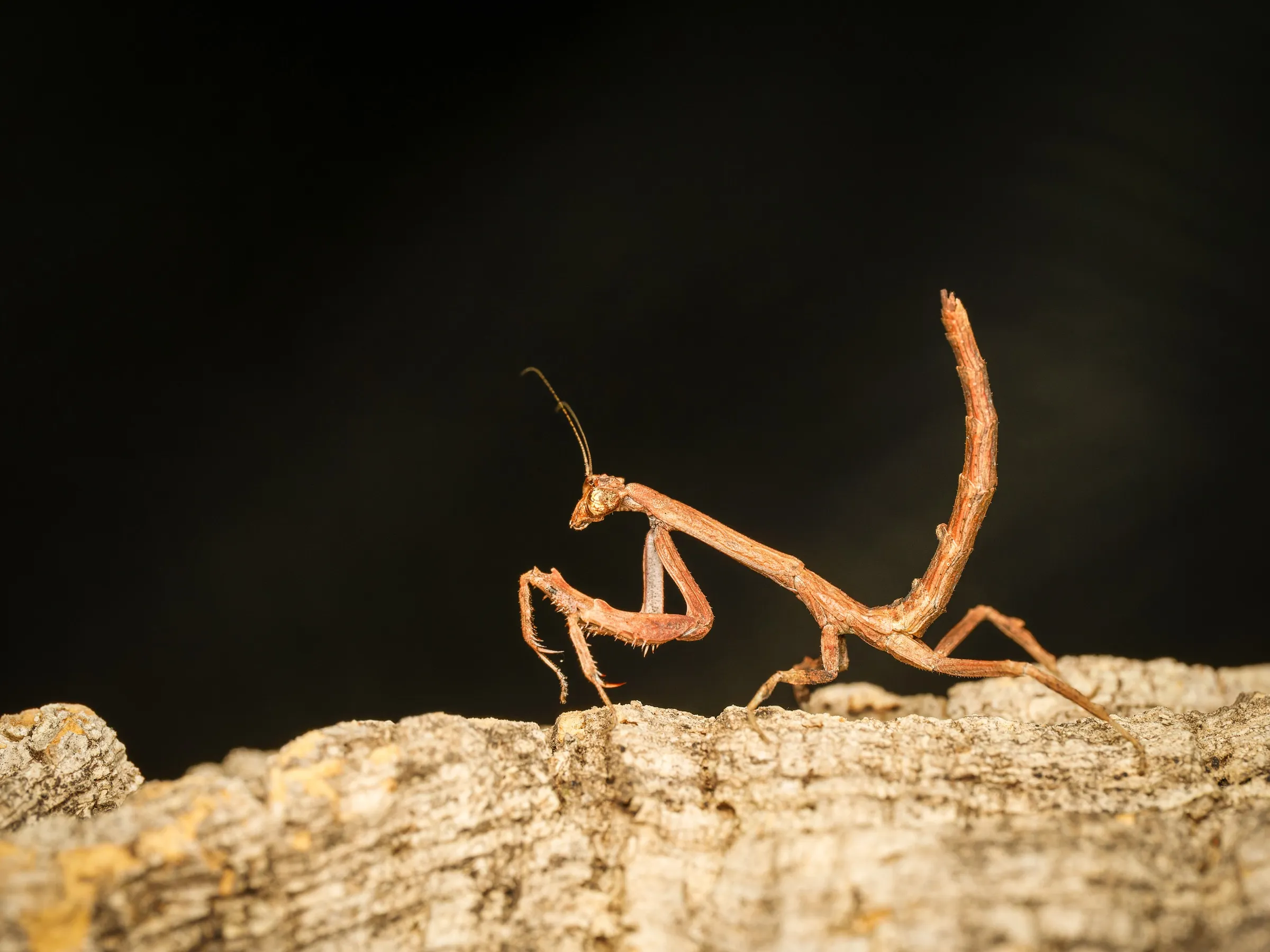
That’s why it’s a praying mantis, not a preying one, though the pun writes itself, since the prayerful pose is actually the cocked-and-ready stance of an ambush predator waiting to strike. The animal looks devout. It’s actually hunting.
This naming all centers on Mantis religiosa specifically. Over time “praying mantis” became a catch-all for the roughly 2,400 mantis species worldwide, but the original is this one.
How to identify a European mantis
The European mantis (Mantis religiosa) has one ID feature that settles the question instantly: the bullseye spot.
Look on the inside of each front leg, in the “armpit” where the raptorial foreleg meets the body (the coxa). There’s a distinctive black-ringed spot, often with a pale or white center, a true bullseye or eyespot. No other mantis you’re likely to encounter in North America has it. If you see that spot, it’s Mantis religiosa. Done.
Beyond the bullseye:
- Medium build: males roughly 2.5 inches, females larger at up to ~3.5 inches (about 6–9 cm).
- Green or straw-brown color morphs, both common.
- A slender, classic mantis silhouette: this is the textbook shape.
The bullseye is the one you want. Everything else is supporting evidence.
How it got to the US
The European mantis is, like the Chinese mantis, an introduced species in North America. It was first recorded on the continent around 1899 (in the eastern US, reportedly arriving on imported nursery stock) and spread across the northern US and southern Canada; its native range spans southern Europe, North Africa, and temperate Asia. It’s even the state insect of Connecticut (adopted in 1977), a designation that has drawn criticism precisely because the “state” insect isn’t native to the state at all. It’s a capable garden predator and, like other introduced mantises, an indiscriminate one that competes with smaller natives such as the Carolina mantis.
A brief, tasteful word on symbolism
Because of the prayer pose and the name, the European mantis carries a lot of cultural weight. Across various traditions it’s been read as a symbol of patience, stillness, mindfulness, and contemplation: the idea of a creature that waits, calm and composed, before it acts. Some cultures historically treated the mantis as a small bringer of luck or guidance.
I’ll leave the meaning to you. As a breeder, what I find striking is how well the symbolism fits the biology: the mantis really is the most patient predator in the insect world. The stillness isn’t piety. It’s strategy. But it’s easy to see why people read more into it.
Does the European mantis make a good pet?
It can be kept, and it’s hardy. European mantises tolerate temperate room conditions, feed readily, and aren’t fragile. As a beginner’s introduction to mantis-keeping on a free, caught animal, they work.
The honest caveats are the same as for any wild-caught mantis:
- A wild adult is already old. One-season lifespan means a late-summer adult is near the end.
- Wild mantises are frequently parasitized. Horsehair worms are common and invisible until the damage is done, and a weakened wild animal is also more prone to molting problems.
- They’re a classic green bug: iconic, but not flashy next to the exotics.
If you find one and want to learn, go ahead. Just know what you’re signing up for.
Care basics if you keep one
Universal mantis rules apply:
- One mantis per enclosure. They’ll cannibalize otherwise. The Ghost Mantis is the only species we’d group long-term, and only as nymphs.
- Paper towel substrate. Easy and clean.
- Prey ~⅓ of body length. Small nymphs eat fruit fly clusters every 1–2 days; adults take a fly or two every few days.
- A light mist on the walls for drinking droplets.
- Room temperature suits this temperate species.
Our getting-started guide covers the setup from scratch, and the feeding guide has the full breakdown. To skip pesticide-risky yard insects, a melanogaster culture feeds a small nymph for weeks, then move up to hydei.
If the namesake hooked you, start with a captive-bred exotic
Here’s where I make my pitch. If the European mantis is what made you fall for these animals (the pose, the patience, the alien elegance), you’ll get all of it, and more, from a captive-bred exotic. Plus a fair shot at the animal’s full lifespan instead of its final weeks.
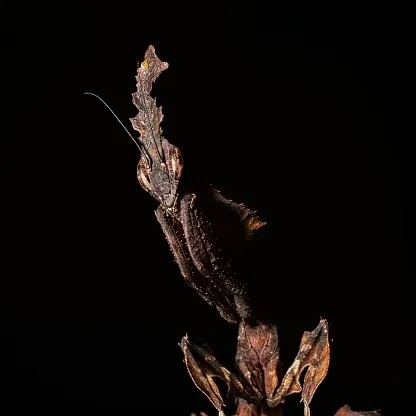
You start at the beginning. Known species, known care, no parasite gamble, no mystery age. And the exotics turn the “classic green mantis” up to eleven: a Ghost Mantis is a hardy leaf-mimic that’s perfect for first-timers, a Spiny Flower Mantis has its own bullseye (a vivid threat-display eyespot on the wings), and an Orchid Mantis looks like a flower that hunts.
Same prayerful predator. Better odds, better looks. Take the quiz or read the beginner ranking to find your match.
The European mantis named the hobby. Let it be your inspiration, and let a captive-bred nymph be your first real pet.
Frequently Asked Questions
What does “praying mantis” actually mean?
“Mantis” is Greek for “prophet” or “seer,” and the species name religiosa means “religious.” Together they describe the insect’s folded-foreleg posture, which resembles hands clasped in prayer. The pose is really a predator’s ready stance.
Is it “praying” or “preying” mantis?
The correct term is “praying” mantis, named for the prayer-like pose. The pun about “preying” is apt (it is a predator), but the name refers to the posture, not the hunting.
What’s the bullseye spot on a European mantis?
A black-ringed eyespot on the inner surface of each front leg, where the raptorial foreleg meets the body. It’s the single most reliable way to identify Mantis religiosa: no common North American mantis shares it.
Is the European mantis native to the US?
No. It was introduced from Europe and is now established across much of the northern US and Canada. Like other introduced mantises, it competes with native species such as the Carolina mantis.
Can I keep a European mantis as a pet?
Yes, and they’re hardy, but a wild-caught adult is near the end of its single-season life and may be parasitized. For a real pet experience, a captive-bred exotic nymph gives you the full lifespan and known care.