

What do praying mantises eat?
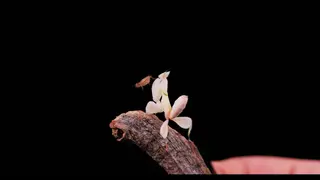
Praying mantises eat live insects, and only live insects: they hunt moving prey and ignore anything that sits still. A pet mantis eats flightless fruit flies as a young nymph, then house flies, blue bottle flies, moths and dubia roaches as it grows. In the wild, mantises take flies, moths, crickets, grasshoppers, caterpillars, bees and other insects, plus the occasional spider, and the largest species sometimes catch a small lizard or frog. They don’t eat fruit, leaves or dead insects, and they drink water droplets off leaves and enclosure walls rather than from a dish.
The rest of this guide is how to feed one well: which prey at which stage, how big, how often, and what to skip.
The two rules
- Prey size no more than 1/3 the mantis’s body length, at any stage. Bigger prey = injuries.
- Frequency scales with stage. Young nymphs eat constantly; adults eat once every few days.
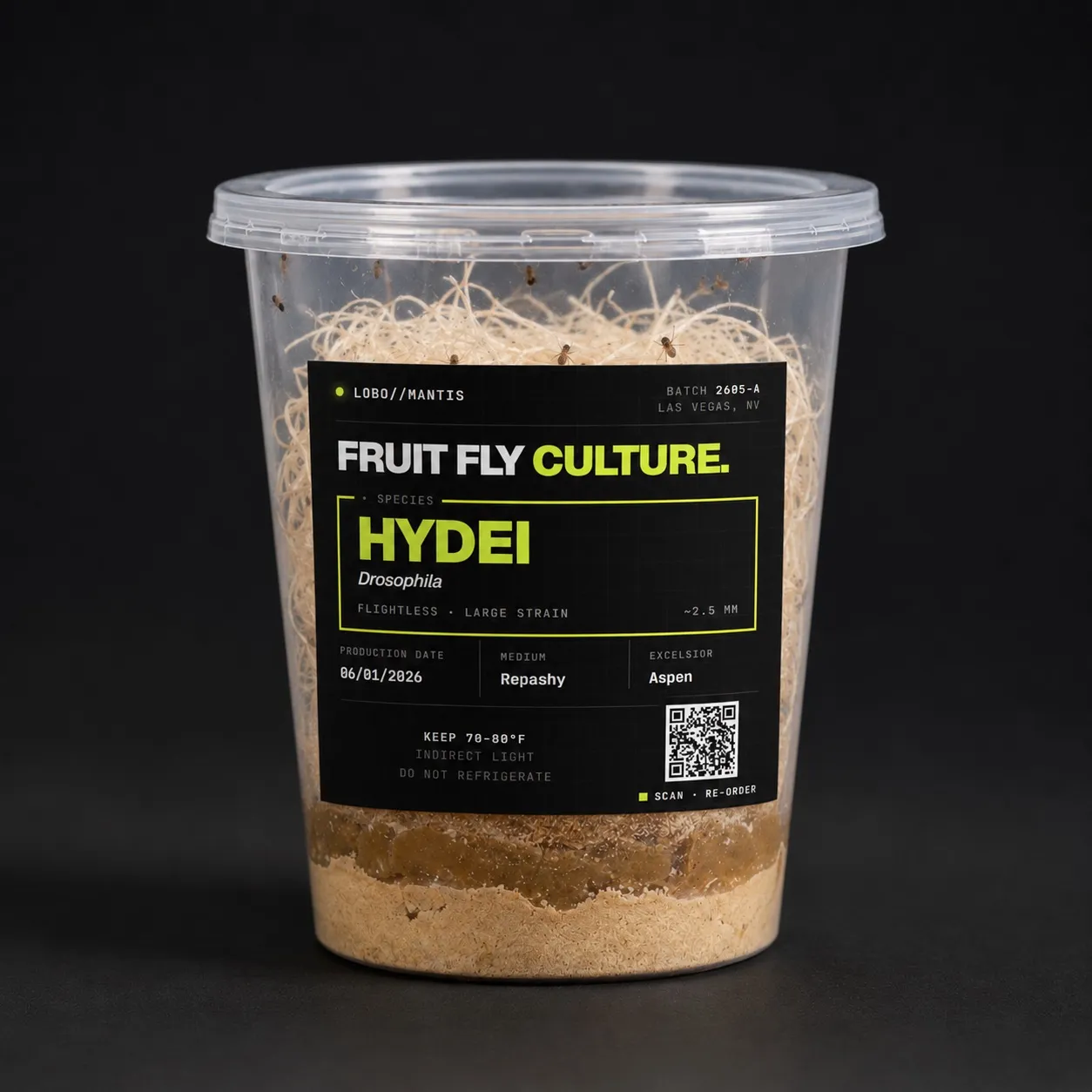
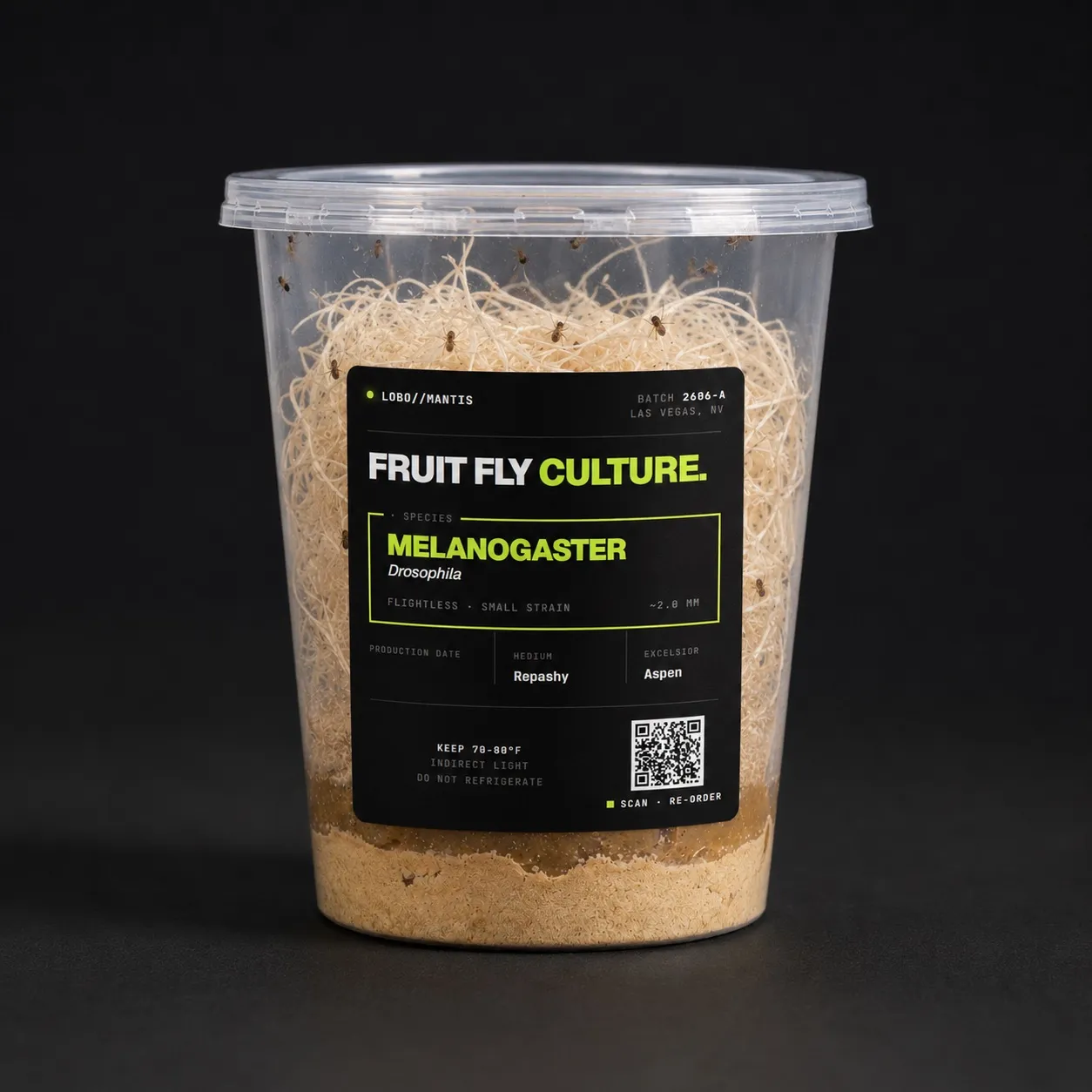
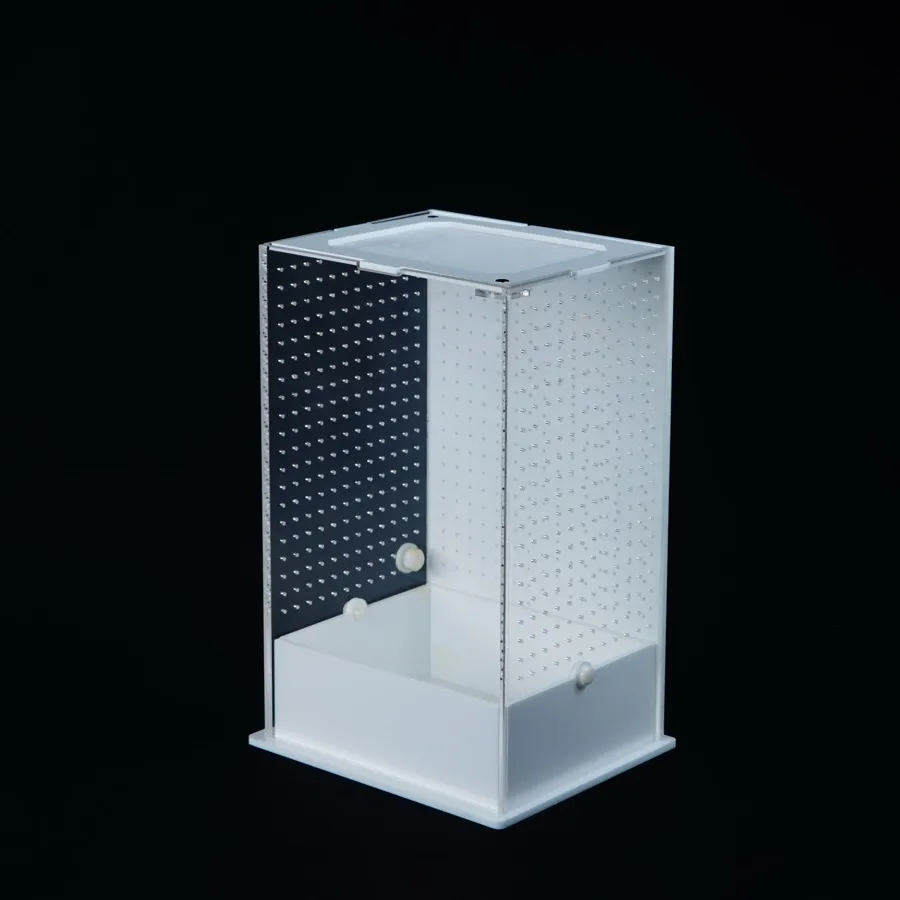
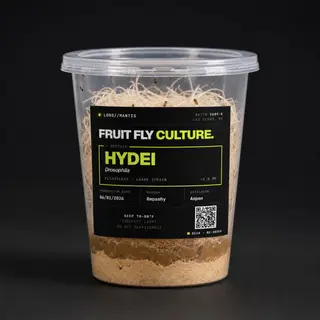
What you need to feed a mantis start to finish: a melanogaster culture ($15) for nymphs, a hydei culture ($15) as they grow, and an enclosure sized to the instar. A misting bottle ($10) covers hydration: droplets on the mesh are how a mantis drinks.
Everything else in this guide is detail.
Prey species by instar
L1–L2 nymphs
Melanogaster fruit flies (flightless). Almost exclusively. L1 nymphs cannot subdue anything larger.
Source: a single fruit fly culture ($15) feeds a single nymph for about a month (roughly one to two instars). One culture gives about 3–4 weeks of harvestable flies before it exhausts its media. Melanogaster is done around day 30–35, hydei often runs to day 40 or beyond. Start a fresh culture every 2–3 weeks so you always have flies coming online. See our fruit fly culture care guide for the full routine.
How to offer: tap 4–6 flies into the enclosure every 1–2 days, and keep a few present between feedings.
L3–L4 nymphs
Hydei fruit flies (larger). Same source ecosystem as Melanogasters, just a different culture. Melanogaster still works at L3 if you offer more. Also fine.
Optional: small houseflies (1/4 inch) once the nymph hits L4.
How to offer: 4–6 flies per feeding, every 2 days.
L5–L6 nymphs
Houseflies and bottle flies. Bottle fly spikes are pupae you hatch into flies: a few days in a ventilated deli cup at room temperature and the flies come out. Green bottle spikes hatch into 8–10 mm flies, the right size at L5–L6. Blue bottle spikes (12–15 mm flies) are the step up from L6. New to feeders? See our feeder insects guide.
How to offer: 2–3 flies per feeding, every 2–3 days.
L7+ / Adults
Bottle flies (blue, green), moths, and appropriately-sized dubia roaches, depending on species.
Some species strongly prefer flying prey: an Orchid may refuse crawling prey outright, and a Spiny Flower takes appropriately sized dubia but strikes fastest at flies and moths. Others (African Twig, Double Shield) eat everything. Check the relevant species care guide: Dead Leaf and Ghost each have their own quirks too.
How to offer: 1–2 prey items every 3–4 days.
Prey-to-mantis size ratio
| Mantis body length | Max prey body length |
|---|---|
| 0.5 cm (L1) | 0.2–0.25 cm (Melanogaster) |
| 1 cm (L2) | 0.3 cm (Melanogaster) |
| 1.5 cm (L3) | 0.5 cm (Hydei) |
| 2 cm (L4) | 0.6 cm (Hydei, small housefly) |
| 3 cm (L5) | 1 cm (housefly) |
| 5 cm (L6+) | 1.5 cm (bottle fly) |
| 7+ cm (adult) | 2 cm (large bottle fly, moth, dubia roach) |
Melanogaster fruit flies are the practical exception: at ~0.2–0.25 cm they sit at or just above the 1/3 line for L1 nymphs, but their soft bodies make them safe to handle anyway.
Err smaller. A too-small prey item is a non-event; a too-large one risks injury.
Feeding frequency
Generally:
- L1–L2: 4–6 melanogaster every 1–2 days (keep a few present in the enclosure)
- L3–L4: 4–6 hydei every 2 days
- L5–L6: every 2–3 days
- L7+ adults: 1–2 prey items every 3–4 days
- Premolt: zero. Stop feeding the moment you suspect premolt (our molting guide covers the signs).
- Post-molt: wait until the mantis has hardened: moving normally, gripping firmly, colour back up. That’s about 24 hours for a nymph and 48 hours or more for an adult. If you’d rather have one number, wait 48 hours. It is too soft to safely subdue prey before that, and even flies can damage a soft mantis. Remove everything. Make the first post-molt meal slightly smaller than usual.
- Gravid females: feed slightly more: every 2–3 days instead of every 3–4.
Skip a feeding if the abdomen is round and full. Don’t skip if the abdomen is thin and concave.
Reading appetite
A healthy mantis with good appetite will:
- Track a flying prey item with the head as it moves
- Adopt a stalking posture (lowered, body tense, raptorial legs cocked)
- Strike within 30 seconds of getting in range
A mantis refusing food might be (for a full walkthrough, see why your mantis isn’t eating):
- In premolt (most common reason; fasting lasts roughly 2–7 days for nymphs (longer for later instars) and 1–2+ weeks for adults approaching the final molt)
- Recently fed (already-full abdomen; check from below)
- Receiving the wrong prey (an Orchid offered stationary, non-fluttering prey)
- Too cold (below 68°F, most species slow dramatically)
- Old (adult females in their final weeks often refuse food)
Gut-loading prey
For optimal nutrition, feed your feeder insects nutritious food for at least 24 hours before offering them to your mantis. This is “gut-loading.”
Fruit flies: standard culture media is sufficient (already enriched with yeast and nutrients).
Houseflies: feed pupae a sugar-water mix as they emerge. No calcium dusting: that’s borrowed from reptile keeping, and mantises don’t need it. Well-gut-loaded flies are enough.
Dubia roaches: feed them fresh greens, carrots, and high-quality dry insect feed for 24–48 hours pre-feed. Avoid spinach, citrus, or anything moldy.
How to dispense fruit flies without flooding your house
- Tap the bottom of the culture against a hard surface to knock flies down.
- Quickly invert the culture over the enclosure mouth.
- Tap a few flies in. Re-cap the culture.
- Use a small funnel or cup-with-vent if your aim is bad.
Loose flies in your kitchen are an inevitable cost of the hobby. Sealed cultures and fast hands minimize the damage.
Water
Mantises drink mist droplets off enclosure walls and perches. They rarely drink from standing water. A light wall-mist on the species’ schedule (daily for tropical species, every other day to a few times a week for the dry-biome species) is all the water they need. On the walls, never the mantis itself.
The exception: very large adult mantises (Dead Leaf, Double Shield) may benefit from a shallow water dish if you observe them ignoring mist droplets. Keep any dish extremely shallow (a bottle cap) and add a pebble or sponge so the mantis can’t drown. Most keepers skip the dish entirely and rely on misting.
What not to feed
- Crickets, any species, any life stage. Not because a mantis can’t eat one; it’s a disease call. Crickets are the most disease-prone feeder in the hobby: densovirus die-offs and gut parasites are common, and a sick cricket can pass problems straight to your mantis. We feed flies and dubia roaches instead, which carry far less risk. This is our policy for every mantis we sell.
- Wild-caught insects. Pesticide exposure is unpredictable and often fatal.
- Mealworms. Tough exoskeleton and hooked mandibles: risk of mantis injury.
- Superworms and waxworms. Superworms are tough and bite back; waxworms are mostly fat. Neither is worth the injury risk or the empty calories.
- Spiders, ants, ladybugs, fireflies. Wild-caught, and some carry toxins or fight back.
- Pinky mice. No. A live rodent bites back and it isn’t needed.
Stick to flies, fruit flies, and dubia roaches and you’ll have no problems.
Frequently Asked Questions
How often should I feed a praying mantis?
Young nymphs (L1 to L2) eat every day or two, L3 to L4 every two days, L5 to L6 every two to three days, and adults take one or two prey items every three to four days. Skip a feeding when the abdomen is round and full, and stop entirely the moment you see premolt signs.
How many fruit flies should I feed a mantis?
Four to six at a time for a nymph: melanogaster at L1 to L2, hydei from L3 to L4. Leave a few in the enclosure so it can hunt between feedings, and tip in more once they are gone.
Can praying mantises eat fruit?
No. A mantis is a hunter of live, moving prey and has no use for fruit, vegetables or any plant matter. It gets its water from mist droplets on the enclosure walls. The sugar water mentioned above is for the flies you feed it, not for the mantis.
Do praying mantises eat ants or mosquitoes?
In the wild, small nymphs take mosquitoes, gnats and sometimes ants. As a keeper, skip both: wild-caught insects can carry pesticide, and ants bite back. A flightless fruit fly is the same size of meal with none of the risk.
What do praying mantises eat in the wild?
Whatever moving insect they can catch: flies, moths, crickets, grasshoppers, caterpillars, bees and butterflies, plus spiders, and for the largest species the occasional small vertebrate. That is why garden mantises are sold as pest control. The catch for keepers is that the wild menu includes crickets and wild-caught bugs, which we leave out in captivity for the disease and pesticide reasons above.