


Overview
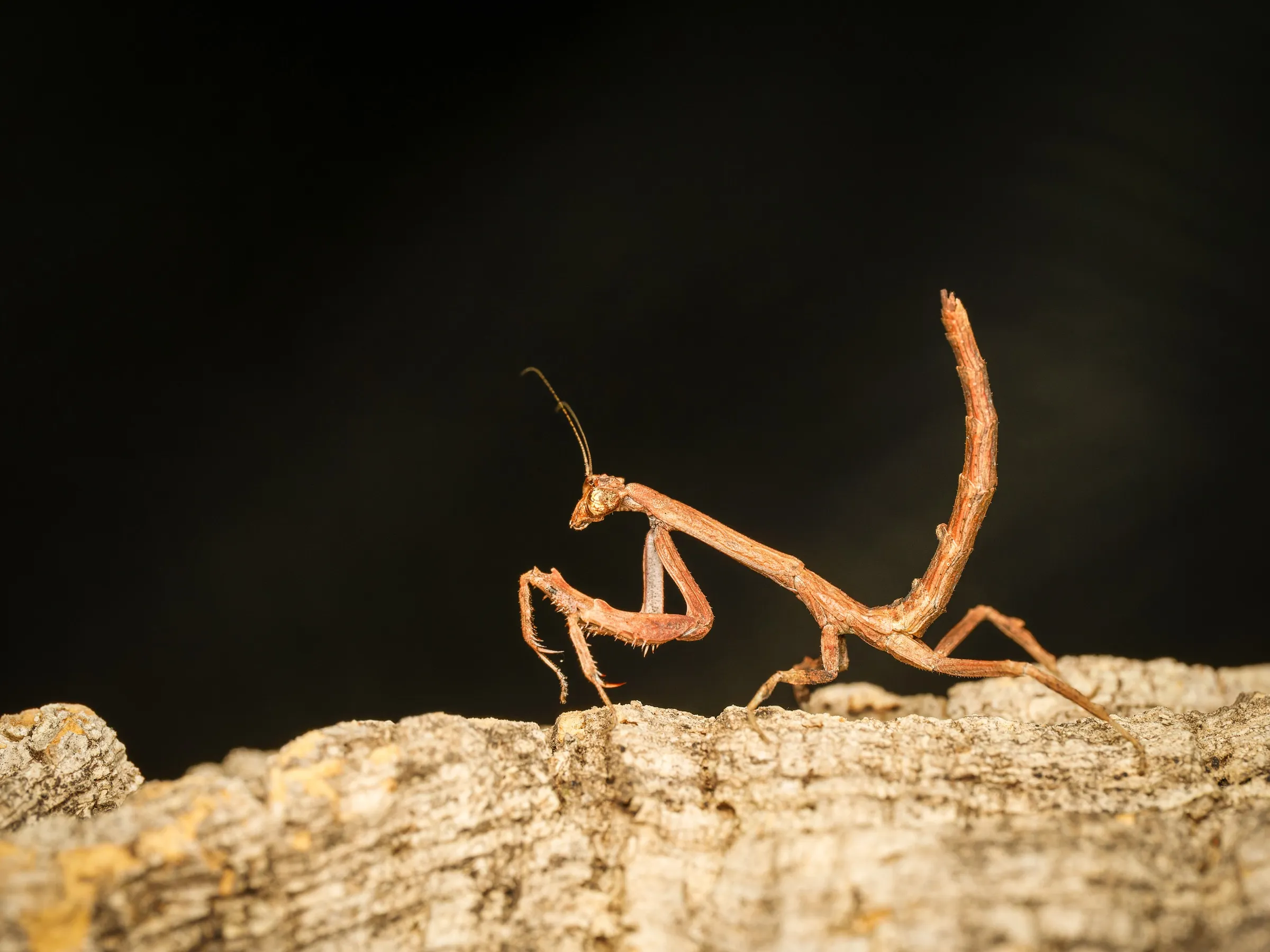
The African Twig Mantis (Popa spurca) is a bark-colored, twig-shaped praying mantis from the wooded savanna of sub-Saharan Africa and Madagascar. Adult females reach 7–8 cm and males 6–7 cm, and females live about 10–12 months, males 6–9. Caring for one is simple, which is why it is the species we hand to first-time keepers who are nervous about humidity and feeding, and it brings three traits a home keeper actually wants:
- Dry-air tolerant. 40–60% humidity, the range most homes sit in already. A light mist a few times a week for drinking water is the whole routine. New to the hobby? Start with our roundup of the best pet mantis for beginners.
- Food-aggressive. It stalks and chases prey instead of waiting for it, which removes the most common way a beginner's mantis dies: refusing to eat.
- Long-lived. Females run 10–12 months from hatch, males 6–9.
Hobby stock is generally attributed to the East African subspecies Popa spurca crassa. In the UK the same animal is sold as the African Stick Mantis. Same species, same care.
How big does an African Twig Mantis get?
Adult females reach 7–8 cm (about 3 in); males 6–7 cm (about 2.5 in). The size gap is modest, so build is the better tell. Females are stockier, carry three or four raised lobes along the top of the abdomen, and have short wings that cover about half of it, so they are effectively flightless. Males are slim, with full-length wings past the abdomen tip and longer antennae, and they fly.
How it defends itself
This is not a species that rears up and flares. Its first move is to become a twig: forelegs stretched straight forward in line with the body, pressed flat along the perch. Pushed further, it drops to the floor and lies motionless for a few minutes. Both are normal, and neither means it is hurt. If you find yours on the floor not moving, wait before you touch it; our guide to whether a mantis is dead or molting covers what to look for.
Not to be confused with
“Twig mantis” covers several unrelated species. Popa spurca is the medium-sized African one with the bark texture. The Giant African Twig Mantis is Neodanuria bolauana, a much longer animal with different care. Brunner’s stick mantis (Brunneria borealis), sometimes called the American twig mantis, is a slender native of the southern US. The Giant African Stick Mantis (Heterochaeta) is the tall one with the cat-like eyes. Some shops also list Popa spurca itself as a “Giant African Twig Mantis”, so check the scientific name before you buy. This guide covers Popa spurca only.
If you have never kept a mantis, this is the right starting point, and our getting started guide covers the gear. Move on to Orchids, Dead Leaves, or Spiny Flowers once you have raised an African Twig from nymph to adult.
Arrival and settling in
Nymphs from us arrive as healthy, established nymphs past the hatchling stage, in a ventilated deli cup with something to grip; the exact stage varies with each hatch. (Stages are written L1, L2, L3… for first, second, third instar. Some US keepers write i3 instead of L3; the numbers are the same.) Film the unboxing from the sealed box onward; it is the evidence for the live arrival guarantee, and our unboxing walkthrough shows the whole routine.
Enclosure
Nymphs tolerate each other when they are kept fed and evenly sized. We have held three L4s in one deli cup with dense prey and no losses, and the older US breeder sheets report the same for net cages. European breeders separate by L3 to L4 and report cannibalism, and the difference is almost always food: a hungry twig mantis will take a sibling. The working rule is groups are fine while every animal is well fed and similar in size; separate at the first size gap, at sub-adult, or the first time a feeding day slips. Adults live alone.
A deli cup for hatchlings, then two enclosures for the rest of its life. The rule behind the sizes: height at least two and a half times the mantis’s body length, three times if you have the choice, with at least twice its body length of clear drop below the perch, and width at least one and a half times, so it can hang and drop cleanly during a molt without its legs touching the walls.
| Instar | Height | What we use |
|---|---|---|
| L1–L2 | 16 OZ | A 16-oz deli cup with a mesh lid. Small on purpose, so a hatchling finds its fruit flies. |
| L3–L6 FIRST HALF | ~15 CM | Something about 15 cm (6 in) tall, like a 32-oz deli cup with a mesh lid or our medium enclosure (10×8.5×15 cm). An L6 is about 3.5 cm, so this still holds four body lengths of height at the end. |
| L7–adult SECOND HALF | ≥ 20 CM | At least 20 cm (8 in) tall, like our large enclosure (12×10×20 cm), which is the size the breeder sheet this species was raised on in the US hobby recommends for adults. An adult female is up to 8 cm, so 20 cm is her minimum and 30 cm (an 8×8×12 in) is the comfortable version if you have the room. |
Move up when the mantis is about a third of the enclosure’s height, which for this species is the molt into L7.
Substrate: dry coco fiber, paper towel, or a bare floor. This species evolved in dry scrub, and damp substrate is the one thing it does not forgive. Skip the bioactive build for this one. If you want a planted, moister setup for a different species, our bioactive terrarium guide and a culture of tropical white springtails are the place to start.
Decor: several thin, rough twigs of a width the mantis can wrap its feet around, some angled, at least one reaching the mesh lid. It camouflages by matching branch texture, so give it branches. Silk leaves are unnecessary; bark pieces are welcome. For the full build, see praying mantis terrarium setup.
Ventilation: a mesh top plus some side ventilation. Stale, damp air is behind most of the mould and mismolt problems in the issues list below.
Lighting: normal room light on a day-night cycle. No UV, no lamp.
Maintenance: swap the paper towel or spot-clean frass weekly, replace any twig that shows mould, and wipe condensation if you ever see it. You should not.
Temperature, humidity and water
Most homes hit this without any equipment. Days in the high 70s to low 80s with a drop into the high 60s at night is ideal and mirrors its home range.
If your room runs below 68°F, add a low-wattage heat source on a thermostat: a small mat on the side wall or a ceramic heat emitter above the mesh. They tolerate the mid 80s without stress.
They drink readily off droplets, and "dry-tolerant" has led more than one keeper to stop misting altogether. Mist lightly one to three times a week, aiming a few droplets at a perch or the wall in front of the mantis, and let everything dry out fully between. A fine misting bottle puts droplets where you want them without soaking the substrate. Young nymphs and incubating oothecae want the higher end of that range; adults the lower. Do not fog, do not keep the substrate damp, and never spray a mantis that is molting.
Diet and feeding
Will take almost anything alive that fits in the strike zone, and will go and get it:
| Instar | Feeder | Amount | Frequency |
|---|---|---|---|
| L1–L2 | D. melanogaster fruit flies | 4–6 | every 1–2 days (keep a few present) |
| L3–L4 | D. hydei fruit flies, small house flies | 4–6 | every 2 days |
| L5–L6 | House flies, green bottle flies, small dubia nymphs; blue bottles from L6 | 2–3 | every 2–3 days |
| L7+ / Adult | Bottle flies, moths, medium dubia | 1–2 | every 3–4 days |
L5–L6Green bottles are the easy upgrade at this size, blue bottles from L6, and hatching blue bottle spikes takes a few days and no skill.
ADULTAdult males eat noticeably less than females.
Keep prey to no more than a third of the mantis's body length. The species above are what we feed, but you'll meet feeders we haven't named: an oversized dubia, a house fly, whatever the shop had. Size is what decides whether it's safe, not what it is. Err smaller: a too-small prey item is a non-event, a too-large one risks injury. Wild-caught insects are the exception: skip them entirely, whatever the size. A moth off the porch light can carry pesticide, and there is no way to tell by looking. Our feeding guide has the sizes worked out centimetre by centimetre.
Active hunters: they stalk and chase, and will take on prey larger than they should, which is exactly why overfeeding is the risk with this species. The abdomen is slim by design. When it looks tight and swollen, skip the next two feedings. A fruit fly culture on hand keeps the schedule honest, and our culture care guide shows how to keep one producing for a month or more.
Remove uneaten feeders the same day, and always before a molt.
Lifecycle and molting
Females reach adulthood after 7–8 molts (adult around L8–L9), males one fewer; breeder counts differ by one or two, and males always mature a stage ahead. Nymph development takes about 4–6 months in a warm room and can stretch toward 10 in a cool one. Adults then live about 4–6 months (females) or 1.5–3 months (males), which puts total lifespan at roughly 10–12 months for a female and 6–9 for a male. The one captive-rearing study of the species (Greyvenstein et al., 2021) measured a mean lifespan of 332 days, about 11 months. For how this stacks up against other species, see praying mantis lifespan by species.
African Twig Mantis lifespan at a glance
Hatch to adult is a molt every 2–3 weeks with a longer wait before the final one.
What a nymph actually looks like
Fresh hatchlings are 6–8 mm and near black. By L3 they are brown, twig-textured, and already hold the forelegs straight out in the twig pose. Wing buds show at sub-adult and swell just before the final molt.
- Refusing prey 24+ hours
- Hanging upside-down for hours without moving
- A dull or slightly darker look
- Swollen wing buds at sub-adult
General mantis behaviour rather than anything specific to this species.
After any molt, hands off until it has hardened (moving normally, gripping firmly, colour back up). That’s about 24 hours for a nymph and 48 hours or more for an adult, and no food until then.
Molts are reliable in this species when the setup is right. When they fail, the causes we see, in order:
- Not enough hanging height.
- An enclosure kept too wet for too long (the species-specific one).
- A live feeder left in during premolt.
- Smooth perches it cannot grip.
Dry air on its own is rarely the problem, but a thirsty mantis molts badly, so keep the droplets coming. If you do run into trouble, our guide to praying mantis molting problems walks through the fixes.
Sexing
Reliable from about L4, earlier with a practised eye. Count from the underside.
Let the nymph walk onto the enclosure wall or into a clear cup and look at the abdomen from below. Count the plates from the tip toward the legs. Females show 6 and the last one is a single large keel-shaped segment. Males show 8, ending in several small ones.
A well-fed male and a young adult female overlap. The lobes and the wing length are the clearer tells at adult, the segment count before that.
Breeding
One of the easiest species to breed, and a single mating fertilises every ootheca (egg case) the female will lay.
- Wait 2–3 weeks after the final molt. Males are ready at 10–14 days, females at 14–21.
- Feed the female well the day before, and again just before, so she is busy.
- Introduce the male into her enclosure (10×10×12 in or larger). She is sedentary; if he does not notice her, nudge her so she moves.
- Connection can take minutes to hours; pairing then lasts several hours.
- Separate afterward. Cannibalism risk is low to moderate, and a backup male is cheap insurance.
The first ootheca comes a few days to three weeks after mating, then roughly every 2–4 weeks: 3–6 across a full adult life, occasionally 8. Each is a flat grey-brown case about 1.5–2 cm long glued to a twig, and hatches 60–100 nymphs (up to about 150) after 4–6 weeks at 75–85°F.
Oothecae are the one thing this species wants kept moister: mist the ooth every one to two days with ventilation, and call it infertile only after eight weeks. Our praying mantis ootheca guide covers incubation setups.
An unmated female lays too. Her oothecae are infertile. Remove them and nothing happens.
Plan for the hatch before it happens: a producing melanogaster culture started two weeks before the due date, a 32-oz cup with a mesh lid, and a plan for a hundred mouths that all need feeding within a day or two of emerging. What baby praying mantises eat covers the first weeks, and how we breed praying mantises is the routine we run ourselves.
Want an African Twig Mantis? We breed Popa spurca year-round in Las Vegas and ship captive-bred nymphs Priority Overnight. See availability, or join the waitlist →
Common issues
Symptom, likely cause, fix. Most of these trace back to one of two habits: keeping the species too wet, or feeding it too much.
Frequently Asked Questions
Do African Twig Mantises have molting problems?
Rarely. Their tolerance for a wide humidity range is exactly why they molt so reliably and make such a forgiving first mantis. Cover the basics (height at least 2.5× body length, something textured to hang from, no feeders left in, an enclosure that is not sitting damp) and molts are usually uneventful. If one does stick, the fixes are in our molting guide.
Why is the African Twig such a forgiving first mantis?
The combination of dry-air tolerance, a broad temperature range, a diet of almost anything that moves, and a lifespan close to a year for females. That combination is why it’s the species we hand to nervous first-time keepers.
How long do African Twig Mantises live?
Females live about 10–12 months from hatch, males about 6–9. The difference is almost entirely in the adult stage: a female lives 4–6 months after her final molt, a male about 1.5–3.
My African Twig Mantis fell and isn’t moving. Is it dead?
Almost certainly not. Freezing as a twig is its first defence and dropping to lie still is the next. Leave it alone for a few minutes and it will right itself and climb. A mantis that stays limp for an hour, or is hanging by one leg after a molt, is a different matter; run through the checks in our guide to whether a mantis is dead or molting.
How do I tell if my African Twig Mantis is male or female?
Count the plates on the underside of the abdomen from L4 onward: 6 for a female, 8 for a male. At adult it is easier still. Females have short wings that cover about half the abdomen and large lobes along its top; males have wings past the abdomen tip, longer antennae, and a slim build.
Will it bite me? Can I handle it?
Mantises don’t really bite; they grab with the front legs. P. spurca is fast and food-aggressive, so a finger that smells like prey can get grabbed, and it is harmless. For handling, let it walk onto an open hand rather than picking it up, wash your hands first, and keep adult males over the enclosure because they fly.
Can I keep multiple African Twigs together?
As nymphs, yes, if they are kept fed and similar in size; we have done it through L4 without losses. Separate at the first size gap or by sub-adult. Adults live alone: mature females will take a male or a smaller female given the chance.
Can African Twig Mantises fly?
Adult males can; adult females can’t, because their wings only cover about half the abdomen. Handle a male over his enclosure.
Is the African Twig Mantis poisonous?
No. No praying mantis is venomous or poisonous to people. A hungry one may grab a finger that smells like food, which is harmless.
Popa spurca vs Ghost Mantis: which should I start with?
Both are excellent beginner species. Ghost is communal-tolerant, prefers slightly higher humidity, and has the more striking leaf-mimic look. African Twig is drier-tolerant and more food-aggressive. A Ghost female outlives a Twig by several months. If your home is dry or you worry about feeding, start with the African Twig. If you want a small group in one enclosure, start with Ghosts. Many keepers end up with one of each.
Where can I buy an African Twig Mantis, and what does it cost?
We breed Popa spurca in Las Vegas and ship captive-bred, established nymphs Priority Overnight to most US states; checkout will tell you if yours is one we can’t ship to. The shop listing shows the live price and stock, and takes waitlist sign-ups when we’re between hatches. For what mantises cost in general and why, see how much a praying mantis costs.