


How long do praying mantises live?
Most praying mantis species live 6-12 months from hatching to natural death; Ghost and Double Shield females reach 18. Females consistently outlive males, often by several months. The exact lifespan depends heavily on species, temperature, feeding frequency, and sex, with larger species and cooler temperatures generally producing longer lives.
Lifespan comparison by species
Here’s the breakdown for the six species we breed at LOBO//MANTIS:
| Species | Total Lifespan | Female Lifespan | Male Lifespan | Instars (Female/Male) | Adult Lifespan |
|---|---|---|---|---|---|
| Orchid Mantis | 5-10 months | 8-10 months | ~5 months | 9/7 | 5-6 mo (F) / 2-3 mo (M) |
| Ghost Mantis | 8-18 months | 12-18 months | 8-12 months | 7/6 | 6-12 mo (F) / 2-6 mo (M) |
| Spiny Flower Mantis | 8-11 months | 9-11 months | 8-9 months | 8/7 | 4-6 mo (F) / 3-4 mo (M) |
| Dead Leaf Mantis | 8-13 months | 10-13 months | 8-10 months | 8/7 | 4-6 mo (F) / 2-3 mo (M) |
| African Twig Mantis | 6-12 months | 10-12 months | 6-9 months | 8/7 | 4-6 mo (F) / 2-4 mo (M) |
| Double Shield Mantis | 12-18 months | 14-18 months | 12-14 months | 9/8 | 6-9 months |
| Giant Asian Mantis (Hierodula membranacea), reference, not bred here | 10-18 months | 12-18 months | 8-12 months | 9/8 | 4-6 months |
| Chinese Mantis (Tenodera sinensis), reference, not bred here | 6-8 months (one season) | n/a | n/a | n/a | a few weeks to about two months |
A few standouts worth noting: Double Shield Mantis has the longest typical lifespan of any species we work with, 12 months is typical, and well-kept females can reach 18. A Ghost female matches that ceiling: 12-18 months, while Ghost males run 8-12. We’ve included the Giant Asian Mantis as a reference row because it’s the species keepers most often ask us to compare against. It’s one of the longer-lived large mantises, though we don’t breed it. On the other end, Orchid Mantis males have the shortest adult phase, about 2-3 months after their final molt, against 5-6 for a female. This is relevant if you’re planning to breed, because males mature four to eight weeks before females and the pairing window is tight. The wild North American species people ask about, the Chinese, European and Carolina mantis, live a single season; the Chinese mantis, for example, hatches in spring and dies in fall. (If you’re still choosing your first mantis, our praying mantis buying guide walks through what to look for.)
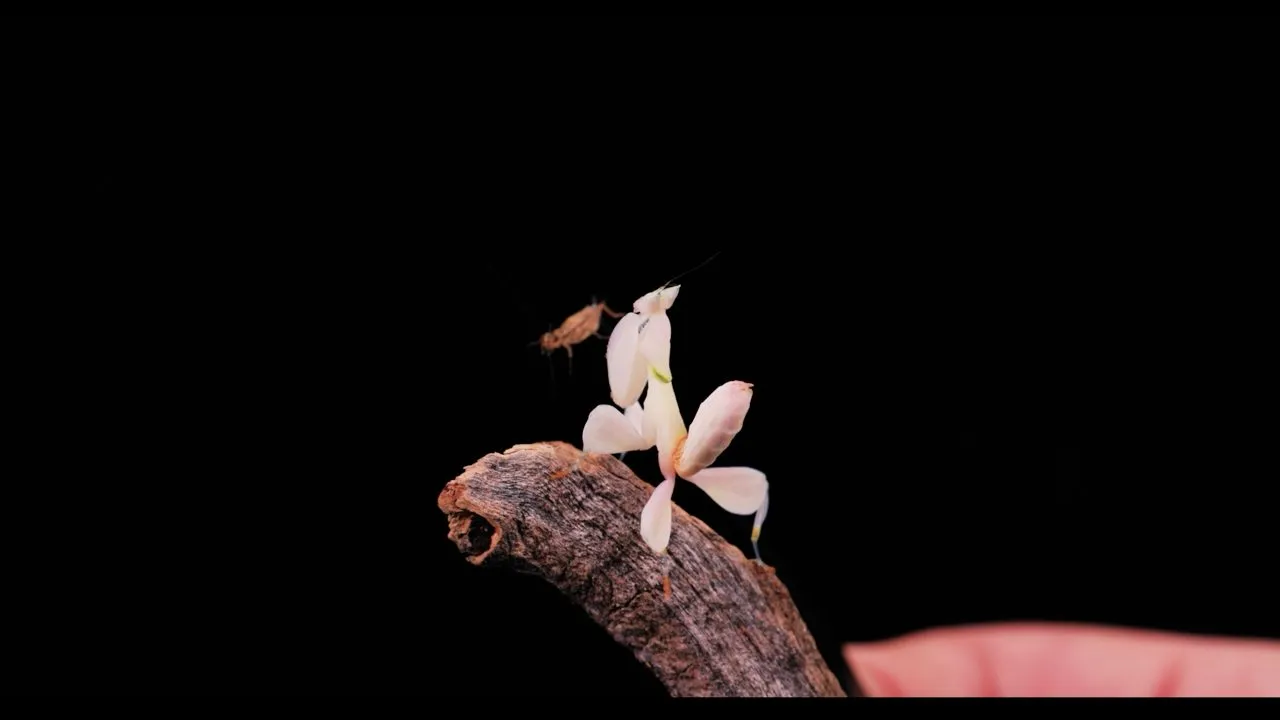
Orchid mantis lifespan: 5-10 months
An orchid mantis female lives 8-10 months from hatch; a male about 5, roughly half as long, with nearly all of the difference coming after the final molt. See the Orchid Mantis care sheet for husbandry.
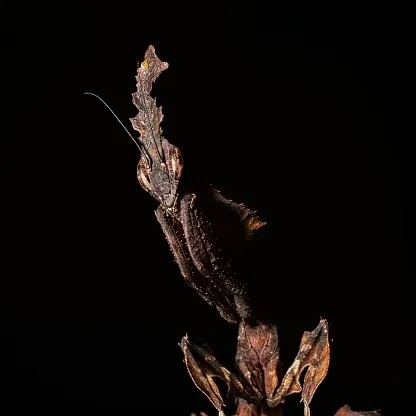
Ghost mantis lifespan: 8-18 months
Ghost mantis females run 12-18 months from hatch and males 8-12. It’s the ghost female, alongside the double shield, that sets the 18-month ceiling for anything we breed. See the Ghost Mantis care sheet.
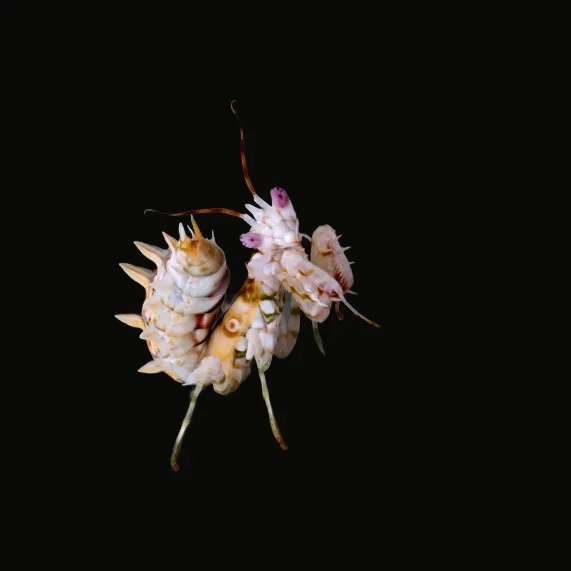
Spiny flower mantis lifespan: 8-11 months
A spiny flower mantis lives around 8-11 months, females toward the longer end and males shorter. Both sexes spend a similar few months as nymphs, so most of the difference shows up in the adult stage. See the Spiny Flower Mantis care sheet.
Dead leaf mantis lifespan: 8-13 months
Dead leaf mantis lifespan runs about 8-13 months, with females at the longer end and males shorter. It’s a slow developer, 5-7 months as a nymph, so most of its life is spent growing before a comparatively brief adult stage. See the Dead Leaf Mantis care sheet.
African twig mantis lifespan: 6-12 months
An African twig mantis female lives 10-12 months and a male 6-9. Nymph development stretches from 3 to 6 months with room temperature, which is the main reason the range is so wide. See the African Twig Mantis care sheet.
Double shield mantis lifespan: 12-18 months
Double shield mantises live 12-18 months from hatch, the longest of any species we keep, with an adult stage of 6-9 months on its own. Females sit at the 14-18 month end and males at 12-14. See the Double Shield Mantis care sheet.
Why mantises live short lives at all
Mantises are hemimetabolous insects. They hatch, molt through a series of instars, reach adulthood, reproduce, and die. That’s the entire biological program. There’s no “old age” phase, once a mantis reaches its final molt, the clock is ticking toward the end of its lifecycle.
This isn’t a flaw. It’s how the animal evolved. In the wild, most mantises don’t even make it to adulthood, predation, weather, and failed molts take out the majority. The ones that reach maturity have one job: make more mantises.
In captivity, we remove most of those threats. Your mantis won’t get eaten by a bird. It won’t freeze. It won’t starve. But we can’t rewrite the biological program. A well-kept mantis lives its full natural lifespan, it just does so in your enclosure instead of on a branch in the wild.
Why females live longer than males
This isn’t just a minor difference, it’s a consistent pattern across all mantis species. Female mantises live longer for three overlapping reasons:
More instars. Females go through more molts than males before reaching adulthood. Each additional instar adds time to their development. An Orchid Mantis female molts about 8 times (adult around L9) versus 6 for males (adult around L7). That’s an additional growth period.
Larger body mass. More instars means larger adult size, and larger mantises simply have more metabolic reserves. A female Orchid Mantis is more than twice the size of the male.
Reproductive investment. Females need to stay alive long enough to produce oothecae (egg cases) after mating. Evolution has selected for longer female lifespans because dead females produce no offspring. Males only need to survive long enough to mate, and they often don’t survive much beyond that.
What affects praying mantis lifespan
Beyond species and sex, several factors within your control influence how long your mantis lives.
Temperature
This is the single biggest environmental factor. Mantises are ectotherms, their metabolism runs on ambient temperature. Warmer temperatures speed up their metabolism, which means faster growth, faster molting, and a shorter total lifespan.
Keeping a mantis at the high end of its temperature range (say, 85F for a species that tolerates 75-85F) will push it through its instars faster and shorten its life. Keeping it at the low-moderate end (75F) slows development and extends total lifespan by weeks or even months.
This is not a trick to make them “live longer”, it’s a trade-off. Slower development means slower growth and longer wait times between molts. But if you want to maximize time with your mantis, running slightly cooler (within the safe range) is the lever you have.
Check the species-specific care guide for recommended temperature ranges: Orchid Mantis care, Ghost Mantis care, Spiny Flower Mantis care, Dead Leaf Mantis care, African Twig Mantis care, Double Shield Mantis care.
Feeding frequency
Overfeeding accelerates growth, and in adults it shortens life. Young nymphs genuinely need frequent food, starving a small nymph to “slow it down” just kills it, but an adult fed every day burns out sooner. Overfeeding also shows up in males, who can rush through their instars in a fraction of the time if kept warm and stuffed.
The schedule I use: L1–L2 get 4–6 melanogaster every 1–2 days with a few always present, L3–L4 a feeding every 2 days, L5–L6 every 2–3 days, and adults 1–2 prey items every 3–4 days. That mimics a more natural feeding rhythm and produces healthier, longer-lived animals. If you’re new to keeping mantises, start with our getting started care guide for the husbandry fundamentals. An overfed female will produce more oothecae but may burn out faster. An overfed male will mature weeks ahead of females from the same clutch, creating breeding timing problems.
Species genetics
Some species are simply longer-lived regardless of conditions. Double Shield Mantis is the marathon runner of the mantis world, it grows slowly, molts more times, and takes its time reaching adulthood. It’s ideal if you want a pet mantis that sticks around. It sits mid-list in our best pet mantis for beginners guide only because it’s less forgiving of inconsistency, the lifespan is the reason to pick it anyway.
Orchid Mantis, particularly males, are sprinters. They mature fast, they’re small, and their clock is ticking from the moment they reach adulthood. This doesn’t make them bad pets, it means you should know what you’re signing up for.
Mismolts and injury
A significant number of captive mantises die from molting complications rather than old age. A bad molt, caused by low humidity, inadequate perching surfaces, disturbance during molting, or genetic factors, can be fatal or leave a mantis unable to hunt.
Proper husbandry dramatically reduces mismolt risk. Maintaining appropriate humidity, providing textured surfaces for gripping, and never disturbing a molting mantis are the basics. See our molting problems guide for the full breakdown.
Life stages and what to expect
Understanding the timeline helps you know what’s coming:
L1-L3 (weeks 1-6): Rapid growth, frequent molts (every 7-14 days), tiny size, fruit fly feeders. This is the most vulnerable period. In the wild, the vast majority of nymphs die before reaching adulthood.
L4-L6 (weeks 6-14): Growth slows slightly, molts space out to every 2-3 weeks. The mantis is establishing its adult shape and coloration begins to show. Feeders move up to house flies and small prey.
L7-adult molt (weeks 14-24): The final instars. Sub-adult mantises develop wing buds visible through the exoskeleton. The final molt produces wings (in winged species) and marks sexual maturity.
Adult phase (the final 2-12 months, depending on species and sex): No more molting. The clock is now fixed. Females will mate and produce oothecae. Males will actively seek mates. This is when the sex-based lifespan difference becomes dramatic, males decline noticeably within weeks of their final molt, while females remain active and hunting for months.
Maximizing your mantis’ lifespan
If you want the longest possible relationship with your mantis:
- Choose a long-lived species. Double Shield or a female Ghost give you the most time, with Dead Leaf next.
- Choose a female. Across the species we breed, females live markedly longer than males, often half again as long or more.
- Keep temperatures moderate. Don’t cook them at maximum heat. Stay in the middle of the acceptable range.
- Feed consistently but don’t overfeed adults. Keep young nymphs fed (every 1-2 days), L3–L4 every 2 days, L5–L6 every 2-3 days, adults every 3-4.
- Prevent mismolts. Proper humidity, good perching surfaces, zero disturbance during molts.
Even with perfect care, a mantis is a short-lived pet. Here’s what I tell every new keeper: a praying mantis is not a long-term companion. It’s a front-row seat to an entire life cycle. You watch it grow from something the size of a grain of rice into a full predator with a personality. You see every molt, every hunt, every threat display. You get the whole arc in about a year.
Some people find that hard. I get it. But most keepers I talk to in our Discord say the opposite, the short lifespan makes you pay attention. You don’t take a single molt for granted. You photograph more. You notice more. And when it’s over, you know exactly what you’re signing up for with the next one.
Browse our available species to find your next mantis, and check the individual care guides for species-specific husbandry that supports a healthy, full lifespan.
Frequently Asked Questions
How long do praying mantises live in captivity?
Most captive praying mantises live 6-12 months from hatch to natural death. Species sets the range: an orchid mantis male may only reach about 5 months, while a ghost or double shield female can reach 18. If you want the most time with one animal, choose a female ghost or double shield.
How long do female praying mantises live?
Female praying mantises live 8-18 months depending on species, from about 8-10 months for an orchid up to 18 for a ghost or double shield. They molt more times than males, grow larger, and must live long enough to lay oothecae, which is why the female is the longer-lived sex in every species.
How long do male praying mantises live?
Male praying mantises live less than females of the same species, often only a few months as adults. An orchid male is the shortest at about 5 months total; a ghost male gets 2-6 months after his final molt against 6-12 for a female. The adult stage is where males lose ground.
How long do praying mantises live in the wild?
Wild mantises in the United States live a single season. The Chinese mantis, for example, hatches in spring and dies in fall, roughly 6-8 months in all, and only the final few weeks to two months of that are spent as a winged adult. Most wild nymphs never reach adulthood.
How long does a praying mantis live after its final molt?
A praying mantis lives 2-12 months after its final molt, depending on species and sex. Females get the longer adult stage: 5-6 months for an orchid, 6-12 for a ghost. Males decline sooner. The double shield adult stage runs 6-9 months.