

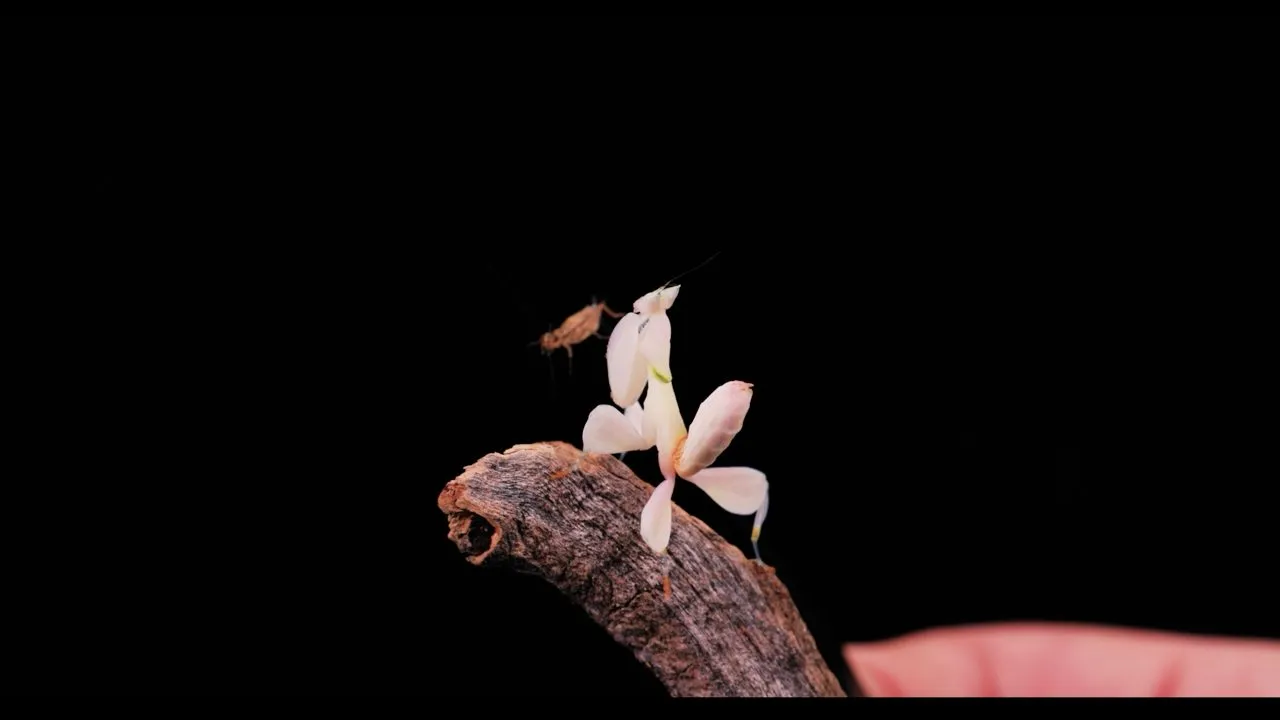
Overview
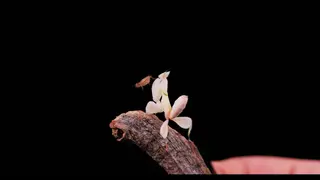
The Orchid Mantis (Hymenopus coronatus) is the species that converts photographers into mantis keepers. Native to the lowland rainforests of Southeast Asia (Malaysia, Thailand, Indonesia and neighboring countries), H. coronatus has evolved petal-shaped leg lobes and pink-and-white coloration that mimic an orchid blossom. Pollinators sometimes land directly on the mantis, mistaking it for a flower.
Two things make this species famous: its appearance and the extreme sexual dimorphism. Adult females reach 6–7 cm with the full petal silhouette and shifting white-pink-yellow coloration. Adult males are tiny (about 2.5 cm) and look like a different species entirely (slim, brown-mottled, fast). First-time keepers often think they were sent the wrong animal when their L5+ male emerges from a molt.
Care lands at the Intermediate level. Daily husbandry isn’t hard, but Orchids are less forgiving of mistakes than Ghost or African Twig mantises: they’re humidity-sensitive and strongly prefer fluttering prey, so the margin for error is narrower than a true beginner species. The genuinely hard part is breeding a pair, not keeping one alive. Not a first mantis, but well within reach of a careful second or third.
What a nymph actually looks like
If you’re buying a nymph, it will not look like the photos. L1 Orchids are red-orange with a black head and black legs. Researchers think they mimic foul-tasting true bugs such as assassin bugs, not pink-and-white flowers. The famous colouring arrives gradually over the next few molts. Nothing has gone wrong and you weren’t sent the wrong animal.
Enclosure
Single-animal housing only. Communal setups fail with this species; separate by L2 at the latest.
The rule behind the sizes: total height at least 2.5× the mantis’s body length, 3× if you have the choice, with at least 2× clear drop below the perch; width at least 1.5×, so it can hang upside-down to molt without hitting substrate. Move up when the mantis is about a third of the enclosure’s height.
By instar:
| Instar | Height | What we use |
|---|---|---|
| L1–L2 | 16 oz | A 16-oz deli cup with a mesh lid. Small on purpose, so a hatchling finds its fruit flies. |
| L3–L6 | ~15 cm | Something about 15 cm (6 in) tall, like a 32-oz deli cup with a mesh lid or our medium enclosure (10×8.5×15 cm). |
| L7–adult | ≥ 20 cm | At least 20 cm (8 in) tall, like our large enclosure (12×10×20 cm). An adult female is 6–7 cm, so 20 cm clears 3×; 30 cm (an 8×8×12 in) is the roomy version. A 2.5 cm adult male is fine staying in the medium. |
Ventilation is critical. Use a mesh top or screen vents on at least two opposing walls. Stagnant air is the leading cause of fungal issues in Orchids.
Substrate: a 1-inch layer of moistened coco fiber or sphagnum moss works well. It buffers humidity without being damp.
Decor: one or two artificial silk flowers + a couple of climbing twigs. Real plants are pretty but raise pest risk.
Temperature & humidity
Heating: a warm room (mid-70s°F) is enough; most homes need a low-wattage CHE on a thermostat to hold that in winter. Use a ceramic heat emitter above the mesh, or a small mat on a side wall (never underneath, never unregulated). No heat lamps on plastic, no UV. Keep nights at or above 72°F. This is a tropical species.
Humidity: mist the enclosure walls heavily once a day, light second misting if conditions are very dry. Nymphs drink the droplets; adults drink less but still benefit. Don’t aim mist directly at the mantis.
A digital hygrometer/thermometer combo is non-negotiable. Eyeballing humidity in this species ends with deaths.
Diet & feeding
Orchid Mantises strongly prefer flying, fluttering prey: flies and moths are the staple and draw the fastest strike. They’ll take other feeders too, but we don’t feed crickets to any of our mantises (see why). Plan your feeder progression:
| Instar | Feeder | Amount | Frequency |
|---|---|---|---|
| L1–L2 | Melanogaster fruit flies (small flightless) | 4–6 | every 1–2 days (keep a few present) |
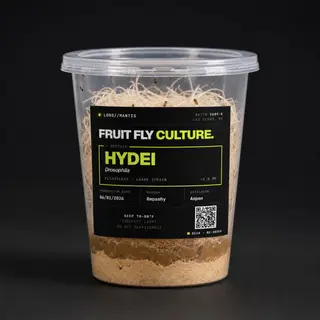
| L3–L4 | Hydei fruit flies (larger) | 4–6 | every 2 days |
| L5–L6 | Houseflies, green bottle flies; blue bottles from L6 | 2–3 | every 2–3 days |
| L7+ / Adult | Bottle flies, moths, occasionally a hornworm | 1–2 | every 3–4 days (gravid ♀ every 2–3) |
Keep prey to no more than a third of the mantis's body length at any stage, and skip wild-caught insects entirely. A moth off the porch light can carry pesticide, and there is no way to tell by looking.
Signs of a well-fed mantis: rounded abdomen, active stalking when prey appears. Signs of overfeeding: distended abdomen, lethargy, refusal of prey. Stop feeding the moment you suspect premolt. Refusal is the strongest signal.
Lifecycle & molting
Females typically molt 8 times (adult around L9), males 6 (adult around L7). From the L2–L3 nymph you receive, a female reaches adult in about 3–4 months (about 8 molts from hatch), a male in about 1.5–2 months (about 6 molts); count from hatch and add two to four weeks. Cooler rooms stretch all of it. Adults then live about 5–6 months (females) or 2–3 months (males), for a total lifespan of roughly 8–10 months and 5 months respectively.
- Refusing prey 24 h+ alongside stillness
- Hanging upside-down from a perch and staying still
- Color shift (Orchids often become noticeably paler before a molt)
- Abdomen pulled close to the body
The premolt fast runs 2–7 days for nymphs (longer at later instars) and 1–2+ weeks before the final adult molt. Through premolt, raise wall-misting slightly and hold humidity steady at the top of the 60–80% range; never spray the mantis, no sudden spike.
A molting Orchid is fragile. After any molt, hands off until it has hardened (moving normally, gripping firmly, colour back up). That's about 24 hours for a nymph and 48 hours or more for an adult; the new exoskeleton is still soft and any misshape set during this window is permanent in an adult.
No food until then either: even flies can damage a soft mantis, so remove everything. It won’t be hunting yet anyway. When it’s hardened, make the first meal slightly smaller than usual.
If a molt fails (mantis stuck in old skin, twisted limbs), it’s usually due to insufficient humidity or insufficient hanging height. Survival is possible if the mantis can still feed, but expect cosmetic damage. For diagnosing and preventing bad molts, see our guide to praying mantis molting problems.
Sexing
By L4 you can usually sex a healthy Orchid:
Abdomen shows 6 visible segments from below, broader and stockier overall. Wing buds emerge larger at L5–L6.
Abdomen shows 8 visible segments from below, slimmer and faster, longer antennae proportionally. By L5 the size difference is unmistakable.
Misidentification is costly because males mature four to eight weeks before females, which matters if you’re pairing: you need to know which is which early enough to stagger them.
Breeding
Pair a female at least 2 weeks after her final molt (3–4 weeks is safer); males are ready about a week after theirs. Females must be well-fed before introduction or they will eat the male. (They may eat him anyway, so keep a backup male.)
Procedure:
- Place the female in a roomy enclosure first; let her settle.
- Feed her a substantial prey item.
- Introduce the male from behind her, on the same perch, slowly.
- The male will mount within minutes to hours. Pairing lasts 4–24 hours.
- Separate after.
Females lay 1–4 ootheca over the following 2–3 months. Kept at about 80°F (77–85°F) and 70–80% humidity, each ootheca hatches in 4–6 weeks and yields 30–80 nymphs.
Ready to buy an Orchid Mantis? We breed Hymenopus coronatus year-round in Las Vegas. See current availability →
Common issues
Frequently Asked Questions
My Orchid Mantis is stuck in a molt / keeps mismolting. What’s wrong?
Orchids are the most molt-sensitive species we sell, and nearly every failed molt traces to humidity, either too low or swinging up and down. Hold 60–80% and keep it stable, easing toward the top of that range as premolt starts, and make sure the mantis is drinking (droplets on the walls) so it goes into the molt hydrated. Mist the enclosure walls, never the mantis. If one is already stuck, raise the ambient humidity around it and wait. Don’t spray it, dip it, or pull the old skin. Full walkthrough in our molting guide.
How long do Orchid Mantises live?
Females live about 8–10 months from hatch, males about 5; the difference is the adult stage, 5–6 months for a female against 2–3 for a male.
Can I keep Orchid Mantises with other animals?
No. Solo housing only. Separate by L2 at the latest. Left together past that, they eat each other reliably.
Can I handle an Orchid Mantis?
Best not. Orchids bolt, adult males fly, and females strike at fingers near the face. Mantises don’t bite in any meaningful sense (they grab with the front legs), and a big adult female can give a sharp pinch that occasionally nicks skin; no venom, no danger. This is a species to observe rather than hold.
Why is my male Orchid so much smaller?
Sexual dimorphism is extreme in this species. A 2.5 cm brown-mottled adult male and a 7 cm pink-petaled adult female are the same species. That’s how nature designed them.
My Orchid won’t drink mist droplets. Is that a problem?
Some individuals sip from substrate or perches instead. As long as humidity is 60%+ and the mantis is feeding, it’s getting enough water.
Do I need supplemental lighting?
Not for the mantis. Indirect ambient room light is fine. If you keep live plants, sure. Otherwise, skip it.