



Overview
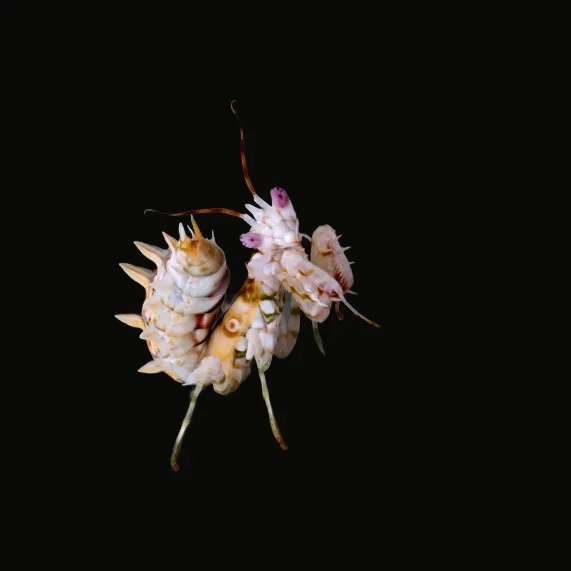
The Spiny Flower Mantis (Pseudocreobotra wahlbergii) is a small flower mantis from East and southern Africa, where it waits on flowering bushes to ambush the insects that visit them. Adult females reach 4–5 cm and males 3–4 cm; females live about 9–12 months and males 6–9. When threatened, an adult throws its wings open to show two large spiral eyespots, a black-outlined spiral on each forewing (each roughly a “6”) that reads as the eyes of a much larger animal.
How often it displays varies from one animal to the next: some flash it at every approach, others almost never. Many keepers consider it the best part of the species.
Husbandry is beginner-friendly if you respect one quirk: Spiny Flowers come from a drier biome than most exotic mantises and prefer 40–60% humidity. Soak this species and it gets fungal infections fast. Otherwise it’s an easy keep.
What a nymph actually looks like
L1–L3 nymphs are glossy black and ant-like. No spiral eyespot, none of the cream and yellow: the entire reason most people buy this species is invisible for the first few molts. The eyespots develop as the mantis grows and are unmistakable by mid-instars. A black nymph in the cup is exactly what you ordered.
Not to be confused with
One close relative shares the name. Pseudocreobotra ocellata, from West and Central Africa, is also sold as a spiny flower mantis and looks almost the same. The US hobby keeps P. wahlbergii (sometimes spelled wahlbergi), and where the animal came from is the surest way to tell them apart. Searching for a “spiny orchid mantis”? The Orchid Mantis (Hymenopus coronatus) has petal-shaped lobes on its legs and no spiral eyespots; the one with thorn-like spines on its body and the eyespot display is this species.
Enclosure
Solo housing only. Cannibalism is severe in this species.
The rule behind the sizes: total height at least 2.5× the mantis’s body length, 3× if you have the choice, with at least 2× clear drop below the perch; width at least 1.5×. Move up when the mantis is about a third of the enclosure’s height.
| Instar | Height | What we use |
|---|---|---|
| L1–L2 | 16 OZ | A 16-oz deli cup with a mesh lid and dry coco fiber substrate. Small on purpose, so a hatchling finds its fruit flies. |
| L3–L6 | ~15 CM | Something about 15 cm (6 in) tall, like a 32-oz deli cup with a mesh lid or our medium enclosure (10×8.5×15 cm). |
| L7–adult | ≥ 20 CM | At least 20 cm (8 in) tall, like our large enclosure (12×10×20 cm). An adult female is about 5 cm, so 20 cm is comfortably past 3×; 30 cm (an 8×8×12 in) is the roomy version. |
Mesh top + at least one screened side wall for ventilation. Stagnant air is more dangerous to Spiny Flowers than to wetter-biome species: it traps humidity that this mantis didn't evolve for.
Decor: silk flowers (especially yellow/black mimicking the threat display), thin twigs for perching, cork bark. For a full walkthrough of substrate, ventilation, and decor, see our praying mantis terrarium setup guide.
Temperature & humidity
Heating: most homes need a little help to reach the high 70s. If the room runs cold, use a low-wattage heat source on a thermostat: a ceramic heat emitter above the mesh, or a small mat on a side wall (never underneath, never unregulated). No heat lamps on plastic, no UV. Keep nights at or above 68°F.
This is the make-or-break. Light mist every other day, not daily. The substrate should look mostly dry between mistings. Never let the substrate stay damp for more than 24 hours.
Keep misting even in a humid room. Those droplets are how the mantis drinks: it takes water off the mesh and foliage, not from a dish. If your room already sits above 65% RH, mist lightly enough to leave droplets without wetting the substrate, and open up the ventilation instead.
A digital hygrometer is essential.
Diet & feeding
Flies are the staple at every stage, moths are welcome, and ours also take small dubia roaches. It’s a sit-and-wait hunter, so if a meal goes ignored, offer it from tweezers in front of the mantis. We don’t feed crickets to any of our mantises (see why):
| Instar | Feeder | Amount | Frequency |
|---|---|---|---|
| L1–L2 | Melanogaster fruit flies | 4–6 | every 1–2 days (keep a few present) |
| L3–L4 | Hydei fruit flies | 4–6 | every 2 days |
| L5–L6 | Houseflies, green bottle flies; blue bottles from L6 | 2–3 | every 2–3 days |
| L7–L8 / Adult | Bottle flies, moths, small dubia roaches | 1–2 | every 3–4 days (gravid ♀ every 2–3) |
Keep prey to no more than a third of the mantis's body length. The species above are what we feed, but you'll meet feeders we haven't named: an oversized dubia, a house fly, whatever the shop had. Size is what decides whether it's safe, not what it is. Err smaller: a too-small prey item is a non-event, a too-large one risks injury. Wild-caught insects are the exception: skip them entirely, whatever the size. A moth off the porch light can carry pesticide, and there is no way to tell by looking. Our feeding guide has the sizes worked out centimetre by centimetre.
Rotate feeders for variety. This species isn’t fussy about what it takes.
Lifecycle & molting
Females reach maturity after 7 molts (adult at L8), males after 6 (adult at L7), usually a few weeks sooner. Nymph time runs about 3–4 months at 80°F, then an adult stage of about 6–8 months for females and 3–5 for males: roughly 9–12 months from hatch for a female and 6–9 for a male. For how this compares across species, see our praying mantis lifespan guide.
- Refusing prey 24 h+ alongside stillness
- Hanging upside-down on a perch
- Slight darkening of the abdomen
The premolt fast runs 2–7 days for nymphs (longer at later instars) and 1–2+ weeks before the final adult molt.
Molts are quick, and failed ones are uncommon when the enclosure is tall enough and the perches are grippy. When humidity is the cause, it's too low, not too high: even though Spiny Flowers want a drier enclosure overall, the molt itself needs moisture, and small nymphs dry out fastest. When you spot a premolt animal, raise wall-misting slightly and hold humidity steady at the top of the 40–60% range; never spray the mantis, and no sudden spike. If a molt goes wrong, our guide to praying mantis molting problems covers what to do.
After any molt, hands off until it has hardened (moving normally, gripping firmly, colour back up). That’s about 24 hours for a nymph and 48 hours or more for an adult, and no food until then: even flies can damage a soft mantis, so remove everything. Make the first post-molt meal slightly smaller than usual.
Sexing
Reliable by L4–L5:
6 (sometimes 7) abdominal segments from below, the terminal segment as wide as those before it. Larger overall body, especially the abdomen.
8 abdominal segments, the last few tapering narrower. Slimmer, faster, with proportionally longer antennae and wings that extend slightly past the abdomen at L5–L6.
The eyespot patterning is similar in both sexes.
Breeding
Pair a male 1–2 weeks after his final molt with a female 2–4 weeks after hers (about 3 is typical), with the female well fed.
- Place female in a 12×12×12 inch enclosure with multiple perches.
- Have a large prey item ready to hand her at the moment you introduce him.
- Introduce the male slowly, from behind, on the same perch.
- Mating lasts several hours, often 4–7.
- Separate immediately after.
This is the hard part of breeding this species, not the keeping. Have a backup male, and don't introduce him to a female who isn't actively eating. The technique that works is giving her a large prey item at the moment you introduce him, not feeding her heavily two days before: what protects him is her being busy right now.
The first ootheca usually comes 3–5 weeks after the female’s final molt, then more every one to two weeks, up to about 7. Each is long, narrow and dark brown, 3–5 cm, and yields roughly 30–70 nymphs. At around 80°F they hatch in 4–6 weeks; below about 70°F the hatch drags on and nymphs can get stuck.
Want a Spiny Flower Mantis? We breed Pseudocreobotra wahlbergii year-round in Las Vegas and ship captive-bred nymphs Priority Overnight. See availability, or join the waitlist →
Related species: prefer a communal beginner option? Read the Ghost Mantis care guide or shop Ghost Mantis. Want a drier, more forgiving first mantis? See the African Twig Mantis care guide. Ready for an intermediate species? See the Orchid Mantis care guide and shop Orchid Mantis.
Common issues
Frequently Asked Questions
How big does a Spiny Flower Mantis get?
Adult females reach about 4–5 cm (under 2 inches) and males 3–4 cm. Females are heavier, with a broader abdomen; males are slimmer, with longer antennae and wings that reach past the abdomen.
How long do Spiny Flower Mantises live?
Females live about 9–12 months from hatch and males about 6–9. Most of that difference is the adult stage: about 6–8 months for a female and 3–5 for a male.
Can Spiny Flower Mantises fly?
Adult males fly readily; adult females rarely do. Handle a male over his enclosure.
Are Spiny Flower Mantises hard to care for?
No. Keep one warm (75–80°F), well ventilated and fed on flies, and it’s an easy keep; most losses trace back to damp, stagnant air. Breeding is harder than keeping, because females readily eat males during pairing.
Are Spiny Flower Mantises rare?
Not in the wild: they’re common across East and southern Africa. In the US they’re captive-bred in batches, so most sellers, us included, sell out between hatches. Our shop page shows live stock and takes waitlist sign-ups.
Where can I buy a Spiny Flower Mantis?
From a captive breeder. We breed them in Las Vegas and ship captive-bred nymphs Priority Overnight with a live arrival guarantee to most US states; checkout will tell you if yours is one we can’t ship to. The shop listing shows the live price and stock.
My Spiny Flower had a failed molt, but I keep it dry like the care sheet says. Why?
This is the classic Spiny Flower trap. They want a drier enclosure day-to-day, but the molt itself still needs moisture. After height and grip, air that’s too dry is the usual cause, and small nymphs are the most vulnerable. When you spot premolt, raise wall-misting slightly and hold humidity steady at the top of the range (never spray the mantis, no sudden spike) and make sure it’s hydrated going in. Then leave it alone. More in our molting guide.
Why are the eyespots so prominent?
They’re a deimatic (“startle”) display. The mantis flashes the wings open when threatened to mimic a much larger predator’s eyes. Researchers think mantis startle displays like this evolved mainly against birds.
Can I trigger the threat display safely?
Yes. Gently breathe near the enclosure or wave a hand. The mantis suffers no harm from a brief display. Don’t repeat constantly; chronic stress shortens lifespan.
Mine has bumpy projections on its body. Is that normal?
Yes. The “spiny” part of the common name refers to small thorn-like projections along the legs and pronotum. They’re protective camouflage, not a health issue.
Do Spiny Flowers need higher temps than Ghost Mantises?
Slightly, yes. They do best at 75–80°F where Ghosts are happy around 75. Both are comfortable at 78°F.