

If you live east of the Rockies and you’ve ever found a big green or brown mantis the length of your hand clinging to a porch screen, you probably found a Chinese mantis. It’s the giant of North American backyards, and almost nobody realizes it isn’t actually from here.
I breed exotic mantises for a living. The Chinese mantis isn’t one of them, and I’ll explain why further down. But it’s the species most Americans meet first, so let’s get it right.
What does a Chinese mantis look like?
The Chinese mantis (Tenodera sinensis) is the largest mantis you’ll find in the United States. Adult females reach about 4 inches, sometimes a touch more. Males are slimmer and a little shorter. Nothing native comes close to that size.
Key ID features:
- Long, narrow body: they look stretched out compared to stockier mantises.
- Green or brown morphs: comes in green and brown morphs, often with a pale green stripe along the forewing edge. Color isn’t tied to sex; both morphs occur in both males and females.
- A vertical green stripe running down the otherwise brown forewing is a classic giveaway.
- Striped face: fine vertical lines between the eyes, a detail you’ll only catch up close.
- A long pronotum: the “neck” segment behind the head is elongated, which adds to that drawn-out look.
If it’s huge, narrow, and you’re in North America, it’s almost certainly this species or its close cousin the Narrow-winged mantis (Tenodera angustipennis).
How did a Chinese mantis get to America?
It was introduced. The standard account places the first US arrival around 1896 near Philadelphia, Pennsylvania, likely as a hitchhiker on nursery stock shipped from Asia. Once here, it spread, and got a reputation as a beneficial garden predator.
For decades, garden-supply catalogs sold (and still sell) Chinese mantis oothecae (egg cases), marketed as natural pest control. That’s the garden-ootheca connection. If you’ve ever bought a tan, papery, walnut-sized foam egg case stapled to a card at a garden center, you bought Tenodera sinensis. Each case can hatch a couple hundred nymphs in spring.
Here’s the honest part most catalogs skip: a Chinese mantis is an indiscriminate ambush predator. It eats pest insects, sure. It also eats pollinators, other mantises, and occasionally, when large females set up near feeders, small hummingbirds. As pest control, it’s a blunt instrument, not a scalpel.
Can you keep a Chinese mantis as a pet?
Yes. They’re hardy, they tolerate a wide range of household conditions, and they’re big enough to watch hunt from across the room. If you catch a late-instar nymph in summer, raising it to adulthood is genuinely doable for a beginner.
But I want to be straight with you about the tradeoffs, because this is where most people get disappointed.
The pros:
- Large, dramatic, easy to observe.
- Forgiving of normal room temperature and humidity.
- Free, if you catch one in your yard.
- Bold feeders that hunt in the open.
The cons:
- If you catch an adult, it’s already old. Mantises live one season. A big adult found in August or September may have weeks left, not months. You’re adopting a senior citizen.
- Wild mantises are often parasitized. Horsehair worms (Nematomorpha) are a known risk in wild-caught mantises. The mantis you bring inside may already be carrying one, and you won’t know until it ends badly.
- No genetics history, no health guarantee. You don’t know its age, its exposures, or its condition.
- It’s a stick-and-leaf-colored generalist. Cool animal, but visually it’s a green or brown bug, not a showpiece.
If you want to learn mantis-keeping on a free animal, a backyard Chinese nymph is a fine teacher. Just go in knowing the clock is the problem. See how the numbers stack up in our lifespan by species breakdown.
Care basics if you catch one
Caught a Chinese nymph and want to raise it? The fundamentals are the same as any mantis:
- One mantis per enclosure. They’re cannibals. The Ghost Mantis is the only species we’d group long-term, and only as nymphs.
- Paper towel substrate. Cheap, easy to swap, holds a little humidity.
- Feed prey about ⅓ of the mantis’s body length. A small nymph eats fruit fly clusters every 1–2 days; a large nymph or adult takes a fly or two every few days.
- A light mist on the enclosure walls gives it droplets to drink. Don’t soak it.
- Room temperature is fine. This species is built for temperate climates.
For the full method (sizing prey, reading appetite, feeding frequency by stage), see our feeding guide. To skip pesticide-risky yard insects, a single melanogaster culture feeds a small nymph for weeks; step up to hydei as it grows.
Why I’d steer you toward a captive-bred exotic instead
Here’s the thing I tell everyone who emails me a photo of the mantis on their tomato plant: if you loved watching that animal hunt, you’ll love keeping a captive-bred exotic even more, and you’ll get a fair shot at a full life with it.
A Chinese mantis gives you the drama for a few weeks. A captive-bred nymph gives you the same hunting behavior, the same head-tracking and striking, but you start at the beginning of its life instead of the end. No mystery parasites. No mystery age. Known species, known care.
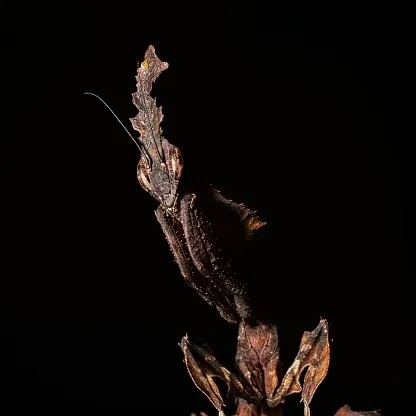
And the exotics are simply better-looking. A Ghost Mantis looks like a dead leaf came alive (torn between the two leaf mimics? Ghost vs Dead Leaf). A Spiny Flower Mantis flashes a bullseye threat display. An African Twig Mantis disappears completely on a bare twig. Same fundamental pet, more payoff. Not sure which fits you? Take the two-minute quiz.
That’s not a knock on the Chinese mantis. It’s a good bug doing a good job in your garden. I’d just rather you leave it out there hunting aphids and start your indoor hobby with an animal that gives you a real timeline.
Want the hunting behavior without the end-of-life lottery? Browse captive-bred nymphs in the shop, or read the best beginner mantises first.
Frequently Asked Questions
Are Chinese mantises dangerous to humans?
No. Mantises don’t bite in any meaningful sense; they grab with the front legs. A big adult female can give a sharp pinch that occasionally nicks skin, but there’s no venom and no danger. They’re predators of insects, not people.
Is it legal to catch and keep a Chinese mantis?
In most US states, collecting a common mantis from your own property is legal. Rules vary by state, and you should never collect native or protected wildlife. Since Tenodera sinensis is an introduced species, it carries fewer concerns than catching a native, but check your local regulations.
Should I buy Chinese mantis egg cases for my garden?
You can, and they’ll hatch, but understand you’re releasing a non-native generalist predator that eats good bugs along with the bad. We don’t sell oothecae of any kind. If your goal is a pet, an egg case is the wrong purchase: you’d get hundreds of nymphs that immediately cannibalize each other.
How long does a Chinese mantis live?
About one season, roughly 6 to 8 months from spring hatch to a fall death, but only the last several weeks to a couple of months are spent as a winged adult, which is the stage most people find. If you find a large adult, it’s near the end of that window.
What’s the difference between a Chinese mantis and a Carolina mantis?
Size and origin. The Chinese mantis is introduced and large (~4 in). The Carolina mantis is the smaller (~2.5 in) US native that the Chinese mantis often outcompetes.