What You Bought
A springtail culture is a vented cup containing a moisture-holding medium, a food source, and a population of live springtails — typically counted in the dozens to low hundreds, though nobody counts them and any seller quoting an exact number is estimating.
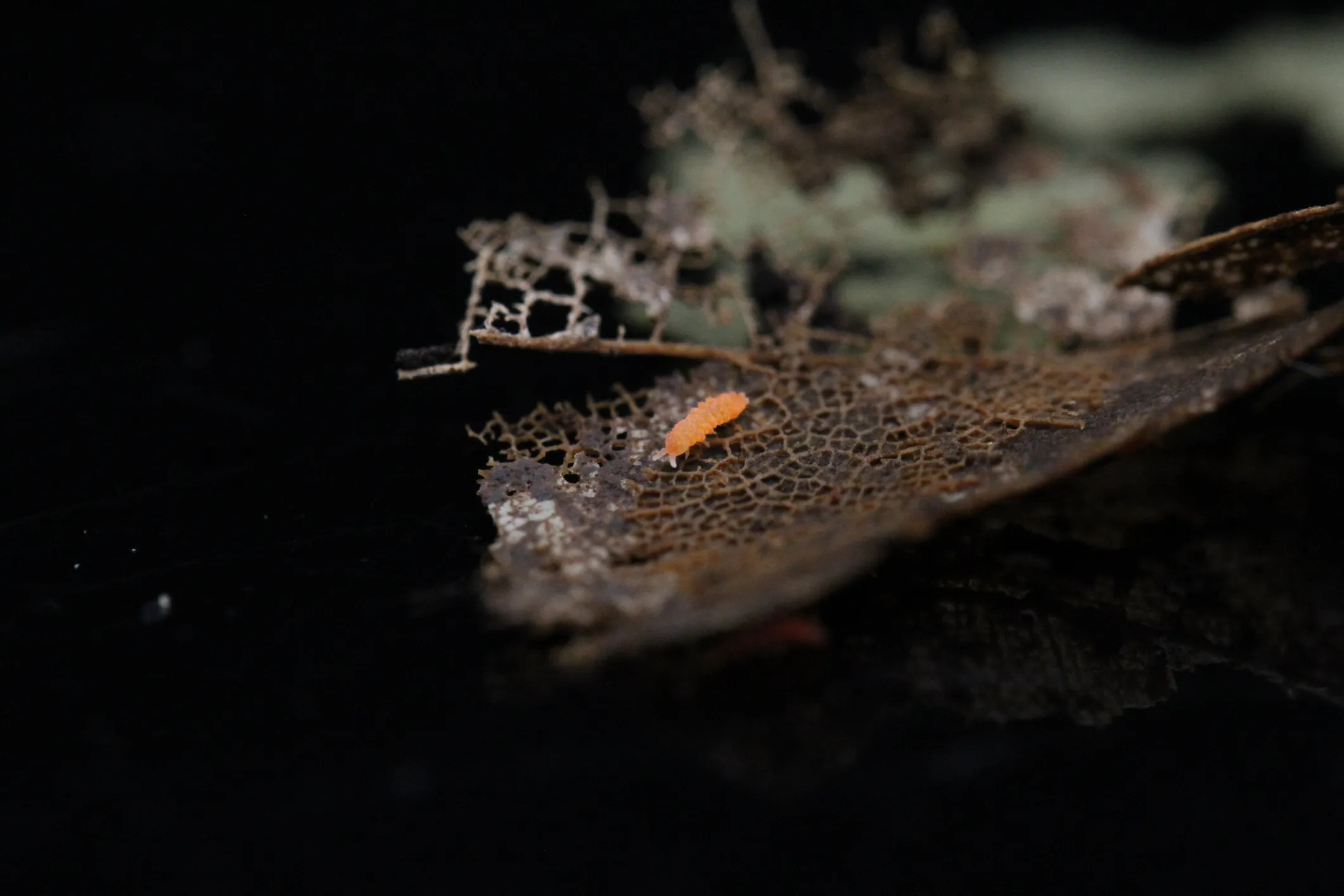
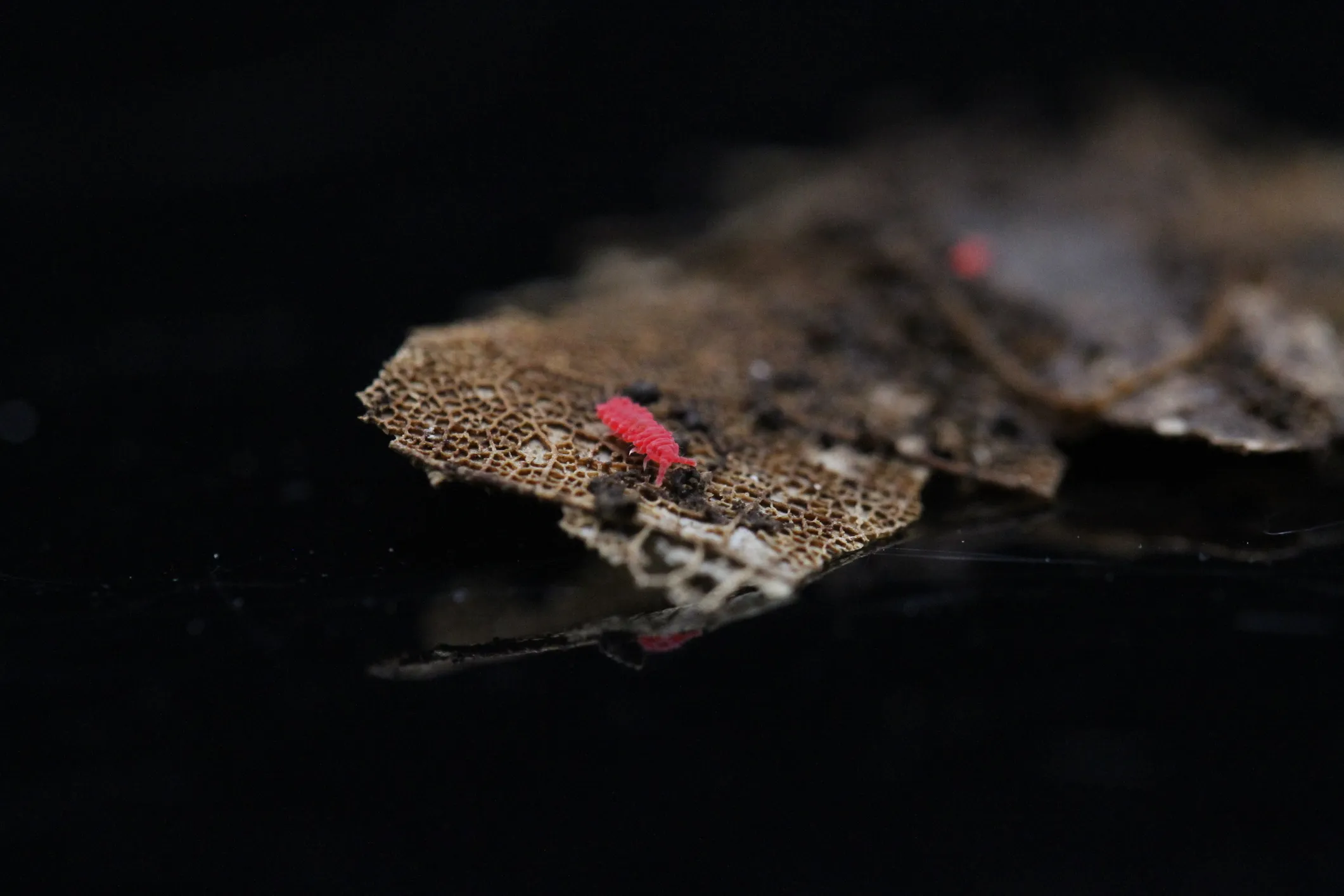
Springtails (Collembola) are ancient, wingless hexapods, one to three millimetres long. They eat mould, fungus, algae and decaying matter. In a bioactive enclosure they are the mould control — the reason a vivarium doesn’t fuzz over in the first month.
They are called springtails because most species have a furcula, a forked tail held under tension against the abdomen. Release it and the animal is flung several times its body length. That is what you are seeing when the culture appears to explode.
What to Expect, Week by Week
Week 1 — quiet. After shipping, activity drops. Leave the culture somewhere stable and do not feed it yet.
Weeks 2–3 — visible surface activity. Springtails gather where the food is. Tap the side of the cup; a healthy culture ripples.
Weeks 4–6 — population boom. Springtails reproduce fast — considerably faster than isopods. This is when a culture becomes harvestable.
Month 2 onward — steady state. A maintained culture produces indefinitely. Most cultures that die do so from neglect or from drying out, not from age.
Where to Keep It
Room temperature, out of direct sun. The working range for the tropical species in the hobby is roughly 65–80°F.
Springtails are more forgiving of temperature than isopods and far less forgiving of drying out. A culture that dries completely is gone; there is no recovering it.
Condensation on the lid is normal and generally a good sign. Standing water covering the whole surface is not — springtails float and will raft on it, but the medium underneath goes anaerobic and sours.
Feeding
Springtails eat mould. You are not really feeding the springtails — you are feeding a small amount of mould for them to eat.
The standard options:
- Brewer’s or baker’s yeast — a few grains, sprinkled. Fastest response, easiest to overdo.
- Uncooked white rice — a handful of grains. Moulds slowly and feeds over a longer period. The most forgiving option.
- Mushroom — a slice. Effective, and rots fast if it isn’t consumed.
Feed sparingly and only when the last feeding is gone. Over-feeding is the most common way to kill a culture. Excess food moulds faster than the colony can graze it, the medium sours, and mites move in.
Harvesting and Seeding a Vivarium
Two methods, depending on your medium.
Flood and pour. Add dechlorinated, distilled or RO water until springtails float to the surface, then pour the surface water into the enclosure. Straight tap water is the one thing that will kill a culture here — chlorine and chloramine are lethal to springtails, and this is the step where you deliberately soak the whole colony. Fast, clean, and it leaves the colony behind. This works best with charcoal or clay media.
Move the medium. Scoop a portion of the culture — medium and all — directly into the enclosure. Cruder, but it transfers eggs and juveniles as well as adults, so the seeded population establishes faster.
For seeding a new bioactive enclosure, move the medium. For routine top-ups, flood and pour.
Culture Media: charcoal vs clay vs soil
This is the one genuine disagreement in springtail keeping, and it is worth understanding rather than copying.
Horticultural charcoal is the traditional medium. It holds moisture, resists souring, and flood-harvesting off it is easy. The objection, raised by Terrarium Tribe, is about shipping: charcoal chunks “can bump into the springtails during transit and damage the population.” That is a real argument about a real failure mode, and it applies to the trip, not the culture.
Clay-based media (bentonite and similar) hold moisture well, are lighter, and are gentler in transit. They have become the preferred shipping medium for several sellers for exactly that reason.
Soil or coco fibre works and is cheapest, but flood-harvesting is messy and the medium fouls faster.
Splitting a Culture
Do this every couple of months once a culture is producing, and always before you need to.
- Set up a second container with fresh, moistened medium.
- Move roughly a third of the existing culture across, medium included.
- Feed both lightly.
- Keep them in different places, if you can.
A culture that is split regularly effectively never ends. A single culture that is harvested hard and never split eventually thins out.
How Many Do I Need?
| Enclosure | Cultures to start |
|---|---|
| Up to 5 gallons | 1 |
| 10–20 gallons | 1–2 |
| 30–40 gallons | 2–3 |
| 55+ gallons | 3–4 |
Springtails self-regulate to the available food. Seeding heavily does not produce a permanently larger population — it reaches a working density sooner. One culture into a small enclosure, given a month, gets you to the same place.
Which culture should you buy? For mould control, the Tropical White is the workhorse — fastest to establish and the most reliable cleanup crew. Orange and Thai Red are kept as much for their colour as for the work they do. The spiny, non-jumping Rambutanura springtails — Red Thai Spiky and Vietnam Spiky — are display specialists, collector animals rather than cleanup crew. Browse all our cultures →
Are springtails safe? Do they bite?
No. Springtails have no biting mouthparts that can affect a person, they are not parasites, and they do not carry disease. They cannot harm a mantis, a gecko, a frog, or you.
They are frequently confused with fleas because both jump. Fleas bite and are parasites; springtails do neither.
Troubleshooting
Why are my springtails all in the water / on the lid?
Usually the medium has gone sour or too wet. Springtails climb to escape it. Increase ventilation, stop feeding for a week, and if it does not recover, move a portion to fresh medium.
Why isn’t my culture producing?
Most often it is too dry, or it was fed too much and the medium fouled. Check moisture first. A culture that has crashed from over-feeding is usually easier to restart from a small transfer into clean medium than to nurse back.
There are mites in my culture.
Grain mites arrive with over-feeding and excess moisture. They compete for food but rarely wipe out a culture. Stop feeding, increase ventilation, and split a clean-looking portion into fresh medium.
My springtails aren’t eating the mould in my vivarium.
Give it time — a seeded population needs weeks to build to a density that visibly controls mould. If it has been months, the enclosure is probably too dry for them, or something in it is eating them.
Are these actually springtails?
Worth asking, because the naming in this hobby is genuinely unreliable. See below.
A note on names
The springtails sold as “tropical white” or “tropical pink” have circulated under the name Sinella curviseta for years. That identification has been challenged: specialists have identified the animal actually in the hobby as a Coecobrya species, and several sellers have since relabelled.
We list ours as Coecobrya sp. rather than claim a species name we cannot verify. The animal is the same one the hobby has been keeping for a decade either way — but a care guide that repeats a name a collembologist has already corrected is a care guide that has not checked.
Thai Red springtails are Lobella sp., originally from Thailand. They are slower and more temperature-sensitive than the tropical whites, and are usually kept as a display or premium culture rather than a workhorse cleanup crew.
Springtails vs Isopods
Run both if you can. Springtails handle mould and establish in weeks; isopods process bulk waste and take months. In a small, humid enclosure where you can only run one, run springtails.
Frequently Asked Questions
Can I feed springtails to my praying mantis?
As a cleanup crew, yes — they belong in a bioactive mantis enclosure. As food, no. Springtails are too small to interest even a freshly hatched mantis nymph; experienced keepers on the mantis forums are direct that they are “nearly worthless” as feeders. Buy fruit flies for feeding and springtails for cleanup.
What do springtails eat in a vivarium?
Mould, fungus, algae, decaying plant matter and animal waste. In an established enclosure you never feed them — the enclosure does.
How long does a springtail culture last?
Indefinitely, if it is kept moist, fed lightly, and split occasionally. Cultures do not die of old age; they die of drying out or over-feeding.
Will springtails escape into my house?
They need consistent moisture to survive and will not establish in a dry home. Escapees from a vivarium die out rather than colonise.
Do springtails need light?
No. They avoid it. A culture keeps fine in a cupboard.
Can I mix springtail species in one culture?
You can, but the faster species usually dominates within a few months. Keep a premium culture like Thai Red separate if you want it to stay a Thai Red culture.
What to Order Next
Springtails are half of a bioactive cleanup crew. Isopods are the other half — they handle the waste springtails don’t.
Both ride along in the same box as a mantis order, so adding a culture costs nothing extra in shipping.