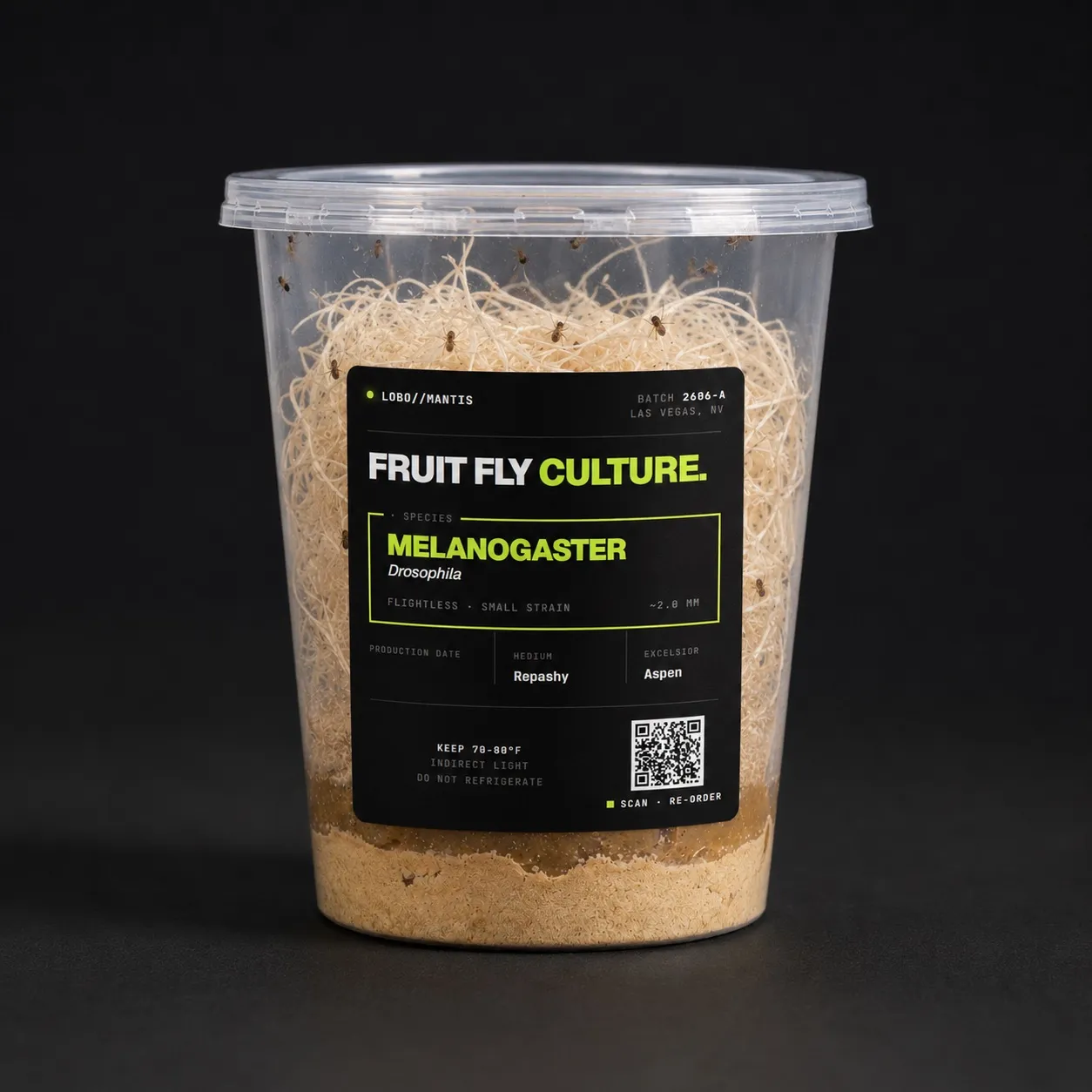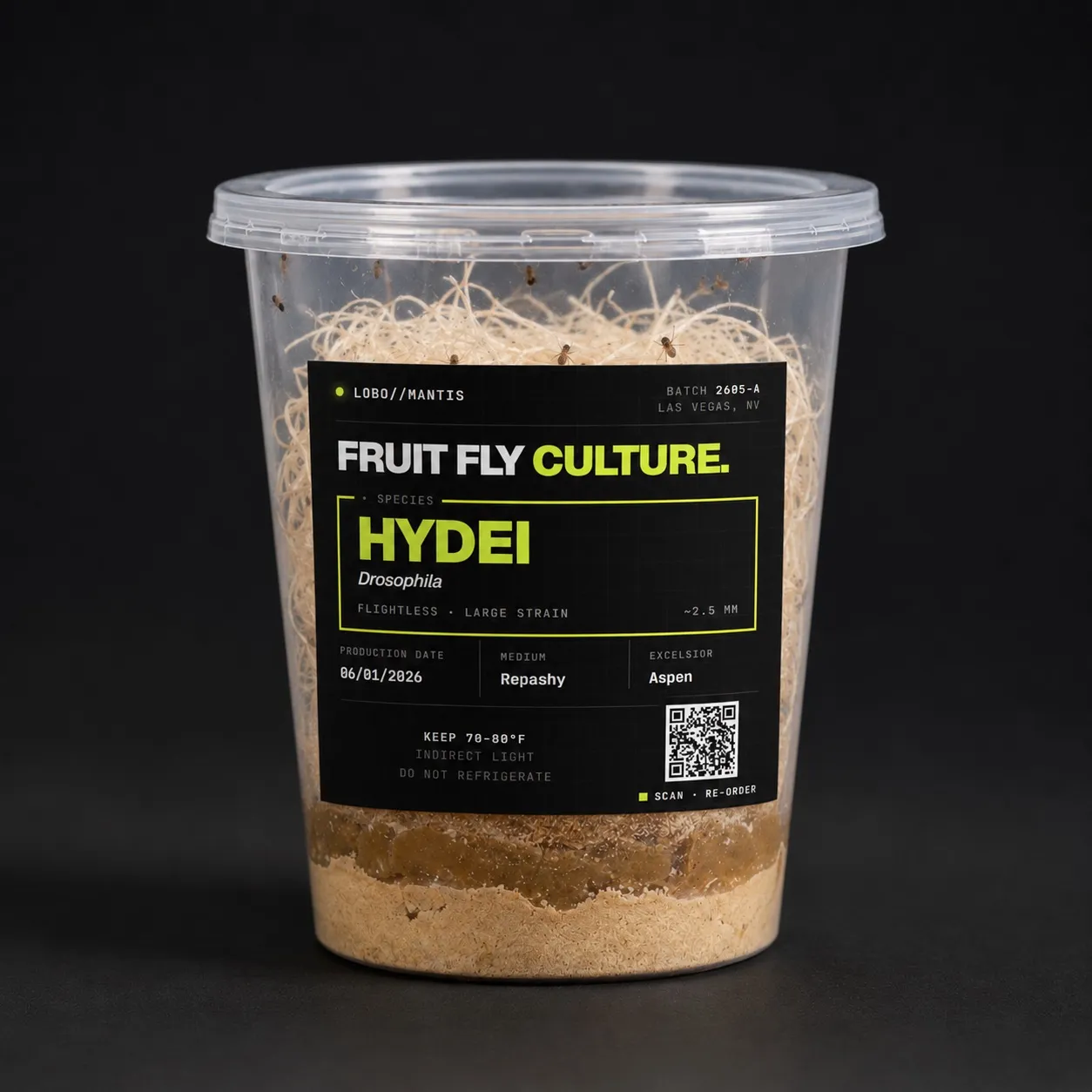
Feeding dart frogs fruit flies comes down to two flies and one rule: use the smaller flightless Drosophila melanogaster for froglets and thumbnail species, step up to the larger Drosophila hydei for full-grown adults, and dust the flies with a vitamin and calcium supplement at nearly every feeding. Get those three things right and the rest is just logistics.
I produce flightless Drosophila cultures for a living, and dart frog keepers are some of my most demanding customers — for good reason. A dart frog eats almost nothing but fruit flies for its entire life, so the culture in your kitchen isn’t a convenience, it’s the whole food supply. Here’s how I’d run it.
Short on time? See the dart frog feeder lineup with live stock →
The two flies, and which frog gets which
Poison dart frogs are tiny, and they get their prey from a very short list. Flightless fruit flies sit at the top of that list because they come in exactly the two sizes a frog collection needs.
Flightless Drosophila melanogaster are the smaller fly, around 2 mm. This is the froglet fly and the thumbnail fly. Newly morphed froglets of any species, and adult Ranitomeya and other small thumbnails, take melanogaster their whole lives. When you have a fresh morph-out, this is what feeds them.
Flightless Drosophila hydei are the larger fly, around 3 mm. Once a bigger species grows up — Dendrobates tinctorius, auratus, leucomelas, and the other robust ground dwellers — an adult can pack away hydei more efficiently than melanogaster, so you get a fuller frog with fewer flies to dust and count.
| Fly | Size | Best for |
|---|---|---|
| Melanogaster | ~2 mm (smaller) | Froglets, Ranitomeya and other thumbnails, any newly morphed frog |
| Hydei | ~3 mm (larger) | Adult tinctorius, auratus, leucomelas, and other larger species |
Most keepers with a mixed collection run both cultures at once — melanogaster for the little ones and the froglet grow-out, hydei for the adult vivariums. If you keep a single adult tinctorius pair, you can honestly run hydei alone. If you’re raising froglets, melanogaster is non-negotiable.
Why flightless cultures are the dart-frog staple
If you’re new to darts, you might wonder why the whole hobby runs on fruit flies specifically. Three reasons:
- They can’t fly off. Both of mine are a genuinely flightless strain — flightless, not wingless: they have visible wings but can’t fly — so the flies stay on the ground and glass where a frog hunts, instead of loose in your house. Keep the cup under about 80°F; above that some of the next generation can regain flight. That matters enormously with an animal that forages at the substrate.
- They’re the right size. Nothing else this easy to produce matches the gape of a dart frog, and melanogaster matches a froglet the way nothing else does.
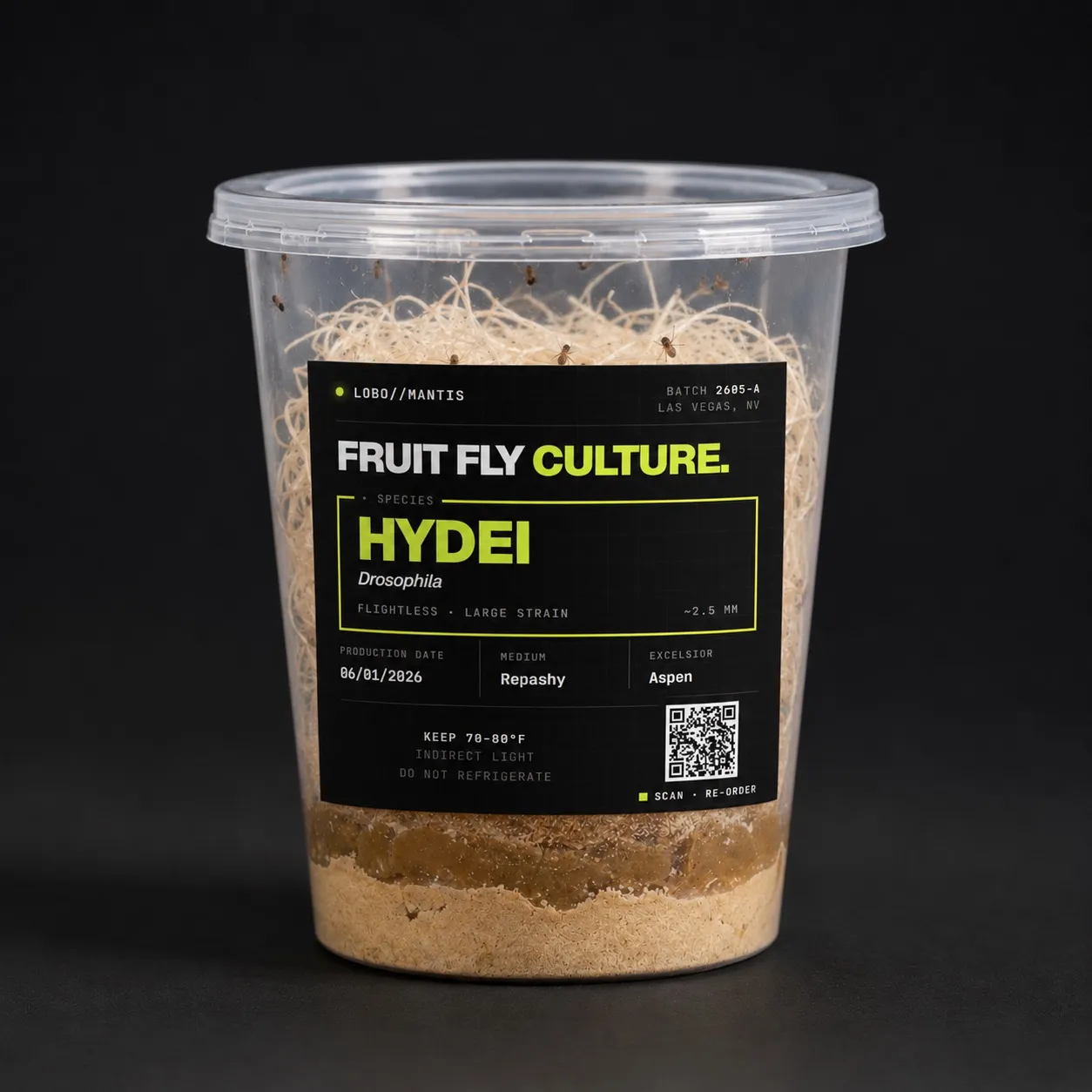
- A culture is self-replicating. You’re not buying flies — you’re buying a producing colony. Both of mine ship as live producing cultures: a cup of media that makes flies for about three to four weeks, peaking in the third week (melanogaster days 14–21; hydei about a week later). One cup feeds a small collection for a good stretch.
That last point is the one people underestimate. A single culture is a supply line, not a snack.
How many flies, and how often
The honest answer is that you feed to the frog, not to a chart. But some working guidelines from years of this:
- Froglets get fed every day, a small pinch of melanogaster each time. They grow fast and burn through food, and a hungry froglet fails to thrive quietly. Watch the belly — you want them rounded, not skeletal.
- Adults eat every other day, or a few times a week, a heavier portion each feeding. A well-conditioned adult tinctorius will happily hunt down a couple dozen flies at a sitting.
- Feed what gets eaten in a few hours. Dumping in more than the frogs can clear just means flies drowning in water features or breeding in the substrate. Start conservative and adjust up.
Frogs are ambush-ish foragers — they respond to movement — so scatter the flies rather than piling them in one spot, and they’ll work the tank.
Dusting: the step you cannot skip
This is where dart frogs differ from most feeders I sell for other animals. Plain fruit flies are not a complete diet. Frogs fed undusted flies slowly develop vitamin and calcium deficiencies, and by the time it shows, it’s hard to reverse. So you dust.
Tip your flies into a cup, add a small amount of a quality frog vitamin/calcium supplement powder, swirl gently to coat, and tap the dusted flies into the tank. Do this at most feedings for froglets and growing frogs, and regularly for adults. I won’t push a specific brand — the hobby has a few well-regarded supplement lines, and any keeper forum will point you to the current favorites — but some supplement, used consistently, is the difference between frogs that thrive and frogs that don’t.
Two practical notes: don’t drown the flies in powder (a light coat, not a snowball), and dust right before feeding so the coating is still on the fly when the frog catches it.
Springtails: a useful complement, not a replacement
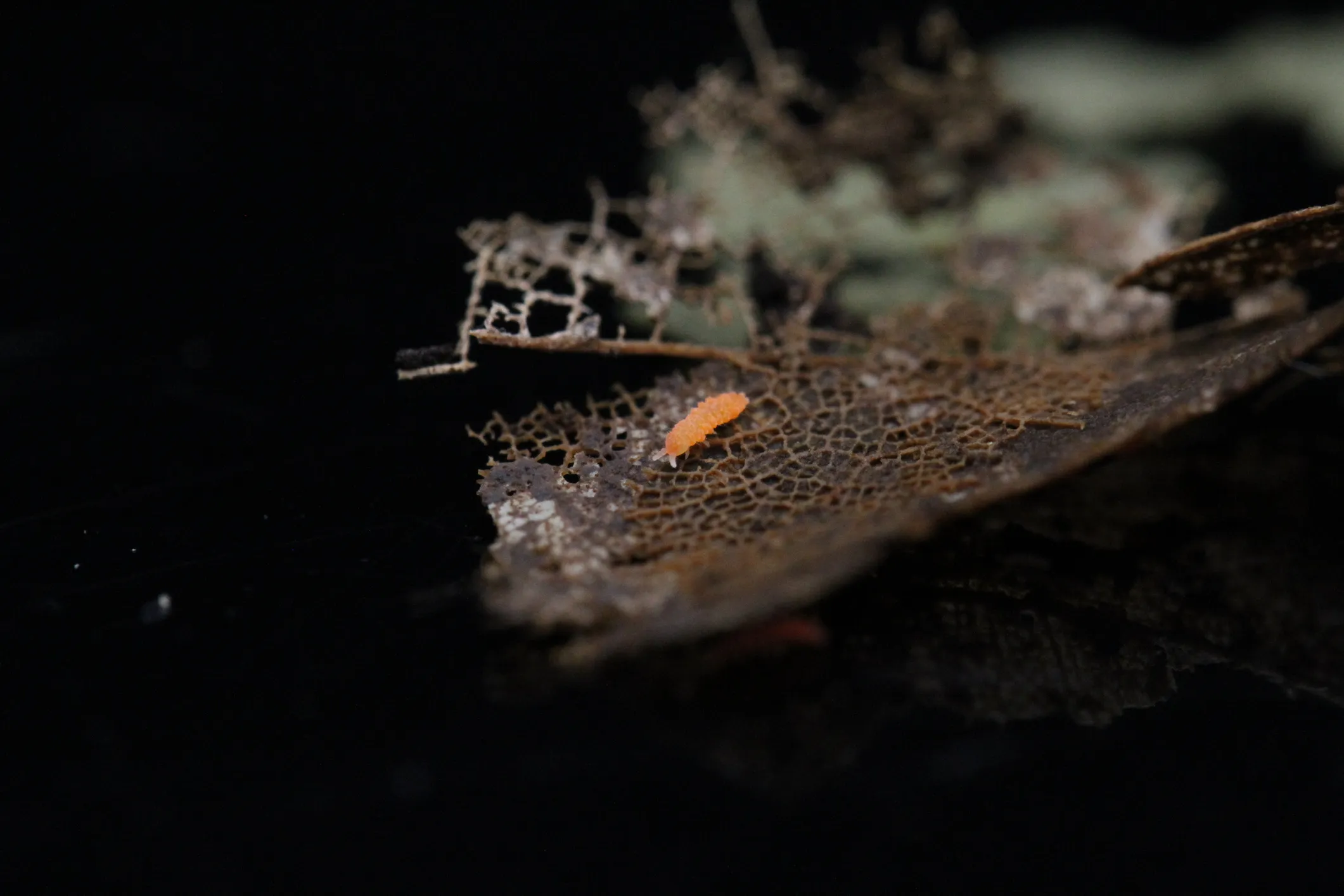
For froglets especially, springtails are worth having in the tank alongside your flies. They’re tiny, they reproduce in the substrate, they clean up uneaten food and mold, and the smallest froglets will pick at them between fly feedings. I sell both, so I’ll be straight: springtails are cleanup and, at most, a snack for the tiniest froglets — never the diet. They won’t grow a frog on their own, and no serious dart keeper runs springtails instead of fruit flies. Seed a springtail culture into your vivarium for cleanup, then feed dusted flies as the real meal.
Culture rotation: never run dry
The one mistake that sinks new dart keepers is running a single culture until it dies, then scrambling. Don’t. Stagger two cultures per fly type — start a fresh one before the current one peaks — so there’s always production coming online. A cup runs about three to four weeks, so a new culture every 2–3 weeks — around day 14 of the current one — keeps you covered indefinitely.
Keep them at 70–80°F; production slows sharply below about 65°F and stops near 60°F, so your flies slow to a trickle right when the frogs are hungriest. My full fruit fly culture care guide walks through venting, humidity, mite prevention, and how to split a culture so you stop rebuying. And if a cup ever goes quiet and you’re not sure whether it’s dead or just loading up for the big wave, I wrote a whole diagnostic on why a culture stops producing — read it before you toss anything.
One more small thing that pays off: dart frogs live in humid, planted vivariums, and a fine misting bottle makes keeping that humidity up far less of a chore than a cheap sprayer.
Getting started
If you’re setting up froglets, start with a melanogaster culture. If you keep adult Dendrobates, run a hydei culture — or grab both if your collection spans sizes, which most do. They arrive as live, producing colonies with laying adults you can feed from on day one — go easy, they’re seeding the next wave. Stagger a second cup two weeks in, dust every feeding, and your frogs will do the rest.
Ready to stock the feeder shelf? Grab a melanogaster culture for froglets, a hydei culture for the adults, and keep a second cup of each on a stagger. Dust every feeding, and your darts are set.
Frequently Asked Questions
Do dart frogs eat melanogaster or hydei fruit flies?
Both, depending on size. Froglets and thumbnail species like Ranitomeya eat the smaller melanogaster. Larger adults like tinctorius and auratus take the bigger hydei more efficiently. A mixed collection usually runs both.
Do I have to dust fruit flies for dart frogs?
Yes. Plain flies aren’t a complete diet — dust them with a vitamin and calcium supplement at nearly every feeding to prevent deficiencies. A light coat, applied right before you feed, is all it takes.
How often should I feed my dart frogs?
Froglets get a small feeding of dusted melanogaster daily. Adults eat a larger portion every other day or a few times a week. Feed roughly what the frogs clear in a few hours.
Are springtails enough to feed dart frogs?
No. Springtails are a useful cleanup crew and a snack for the smallest froglets, but they aren’t a diet. Dusted fruit flies are the staple; springtails are a complement.
How long does a fruit fly culture last?
About three to four weeks of production per cup, peaking in the third week. Start a fresh culture every 2–3 weeks so you never run dry — see the culture care guide for splitting and troubleshooting.