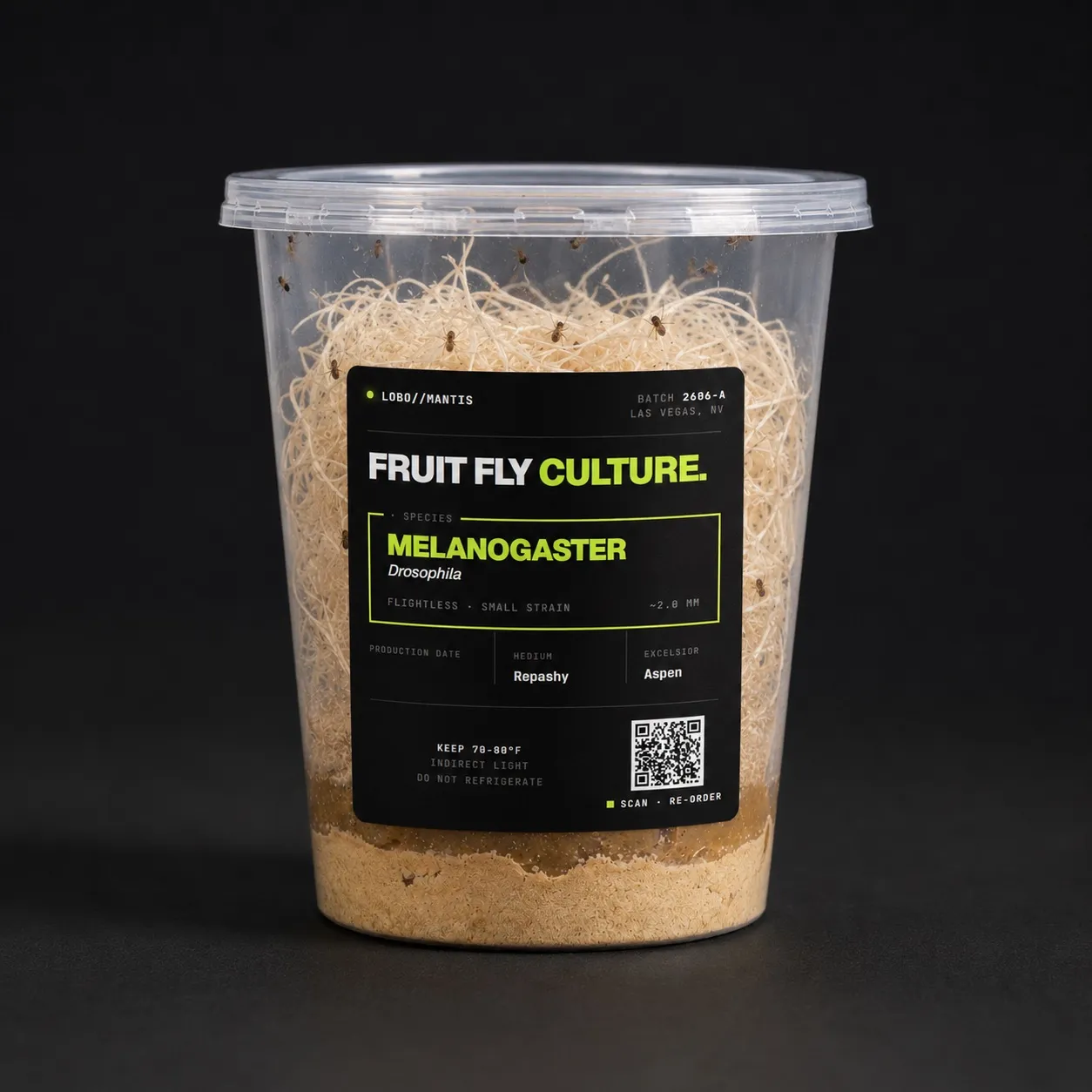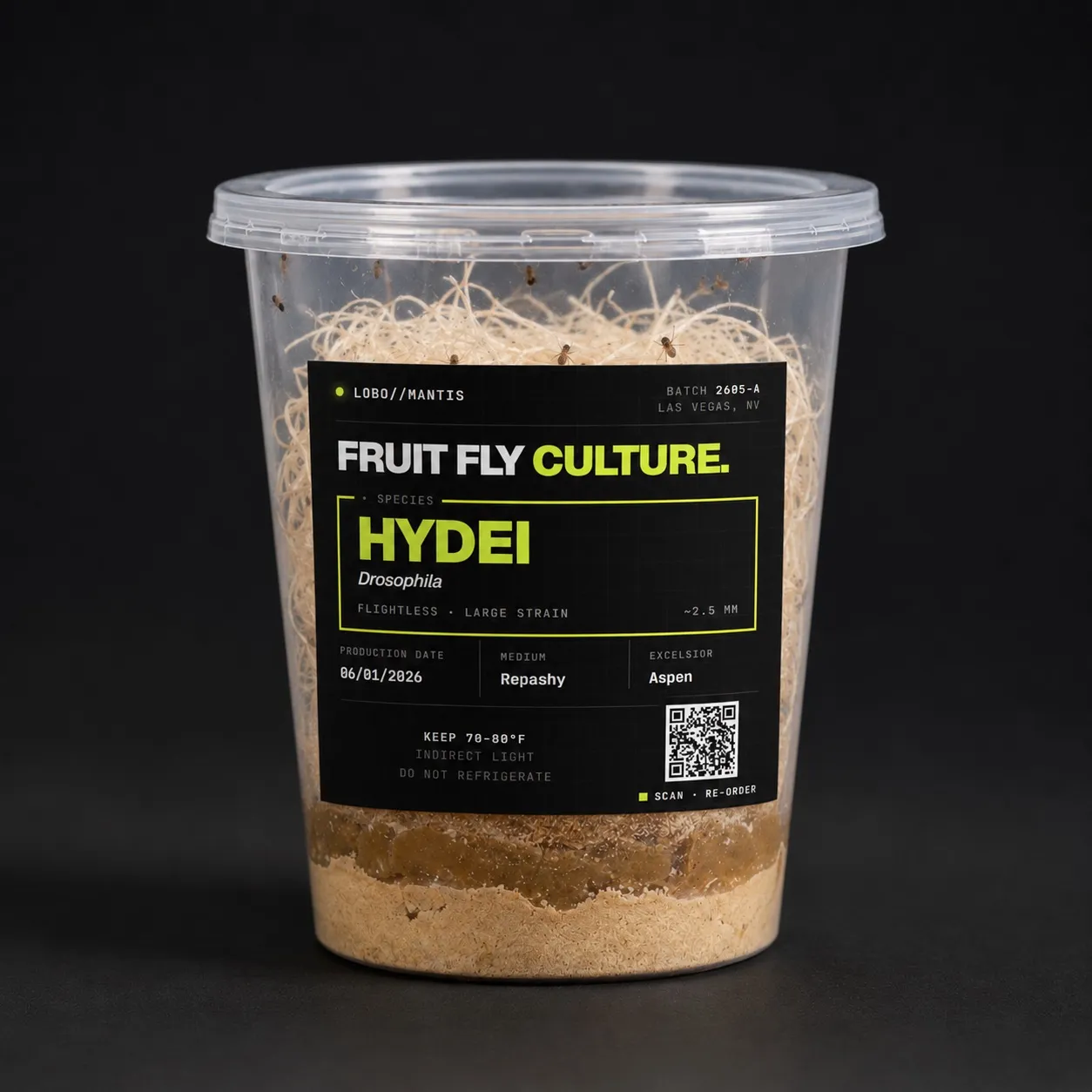
If you just brought home your first jumping spider — a Phidippus regius sling about the size of a pencil dot, most likely — the honest answer to “what do I feed it” is short. The best fruit flies for jumping spiders come down to two species matched to your spider’s size: tiny slings eat Drosophila melanogaster (the smaller fly), and juveniles and adults graduate to Drosophila hydei (the larger one). That’s the entire feeding decision for the first several months of a jumper’s life.
I breed feeders in Las Vegas and ship both strains year-round. Jumping spider keeping has quietly become a big corner of the invertebrate hobby, and nearly all of those spiders start on the same two fruit fly cultures. Here’s how to pick the right one, why flightless isn’t optional, and how a culture actually works.
Short on time? See the jumping spider feeder lineup with live stock →
The quick answer, by spider size
| Jumping spider stage | Best fruit fly | Fly size | Why it fits |
|---|---|---|---|
| Slings (freshly hatched to ~3rd instar) | D. melanogaster | ~2 mm | Small and soft enough for a spiderling to subdue safely |
| Juveniles (4th instar and up, visibly growing) | D. hydei | ~3 mm | More meat per fly, so fewer feedings and faster growth |
| Sub-adults / adults | D. hydei (staple) | ~3 mm | Reliable adult diet; big females can add a bottle fly |
If you remember nothing else: small spider, small fly. Match the fly to the spider and you’ve solved most of jumping spider feeding.
Why flightless matters more for spiders than almost anything
Jumping spiders are visual, ambush-and-pounce hunters. They don’t build a web to catch food — they see prey, stalk it, and jump. That makes a walking fly perfect and a flying fly a genuine problem.
A winged fruit fly does three bad things inside a jumper enclosure. It escapes through the ventilation slots. It hides up in the lid where your spider can’t reach it. And it stresses a small spider that has no way to catch something buzzing around above its head. You end up with an unfed spider and fruit flies loose in your apartment.
Both of our cultures are a flightless strain — flightless, not wingless: they have visible wings but can’t fly, so they crawl. (Keep the cup under about 80°F; above that some of the next generation can regain flight.) They walk the enclosure walls straight into your spider’s hunting lane, which is exactly the presentation a Phidippus is wired to attack. It’s the single biggest reason flightless fruit flies run the feeder hobby.
Melanogaster: the sling fly
For a freshly molted sling, Drosophila melanogaster is the right first food. At roughly 2 mm it’s the smaller of the two flies — about the size a spiderling can actually wrestle down without getting overwhelmed. This is what nearly every jumping spider eats from the moment it leaves the mother’s nest until it’s a few molts along.
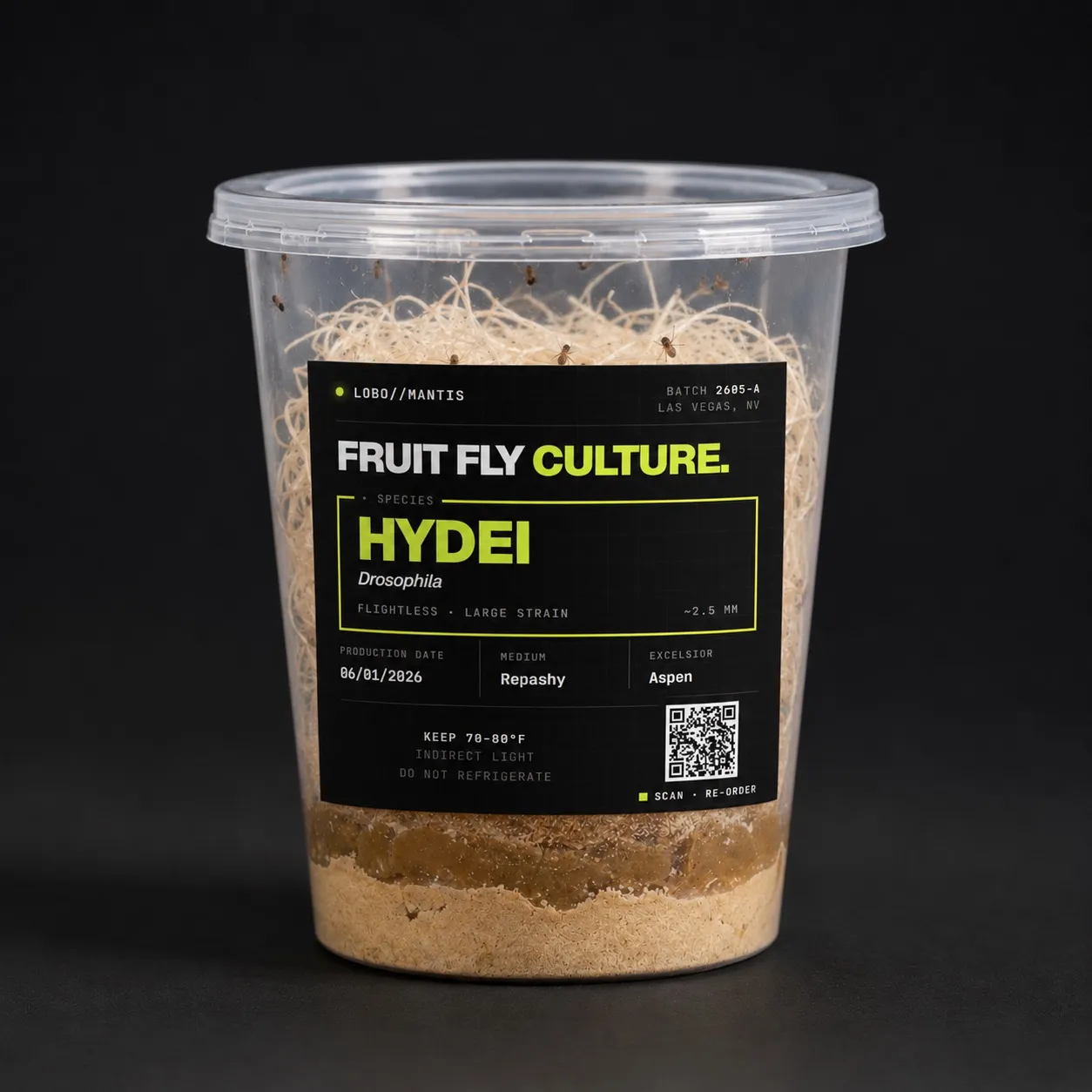
A melanogaster culture is a cup of media that produces a steady stream of these flies for about three to four weeks, peaking in the third week (days 14–21). At $15, one culture feeds a single sling for weeks — you tap a few flies out at a time and the cup keeps making more. For your first spider, this is the culture to start with, full stop.
Hydei: the juvenile-and-adult fly
Once your spider has a couple more molts on it and is visibly bulking up, step up to Drosophila hydei. At about 3 mm it’s the larger flightless fly — noticeably more food per bug, which means a growing juvenile gets a proper meal in one or two flies instead of chasing down five little ones.
Most adult jumping spiders live comfortably on hydei fruit flies as their staple for the rest of their lives. The transition isn’t a hard cutoff — plenty of keepers run both cultures at once and offer whichever size suits the spider that week. If you’re only going to keep one culture going long-term for an adult jumper, make it hydei.
How much, and how often
There’s no need to overthink this, but the rhythm changes as the spider grows:
- Slings: offer 2–3 melanogaster every 1–2 days. Little spiders have small fuel tanks and eat often. A sling with a plump, rounded abdomen is a well-kept sling.
- Juveniles and adults: offer a few hydei every 2–4 days. As they mature you can stretch the interval; an adult that skips a meal now and then is normal, especially before a molt.
A jumping spider that’s about to molt will often stop eating and hunker down — don’t panic, and don’t leave a pile of feeders crowding it. One nice thing about flightless fruit flies: unlike crickets, a stray fly won’t harm your spider. Any uneaten flies just wander the enclosure and get picked off later. Still, feed to the spider’s appetite rather than dumping twenty flies in at once.
A rough prey-size rule: a fly around the size of your spider’s body (roughly the abdomen) is a safe target. Timid spiders do better with something a hair smaller; bold Phidippus will happily take prey close to their own length.
What a “culture” is, and keeping it producing
If you’ve only ever bought feeders by the tub, a culture works differently — and better. You’re not buying a countable box of flies; you’re buying a live, producing colony. The cup contains flies plus a media they lay eggs in, and over the following weeks a new generation hatches out. One cup keeps making flies for about three to four weeks, which is why it’s such good value for a single spider.
Two things keep a culture healthy. First, temperature: 70–80°F is the sweet spot. Production slows sharply below about 65°F and stops near 60°F, so don’t keep the cup somewhere cold. Second, timing: melanogaster peaks around days 14–21 (hydei about a week later), so if you want an unbroken supply, start a second culture every 2–3 weeks — around day 14 of the current one. I walk through the full routine in our fruit fly culture care guide.
If a culture ever seems to quit on you — no new flies, no larvae crawling the sides — it’s almost always temperature, age, or condensation, not a dead culture. Our why your fruit fly culture isn’t producing post covers the fixes before you assume the worst.
Beyond fruit flies: big adult females
Most jumping spiders never need anything larger than a hydei. The exception is a big adult female — a mature Phidippus regius female, for example, is a substantial spider and can take a larger feeder. If yours is clearly outgrowing fruit flies, a single bottle fly makes a good occasional adult meal; our blue bottle spikes hatch out into flies you offer one at a time. That’s an upgrade for large adults, though — for everything up to that point, fruit flies do the whole job.
Bottom line
For the best fruit flies for jumping spiders, size is the only variable that matters: slings eat melanogaster, juveniles and adults eat hydei, and both need to be the flightless strain so your spider can actually catch them. Start a sling on one melanogaster culture, add a hydei culture when it graduates, and you’ve got the entire feeding plan for a jumping spider’s life on your shelf for $15 a cup. Simple, cheap, and exactly what these little hunters are built to eat.