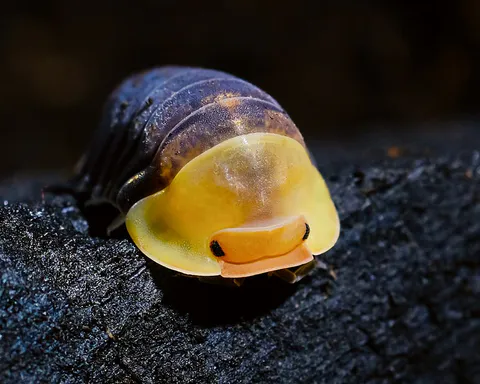


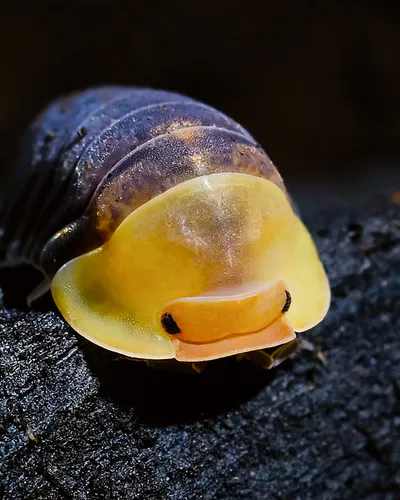
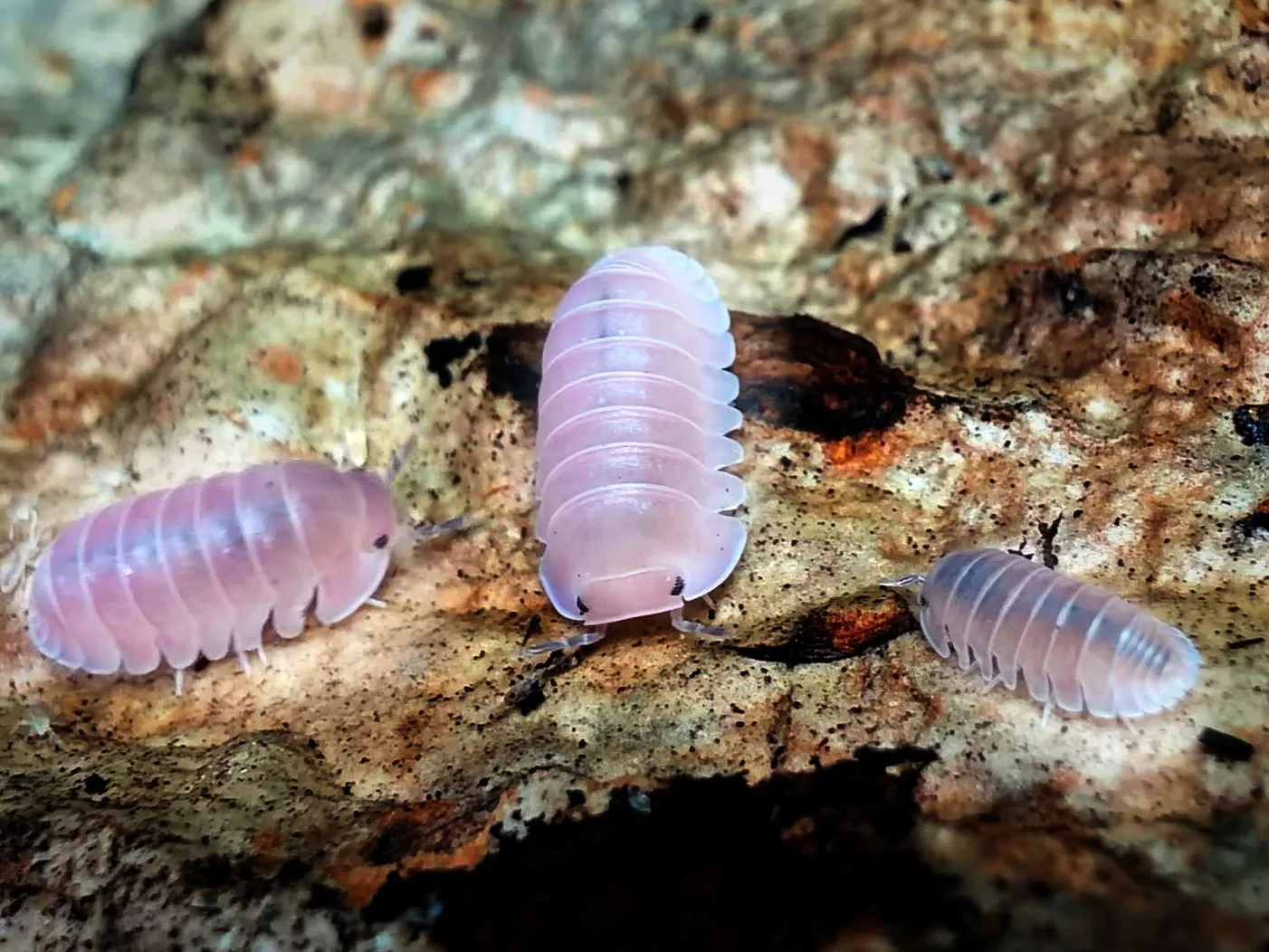
Cherry Blossom isopods are pastel pink as adults; one US breeder says the young start pale or grayish. They are sold as Cubaris sp. “Cherry Blossom”, a line sellers trace to Thai Pak Chong stock. Adults reach ≈ 12–15 mm (Antderground 1.2–1.5 cm, Insektenliebe under 12 mm). We rate it Beginner; swings in warmth or moisture set it back.
At a glance
| Cherry Blossom isopod | |
|---|---|
| Temperature | 70–80°F, steadiest at 72–78°F |
| Humidity and moisture | 75–85% at the damp end; most of the tub moist, with a small drier area |
| Substrate depth | ≈ 3 in or more, deeper on the damp side (a genus figure) |
| Adult size | ≈ 12–15 mm (two sellers; nobody has published a measurement) |
| Breeding pace | Slow. First young ≈ 3–6 months, typical for Cubaris; no Cherry Blossom figure has been published |
| Lifespan | About two years, estimated, not measured |
| Difficulty | Beginner, our rating; most other sellers say intermediate |
Red Pak Chong, the parent line sellers name; Pak Chong sheets describe a bigger animal. Sakura, a name some sellers use for this same animal and others for a related line. The cherry blossom tree: this page is about the isopod, not the tree.
Cherry Blossom, Sakura and Red Pak Chong: what the names mean
Is a Sakura the same animal, and is Cherry Blossom a pink form of Red Pak Chong? Sellers disagree on both, and nothing about Cherry Blossom itself has been published in the scientific literature. Its scientific name is written Cubaris sp. “Cherry Blossom”: not identified to species, and thought to be undescribed. What follows comes from sellers, keepers and hobby references, with their names attached so you can weigh it.
| Name you’ll see | What sellers say | What is published |
|---|---|---|
| Cherry Blossom | A pink line selected in captivity from Red Pak Chong stock (Creature Cache, PostPods, Exuvium, Holy Poly Isopods, Xoticbugs, Ilyas Insects). Insektenliebe, a German shop, says instead that the color occurs this way in nature. Antderground, a Spanish shop, gives the origin only as Asia, possibly Thailand or Vietnam. | Nothing. No wild locality is known for the pink form. |
| Sakura | The same line under a second name (Exuvium, a Dutch shop); a closely related but separate line (Creature Cache, a US breeder); a name sellers are split on (PostPods, a UK breeder). | Nothing. The Cubaris pages of isopod.site, a species profile site, have no Cherry Blossom or Sakura entry. |
| Red Pak Chong | The parent line, named for Pak Chong, the district of Thailand where it was collected (Smug Bug; Tropical Isopods lists the origin as Pak Chong, Thailand). | A collection locality, Pak Chong in Thailand, on hobby and seller pages; no species name and nothing in the literature. |
PostPods also reports that some sellers treat Red Pak Chong as the same species as Rubber Ducky; nothing on that has been published either. Our working line: a trade line of unpublished origin, linked by sellers to Thai Pak Chong stock. The listings we read use the Cherry Blossom name, and Exuvium’s adds Sakura; ours is listed as Cherry Blossom isopods for sale.
Conditions: enclosure, warmth, moisture and air
Cherry Blossom uses the shared Cubaris setup, which the Cubaris section of our isopod care guide explains once. These are its own values.
| Cherry Blossom | |
|---|---|
| Temperature | 70–80°F (21–27°C), steadiest at 72–78°F (22–26°C). Keep it under about 80°F; no tested lethal temperature has been published. |
| Damp end | 75–85% humidity. A clump of damp sphagnum moss on the wet side holds the water. |
| Rest of the tub | Mostly moist, with a small drier area. |
| Air | Moderate cross-ventilation: a few small vents on opposite sides. Vented, never sealed. |
| Substrate | ≈ 3 in or more, deeper on the damp side. A burrowable organic mix: leaf mold or flake soil, white-rotted hardwood and fertilizer-free topsoil. |
| On top | Hardwood leaf litter (oak, beech, magnolia or maple), kept topped up, and cork bark for cover. |
| Food | Leaf litter and rotting wood first, as for any isopod; PostPods adds a weekly pinch of protein. |
| Calcium | Cuttlebone or limestone, in the tub at all times. |
| Tankmates | Its sellers pair it with a springtail culture (Creature Cache, PostPods, Mossarium Labs). |
Coco fiber is the one ingredient its sellers argue about: PostPods says leave it out, while Creature Cache’s mix, Bioactive Bugs and the Invertebrate Dude keeper blog all use some.
What Cherry Blossom sellers stress
Two points run through its sellers’ pages. No source shows either one is unique to Cherry Blossom.
- Steadiness over any one number. PostPods, Bioactive Bugs, Insektenliebe and Ilyas Insects all ask for stable conditions, and PostPods says fluctuation is what does the damage: its example is a 64°F (18°C) night after a 75°F (24°C) afternoon. Most of its sellers put the floor at 72°F; two go lower (Creature Cache 70°F, and Richard's Inverts down to 64°F). Antderground gives the same 72–78°F band as its ideal.
- Gentle air, not stale air. PostPods calls it a still-air Cubaris and gives it less airflow than Mediterranean Porcellio or Armadillidium, but it warns against stagnant, wet air too. Creature Cache and Xoticbugs ask for moderate ventilation, and BCO Mushi's Cubaris guide says a tub kept too wet can go sour fast. Ilyas Insects is the one seller that recommends a tightly sealed tub.
Why its humidity figures run from 55% to 90%
The spread has causes, and averaging it would give a number no seller uses.
- One seller recommends a sealed tub. Ilyas Insects gives 80–90% for a tightly sealed microclimate with minimal airflow, the opposite of the vented tub the others describe.
- One sheet is copied text. Exuvium’s 55–70% sits on a page whose numbers match its Pak Chong sheet word for word, so it tells you nothing about Cherry Blossom.
- The rest are two close camps. 75–85% (Antderground, Insektenliebe, Holy Poly) and 70–80% (Creature Cache, PostPods, Mossarium Labs). Both describe high humidity with a gradient. We print 75–85% for the damp end, the figure on both Cherry Blossom pages that our independent fact check re-read, Antderground’s and Insektenliebe’s.
No Cherry Blossom source gives a usable figure for how much of the tub to keep wet.
Why aren’t my Cherry Blossom isopods pink?
Three things make one look washed out: it is young, it is mid-molt, or it comes from the paler end of a variable line. Most of its sellers describe settled adults the same way: a pastel pink body with paler cream or white edges on each segment. PostPods adds a faint gray line down the middle.
- It's young. Creature Cache describes juveniles as pale or grayish, coloring up over successive molts. A group of young animals can look nothing like the adult photos.
- It's mid-molt. Like any isopod it molts in two halves, rear first, and new shell is pale until it sets. Leave it alone and keep calcium in the tub.
- The line varies. Sellers describe it as a selected line, and PostPods notes that color intensity varies across a group. Their descriptions run from pastel to bright pink (Xoticbugs) to pink with hints of lavender (Noli), so one listing photo is not a promise.
Does food change the color? No study has tested it, and its sellers disagree, so feed for health, not for color. Food left to rot invites mold and mites.
Breeding Cherry Blossom isopods: slow, with no published numbers
Most Cherry Blossom sellers call it a slow breeder. PostPods, Holy Poly, Bioactive Bugs, Richard’s Inverts, Micro Exotics, Ilyas Insects and Noli all say so, and Antderground says it is not the easiest to breed. A few are more upbeat: Creature Cache calls breeding moderate, and Insektenliebe says they breed reliably.
What nobody publishes is a number. No source gives the age at maturity, the brood size, how often a female breeds, the time to first young or the time to a colony you can split. The ≈ 3–6 months to first young in the table is the usual window for Cubaris in general, not a Cherry Blossom measurement. The one Cherry Blossom report with a time in it comes from a US keeper’s blog, Invertebrate Dude (January 2026): babies in both of the keeper’s Cherry Blossom bins, stocked from two sources, within the several months since buying them. That is one keeper, two bins and no counts.
What the slow start looks like. Sellers describe a new group as shy at first (isopods.co.uk, Noli) and often out of sight for the first weeks. They burrow a lot (Creature Cache, PostPods, Bioactive Bugs) and roll into a ball when disturbed (Antderground, PostPods, Insektenliebe). Once settled, a colony is fairly easy to see in the evening (Creature Cache, PostPods, Insektenliebe), and Antderground finds them surprisingly quick next to more sedentary Cubaris. The caution from isopods.co.uk still holds: this is not an animal to buy for constant roaming in the open.
Cherry Blossom problems: stale air, swings, pale young
Open questions about Cherry Blossom
- Where the pink line came from, and whether Sakura is the same animal or a separate line.
- Whether food changes the color.
- How it does in a planted vivarium with frogs or geckos. No source covers it.
Frequently Asked Questions
Are Cherry Blossom and Sakura isopods the same?
Nobody can say for sure, because neither name has been published or tied to a wild population. Sellers split three ways: Exuvium, a Dutch shop, lists Sakura as another name for the same line; Creature Cache calls Sakura a closely related but separate line; and PostPods says sellers are divided. If the name matters to you, ask the seller where their founders came from and what they were sold as.
Is the Cherry Blossom a Pak Chong morph?
That is what most of its sellers say: a pink line selected in captivity from Cubaris sp. “Red Pak Chong”, a Thai line named for the district where it was collected. It hasn’t been published, though, and not every seller agrees. Insektenliebe says the color occurs this way in nature, and Antderground gives the origin only as Asia, possibly Thailand or Vietnam.
Do Cherry Blossom isopods change color as they grow?
According to Creature Cache, a US breeder, yes: it says the young start pale or grayish and gain their pink molt by molt. Any isopod also looks washed out while its new shell sets. PostPods notes that the intensity varies across a group, so judge your line on settled adults, not on juveniles.
Does diet change the color of Cherry Blossom isopods?
Nobody has tested it, so there is no evidence either way. PostPods, a UK breeder, says nothing shows food deepens the pink, while Mossarium Labs and Creature Cache’s product page say a varied diet supports color. A normal isopod diet keeps them healthy, and piling on extra food mostly leaves leftovers to mold.
How deep should the substrate be for Cherry Blossom isopods?
≈ 3 in or more, deeper on the damp side: they burrow a lot, and the young stay down in the mix. Skip the 2 to 2.5 inches some online summaries quote. Both Cherry Blossom care guides we found with a figure ask for more: Creature Cache 3–4 in and Mossarium Labs at least 5–6 in. Formiculture’s Cubaris guide asks for at least 4 in.
How big do Cherry Blossom isopods get?
Adults reach ≈ 12–15 mm, roughly half an inch, but sellers’ figures disagree. Antderground gives 1.2–1.5 cm; Insektenliebe and Micro Exotics put adults at or under 12 mm, so some may stay at the small end. Nobody has published a measured adult. The 15 mm on several pages may be carried over from sheets for the Pak Chong parent line, which isopod.site puts at about 15 mm and Antderground at 1.5–2 cm.
How long do Cherry Blossom isopods live?
About two years, but that is an estimate: nobody has measured the lifespan of this line. Antderground, a Spanish shop, gives 1.5–2 years for Cherry Blossom. Exuvium’s Cherry Blossom sheet says 2 to 3 years, but it prints the same “2 to 3 years” line on its sheets for other Cubaris lines, so its figure is not Cherry Blossom data.
Do Cherry Blossom isopods breed fast?
No. Most of its sellers call it a slow breeder, PostPods, Holy Poly and Micro Exotics among them, and none of them gives a timeline. Creature Cache disagrees, calling breeding moderate. The one dated keeper report, on the Invertebrate Dude blog in January 2026, found babies in both of the keeper’s bins within several months of buying.
How hard is it to take care of a Cherry Blossom isopod?
We rate it Beginner: held warm, steady and damp at one end, it is not a hard animal to keep. Most other sellers rate it intermediate, among them Antderground, Micro Exotics and PostPods. The catch Cherry Blossom pages name is sensitivity: PostPods, Bioactive Bugs, Insektenliebe and Ilyas Insects all ask for stable conditions, and PostPods warns against stagnant, wet air as well.
Sources
Care guides, seller pages and reference pages read for this guide in October 2026, mainly from the US, UK, the Netherlands, Germany and Spain. Seller figures are attributed in the text.
- Antderground (Spain), Cubaris “Cherry Blossom” and Cubaris sp. “Pak Chong” product pages
- Creature Cache (US), “Cherry Blossom Isopod Care Guide (Cubaris sp.)”, 2026-06-16, and its product page
- PostPods (UK), “Cherry Blossom Isopod Care Guide (Cubaris sp.)”, 2026-08-20, its product page and “Pink Isopods: Species, Morphs and Their Care”, 2026-10-06
- Bioactive Bugs (UK), “Cherry Blossom Isopods Care Guide”, 2026-07-03
- Mossarium Labs (US), “Cubaris Cherry Blossom Isopods Care Guide”, 2025-11-19
- Insektenliebe (Germany), product page
- Holy Poly Isopods (US), product page
- Exuvium (Netherlands), product care sheet (used for the Sakura name, the Red Pak Chong lineage claim and as the example of copied text; its numbers are not used)
- Richard’s Inverts (UK), product page
- Xoticbugs (UK), species care page
- Micro Exotics (UK), product page
- isopods.co.uk (UK), product page
- Ilyas Insects (US), product page
- Noli Pods n Stuff (US), product page
- Invertebrate Dude (US keeper blog), “Isopod Updates Galore”, 2026-01-17
- Tropical Isopods (US), Cubaris sp. “Red Pak Chong” product page
- isopod.site, Cubaris category pages and the Cubaris sp. “Pak Chong” profile
- Smug Bug, “The Great Cubaris Dilemma”
- Formiculture forum, “The Ultimate Cubaris Guide: From the Wild to Captivity”
- BCO Mushi, “Collector Guide to Cubaris Isopods”
- Wikipedia, “Cubaris” (genus status)
Change log: October 2026: first published.
20 care sheets, seller pages and papers read for this guide (listed under Sources). Research and first drafts were prepared with AI tools.