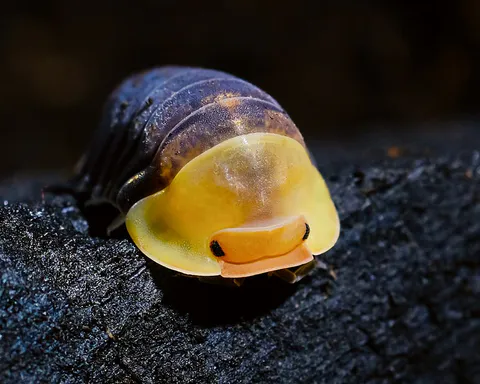


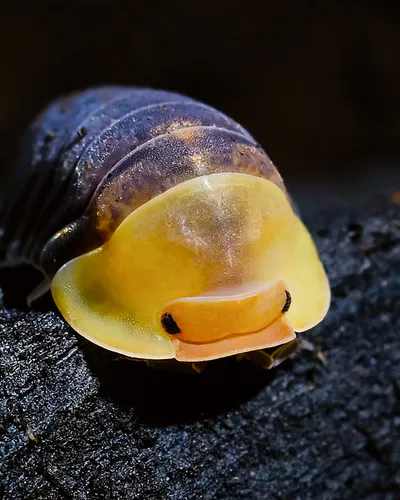
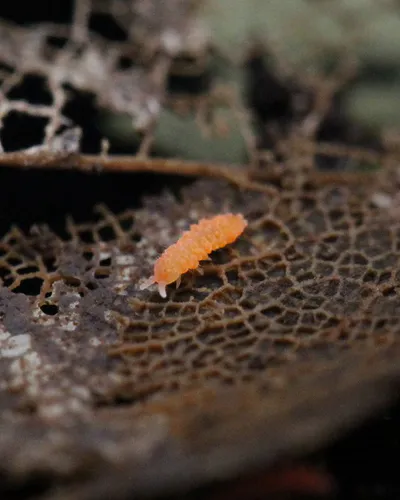

Armadillidium maculatum, the Zebra isopod, is native only to a short stretch of the French and Italian Riviera and Monaco. It wants a drier tub than tropical isopods do: about a third of the bin damp and the rest drier, at room temperature. Adults reach 15–18 mm and roll into a sealed ball. Rene rates it Beginner.
Zebra isopod at a glance
| What | Zebra isopod | How sure |
|---|---|---|
| Temperature | 65–80°F | Most sources agree; PostPods runs cooler, Terrarium Tribe and Rubber Ducky Isopods warmer |
| Humidity and moisture | ≈ 60–75%, about a third of the bin damp | Two breeders: Exuvium 60–75%, Insektenliebe 60–80%; other figures start as low as 40% |
| Substrate depth | ≈ 2–3 in | One source, TC Insects; Richard’s Inverts sets a 3 cm minimum |
| Adult size | 15–18 mm | Settled: every breeder page we read tops out at about 18 mm |
| Breeding pace | ≈ a visible colony over several months; maturity about 6 months | One breeder (Insektenliebe) for both figures; most sources call it moderate to fast |
| Lifespan | Not published for this species | No species figure; the general one for woodlice is on the isopod care page |
| Difficulty | Beginner | Rene’s rating; The Bio Dude and PostPods rate it Intermediate |
Armadillidium maculatum: name, range and family
Armadillidium maculatum (Risso, 1816) is a described species, accepted by WoRMS, GBIF and Catalogue of Life, with no recent change of genus. The parentheses around Risso’s name mean he first placed it in a different genus. Catalogue of Life and GBIF also list one named subspecies, A. m. cingendum Verhoeff, 1910. In the trade it goes by Zebra isopod, Zebra pillbug and Zebra roly-poly, and iNaturalist files it as “Zebra Isopod”.
Maculatum is Latin for spotted. Wikipedia notes that wild animals are often spotted, while the striped look dominates captive stock.
It belongs to the family Armadillidiidae. Zebras roll into a full, sealed ball when disturbed. Richard’s Inverts and Terrarium Tribe call them slow and easy to handle.
Where it lives
The wild range is small. It is endemic to the coast of south-east France (the Var and Alpes-Maritimes), Monaco and the western end of Liguria in Italy, around Imperia. In 2026 GBIF held 389 records: 333 from France, 20 from Italy and 8 from Monaco. iNaturalist’s wild observations tell the same story, with 318 in France, 19 in Italy (16 of them in the province of Imperia, the rest just east in Savona) and one in the whole United States, from Oxford, Ohio. WoRMS lists France and Italy.
You may read that the species is native to much of Europe, or established in several US states. The records above support neither.
Zebra isopod morphs
The hobby has several color forms besides the striped wild type. Every one of them is A. maculatum, and no page we read gives a morph different care. TC Insects, which sells the Champagne form, says it differs from the wild type only in base color.
| Morph | What the name describes | Named on the pages we read |
|---|---|---|
| Wild type | Dark grey to black with white bands; wild animals are often spotted | Wikipedia, and every seller |
| Yellow, Yellow Zebra | Yellow tones in place of the dark base | Wikipedia, Richard’s Inverts, Terrarium Tribe, The World of Isopods |
| High White | More white than the wild type | Wikipedia, The World of Isopods |
| Chocolate | A brown base | Richard’s Inverts, Terrarium Tribe; Rubber Ducky Isopods called it emerging (read August 2026) |
| Champagne | A beige base with white stripes | TC Insects, Richard’s Inverts |
| Spotted | Spots in place of clean bands | Wikipedia |
| Paradox | Not described on the page that names it | Richard’s Inverts |
No page we read says whether each morph breeds true, so if you keep two morphs, give each its own tub and you will know which adults produced which young.
Setting up the tub
A Zebra tub is an ordinary isopod tub with one difference: only part of it is kept damp.
- A vented tub with a lid that closes. Vents ideally on two opposite sides, with fine mesh over the holes. Terrarium Tribe says Zebras are not great climbers, and Exuvium leaves them off its list of wall climbers. They rarely manage smooth glass, but they use seams, condensation and mesh, so keep the lid on, as Insektenliebe (a tight lid) and Richard's Inverts (an escape-proof tub) advise.
- ≈ 2–3 in (5–8 cm) of substrate. TC Insects gives 2–3 in, the only depth figure we found for this species. Richard's Inverts sets a minimum of 3 cm (about 1 in) and says deeper substrate holds moisture better.
- A soil base. Topsoil free of fertilizer and pesticide, mixed with rotted hardwood and decayed leaves (Richard's Inverts, TC Insects, The Bio Dude). Terrarium Tribe and The World of Isopods build on coco fiber and sphagnum instead.
- Hardwood leaf litter on top, kept thick, with pieces of rotting hardwood for food and cover.
- Flat bark as hides (isopod.com; The World of Isopods names cork bark). Lay one across the damp end.
- Calcium in the tub at all times (TC Insects).
Starter colony sizes are listed on the Zebra isopods for sale page.
Zebra isopod humidity and temperature: room temperature, a damp third
The ≈ figure is where Exuvium's and Insektenliebe's ranges overlap. Every other published figure, from 40% up, follows under the next heading.
Moisture. Keep about a third of the bin damp, ≈ 60–75% at that end, and let the rest run drier but never bone dry. The third follows Exuvium, which keeps about a third moist with a dry part at all times, and Insektenliebe’s keeping report, which describes one moist corner with the other side drier. TC Insects says many keepers run a third to a half, and Richard’s Inverts keeps half. Any of these is drier than a tropical isopod such as Rubber Ducky wants (see the Rubber Ducky care guide). How to build and keep the gradient is in the isopod care basics.
Temperature. Keep the tub at room temperature, 65–80°F (18–27°C), and steady. That is isopod.com’s range, and most other published ranges sit inside it or close to it. PostPods keeps them cooler, at 64–72°F (18–22°C). Terrarium Tribe, a hobby care site, gives 75–80°F (24–27°C) and suggests a heat mat in a cold room or a small container, and Rubber Ducky Isopods, a US seller, goes up to 85°F (29°C). Keep the tub under about 80°F; no tested lethal temperature has been published. Richard’s Inverts says they need no winter rest.
Airflow. Every source that covers ventilation asks for moderate to good airflow, ideally across the tub. TC Insects wants enough to prevent stagnant pockets, but not so much that the damp end dries within a day, and Terrarium Tribe asks for plenty of ventilation and ideally a drier area. The Bio Dude warns that consistently wet conditions can harm molting and breeding.
Why Zebra humidity figures disagree
Published Zebra humidity figures run from 40% to 80%. The spread comes from who is writing and for what kind of build:
- The Bio Dude: 40–60%. Its sheet is written around temperate and semi-arid bioactive builds, and it pairs its isopod soil with an arid base for the drier ones.
- PostPods: 60–70%.
- Exuvium: 60–75%. It adds that Zebras want more moisture than the average Armadillidium.
- Insektenliebe: 60–80%.
- No number at all. Richard’s Inverts says “medium”, TC Insects and The World of Isopods “moderate”, and Rubber Ducky Isopods “low”.
The band this guide prints is the stretch that the Exuvium and Insektenliebe ranges share, with PostPods’ range inside it; it is not an average of the camps. Nearly every source agrees on the gradient itself, a damp part and a drier part. The one exception we found is Insektenliebe’s shop page, which says “evenly moist”, while the same breeder’s keeping report describes a single moist corner.
Lichen, bark and live plants
The everyday diet is the one in the isopod care basics linked above. Zebra sources add two things:
- Lichen and bark. Wikipedia says that, like other Armadillidium, it also eats lichen, bark and algae, so a piece of lichen-covered bark is a reasonable extra.
- Live plants. Soft plants and moss get nibbled too, which matters in a planted build; the FAQ below says who reports it.
Molting: the half pale, half striped isopod
Is my Zebra dying? Not if it is pale and stripeless at one end and still banded at the other: that is a Zebra mid molt. TC Insects advises against disturbing one while it is visibly mid molt, since the soft new shell is easily damaged until it hardens. Failed molts and the calcium list are under molting on the isopod care page.
Zebra breeding: both sexes, then months
Both sexes. Zebras reproduce sexually (PostPods), so begin with a mixed group of adults, not two or three animals.
How fast. Rene rates Zebra the fastest breeder of the isopods we carry (his call, October 2026); most sources call them moderate to fast (see the FAQ).
One source each, in order: TC Insects, PostPods, Insektenliebe. Nobody has published a measured time from setup to first young for this species.
Insektenliebe, a German breeder, says one female can produce up to four broods of up to 300 young; Wikipedia, citing an older Insektenliebe page, gives as many as a hundred. None of the sources we read reports a counted brood.
When yours is crowded, the steps for splitting are in the isopod care guide.
Zebras in a planted vivarium
The Bio Dude places Zebras in temperate and semi-arid bioactive builds. The Bio Dude, Richard’s Inverts and PostPods all treat them as a display isopod, and Richard’s adds that they do real cleanup only in large numbers, though Frontier Exotics lists them as cleanup crew. Josh’s Frogs notes that many dart frogs can’t eat adults, and TC Insects that the hard shell they roll into makes them poor feeders.
Once settled they spend a lot of time in the open. Exuvium describes them as active by day, by night and in the early morning, Insektenliebe as seen more often than many other isopods, and The Bio Dude as surface-active and highly visible.
Two cautions for a planted build: the plant nibbling above, and a tank kept wet throughout, which leaves them no drier ground. Sharing a build with other isopod species, or with springtails, is covered in the isopod care FAQ.
When a Zebra colony struggles
Still open for Zebra keepers: morphs, winters, sexing
- Whether each morph breeds true, or grows and breeds like the wild type.
- Whether breeding slows over a cool winter. No source we read says.
- A way to sex them by eye that a reliable source describes.
- How much damp area a Zebra tub needs in a desert home, where the dry part dries faster. Most of the damp-area figures come from European breeders.
Frequently Asked Questions
Are Zebra isopods good for beginners?
Yes. Rene rates them Beginner, and most sources we read agree: Exuvium calls them easy to keep and breed, and Insektenliebe rates them simple and robust. The Bio Dude and PostPods put them a step up, at Intermediate, and PostPods gives the reason: the gradient and the ventilation they need. Get the damp third and the airflow right and the rest is ordinary isopod care.
How quickly do Zebra isopods reproduce?
Moderately to quickly, by most accounts. Exuvium and Richard’s Inverts call them prolific, and Insektenliebe says colonies grow relatively quickly, though a new group takes several months to grow noticeably. isopod.com says moderate, TC Insects moderate to good once established, and Josh’s Frogs relatively slow but quick once established. The Bio Dude calls them slower. Rene rates Zebra the fastest breeder of the isopods we carry.
How long do Zebra isopods take to mature?
≈ 6 months from juvenile to adult, by the one breeder figure we found, from Insektenliebe. Two content sites give 2–3 months, one of them 6–10 months elsewhere on the same page, and the figure matches a general statement about woodlice rather than anything measured on Zebras. Add a brood pouch period of ≈ 30–40 days (PostPods), and a new colony’s first home-grown adults are months away.
Do Zebra isopods need a male and a female to breed?
Yes. Zebras reproduce sexually, so a colony needs both sexes. PostPods, a UK breeder, calls the claim that they breed without males misinformation. Start with a group rather than a pair: we found no reliable source that explains how to tell the sexes apart by eye, so a pair you pick yourself may be two of one sex.
How big do Zebra isopods get?
About 0.6–0.7 in (15–18 mm), and no breeder page we read goes above 18 mm. Insektenliebe, a German breeder, gives 15–18 mm for adults, and isopod.com lists an adult size of 18 mm. The 2 cm (0.8 in) you may see comes from content sites, not breeders.
What humidity do Zebra isopods need?
Moderate: ≈ 60–75% at the damp end, with about a third of the bin damp and the rest drier. Exuvium gives 60–75% and Insektenliebe 60–80%, so 60–75% is the part both cover. The Bio Dude goes as low as 40%, and PostPods gives 60–70%. Treat the number as a guide and the gradient as the rule: one damp part, plenty of air, and never the whole tub wet.
Do Yellow and Chocolate Zebra isopods need different care?
No. Yellow, Chocolate, Champagne, High White and Spotted Zebras are all Armadillidium maculatum, and none of the pages we read gives any morph its own care; TC Insects says its Champagne differs from the wild type only in base color. Keep any of them like the wild type: 65–80°F, ≈ 60–75% at a damp third, and good airflow.
Will Zebra isopods eat my plants?
Sometimes, and mostly the soft ones. The Bio Dude says they may nibble soft live plants now and then. Terrarium Tribe says they snack on moss and softer plants, so it calls them arguably not the best choice for terrariums. Wikipedia adds that, like the rest of their genus, they eat some fresh plant matter.
Sources
Read for this guide. Two pages from one owner are listed together and counted once. Search summaries, content sites we judged unreliable and listings we could not open are not counted or listed.
- Exuvium (Dutch breeder), Armadillidium maculatum “Zebra” species page, and its “Basic care guide for keeping and breeding isopods”.
- Insektenliebe (German breeder), Armadillidium maculatum “Zebra” keeping report, and its shop page for the species.
- The Bio Dude (US), “Zebra Isopod Care Sheet”, Josh Halter, updated May 2026.
- Richard’s Inverts (UK breeder), “Care Sheet: Zebra Isopods (Armadillidium maculatum)”, read August 2026.
- PostPods (UK breeder), “Armadillidium maculatum (Zebra Isopods) Care”, read August 2026.
- Terrarium Tribe, “Zebra Isopods (Armadillidium maculatum) Bioactive Care Guide”, Dan Jones, updated August 2026.
- TC Insects (US retailer), “Champagne Zebra Isopods”.
- isopod.com (US breeder and retailer), “Armadillidium maculatum”.
- Frontier Exotics (US retailer), Armadillidium maculatum “Zebra”.
- Josh’s Frogs (US retailer), Armadillidium maculatum “Zebra” Isopods.
- The World of Isopods (US retailer), “Zebras”, with its Yellow Zebra and High White Zebra listings, read August 2026.
- Rubber Ducky Isopods (US retailer), “Zebra Isopod”, read August 2026.
- isopod.site, Armadillidium maculatum.
- Wikipedia: “Armadillidium maculatum” (English and French editions) and “Woodlouse”.
- WoRMS, Armadillidium maculatum (Risso, 1816), AphiaID 257739, and its distribution record.
- GBIF, species 2203614 and its occurrence records by country.
- Catalogue of Life (ChecklistBank), Armadillidium maculatum.
- iNaturalist, taxon 705237 “Zebra Isopod”, and its wild (non-captive) observations by place.
Change log: October 2026: first published.
18 care sheets, seller pages and papers read for this guide (listed under Sources). Research and first drafts were prepared with AI tools.