If you’re weighing the ghost mantis vs dead leaf mantis question for your first camouflage mantis, get the Ghost. It’s smaller, hardier, forgives beginner mistakes, and costs a little less. The Dead Leaf is the more dramatic animal — bigger, more theatrical, a genuine showpiece — but it wants more humidity, more height, and a keeper who already knows what pre-molt looks like.
That’s the short version. Both are leaf-mimics, both are gorgeous in completely different ways, and I breed both here in Las Vegas. So here’s the honest head-to-head, category by category, so you can pick the one that actually fits your setup and your experience.
Quick comparison table
| Category | Ghost Mantis | Dead Leaf Mantis |
|---|---|---|
| Scientific name | Phyllocrania paradoxa | Deroplatys gorochovi |
| Adult size | ~5 cm (~2”) | 7–8 cm females (~3”), 5–6 cm males |
| Difficulty | Beginner | Intermediate |
| Temperature | 70–80°F (room temp) | 72–85°F (77–85 by day, 72–76 at night) |
| Humidity | 60–70% (forgiving) | 60–80% (lightly damp substrate) |
| Housing | Solo or communal | Solo only — cannibalistic |
| Temperament | Calm, sways like a leaf | Shy ambusher, plays dead |
| Price | $30 | $35 |
| Best for | Your first mantis | A showpiece for round two |
Appearance
Ghost Mantis
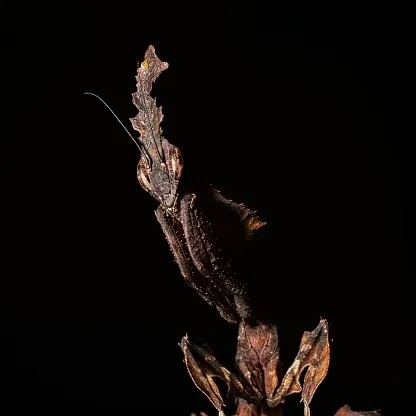
The Ghost is a small, cryptic leaf-and-twig mimic with a forked crest on its head that looks like a torn leaf vein. Color runs from ashy brown to greenish-tan depending on how it’s raised. It’s not flashy — it’s strange, in the way that grows on you the longer you watch it. At around 5 cm adult, it’s a compact animal that reads as a scrap of dead foliage snagged on a branch.
Dead Leaf Mantis
The Dead Leaf is the theatrical one. It wears a wide, shield-shaped pronotum patterned with vein detail and asymmetric, weathered edges, and an adult sitting in real leaf litter genuinely disappears. Females hit 7–8 cm, males 5–6 — a substantial mantis with real presence next to a Ghost. The trade-off is that its whole evolutionary job is to vanish, so a naturalistic setup can make it functionally invisible for days at a time.
Winner for appearance: Tie. The Ghost is subtle and weird; the Dead Leaf is a big, dramatic leaf-sculpture. Pick the look you want to live with.
Care difficulty
This is where the two really separate.
Ghost Mantis care
The Ghost is about as forgiving as exotic mantises get. It’s happy at the 70–80°F most homes already sit at, sits happily at 60–70% humidity and shrugs off a short dip to 50%, and actually prefers to run a little dry — it evolved in semi-arid African scrub, so a light wall mist daily to every other day is plenty. Molts are fast and rarely fail at normal room humidity. If you forget to mist for a day, it’s probably fine. That’s the whole reason I recommend it as a first mantis. The full husbandry is in the Ghost Mantis care guide.
Dead Leaf Mantis care
The Dead Leaf asks for more. It wants 72–85°F (77–85 by day, 72–76 at night) and 60–80% humidity over a lightly damp coco-fiber or sphagnum substrate, which usually means a daily wall mist and a low-wattage heat source on a thermostat. The catch is that high humidity plus stagnant air invites mold, so you also need real cross-ventilation. And that wide pronotum makes molting riskier — it has to clear the old skin without snagging, so it needs generous hanging height. None of this is hard once you’ve done it, but it’s more moving parts than a beginner usually wants to juggle. Details are in the Dead Leaf Mantis care guide.
Winner for ease of care: Ghost Mantis, clearly. It’s one of the most beginner-forgiving species in the hobby; the Dead Leaf sits at a solid intermediate.
Temperament and handling
Ghost Mantis
Ghosts survive by pretending to be dead leaves, so their instinct when startled is to freeze and sway rather than bolt. That makes them exceptionally calm — they rarely run, almost never panic-fly, and tolerate brief, gentle handling well. One of the easiest mantises to have sit on your hand. Still, every mantis is a look-mostly pet: brief, occasional, hand-under-not-grab, and never in the 48 hours around a molt.
Dead Leaf Mantis
The Dead Leaf is a shy ambush predator with a bigger bag of defensive tricks. Disturb it and it freezes first, trusting its camouflage. Press it and it throws a deimatic display — wings open, body twisted, sometimes a hiss — and if that doesn’t work it drops into full thanatosis, going limp and playing dead. It’s fascinating to witness, but it means the animal reads your hand as a threat. It’s a look-don’t-touch display species.
Winner for handling: Ghost Mantis. The Dead Leaf is more interesting to watch, but the Ghost is the one that stays calm on your hand.
Housing: communal vs solo
This one’s black and white. Ghost Mantises are one of the few reliably communal species — with enough space and dense prey, you can raise a group together from L3 through the nymph stages (separate them around subadult), which is great if you want a display colony instead of a single pet. Dead Leaf Mantises are solo only; cannibalism is severe even at young instars, so every animal needs its own enclosure. If you were dreaming of a leaf-litter tank full of mantises, only the Ghost can do it.
Winner for flexibility: Ghost Mantis, no contest.
Cost
A Ghost Mantis nymph is $30 and a Dead Leaf Mantis nymph is $35 — a $5 gap that barely matters on its own. What matters more is what a mistake costs. A beginner is far more likely to lose a Dead Leaf to a humidity crash or a snagged molt than a Ghost, so the real cost of learning on the harder animal is higher than the sticker price suggests.
Winner for value: Ghost Mantis, mostly because it’s cheaper to keep alive while you’re still learning.
Who should get a Ghost Mantis?
Get the Ghost if:
- This is your first mantis
- You want something forgiving that still looks genuinely cool
- Your home sits around 70–80°F without much fuss
- You like the idea of keeping a communal group
- You want an animal calm enough to handle
Who should get a Dead Leaf Mantis?
Get the Dead Leaf if:
- You’ve already raised at least one mantis to adulthood
- You can hold steady warmth and humidity over a lightly damp substrate
- You want a big, dramatic display animal with a real defensive repertoire
- You’re fine with an ambush sitter you observe rather than handle
- You’ve got the vertical space a wide-pronotum molter needs
My recommendation
If you’re new and torn between the two, start with the Ghost Mantis. Raise it to adulthood, get comfortable reading pre-molt signs and managing feeders, and then come back for the Dead Leaf as your second, more theatrical species. You’ll enjoy the Dead Leaf far more when its humidity and molting demands aren’t also your introduction to the hobby.
If you keep landing on “but which one looks cooler,” that’s the Orchid conversation too — my Orchid Mantis vs Ghost Mantis breakdown covers the flashiest species in the shop. Either way, start forgiving. Browse the Ghost Mantis and Dead Leaf Mantis and pick the one that fits where you actually are.
Frequently Asked Questions
Which is easier for a first mantis?
The Ghost is the beginner pick; the Dead Leaf is a solid intermediate. The Ghost is smaller, cheaper, and far more forgiving of a missed misting. Come back for the Dead Leaf as a second species if the bigger, more dramatic camouflage is what excites you.
Which lives longer?
The Ghost: 8-18 months total (males 8-12, females 12-18) against the Dead Leaf’s 8-13, with females of both outliving males by months. Full ranges are in the lifespan by species table.
What do they cost?
Ghost Mantis is $30 and Dead Leaf Mantis is $35 at our shop, which makes either a low-risk first exotic.